
When a Tint Ticket Adds License Points
Check whether an illegal-tint citation carries DMV points, how equipment classifications differ, and why companion or out-of-state charges matter.
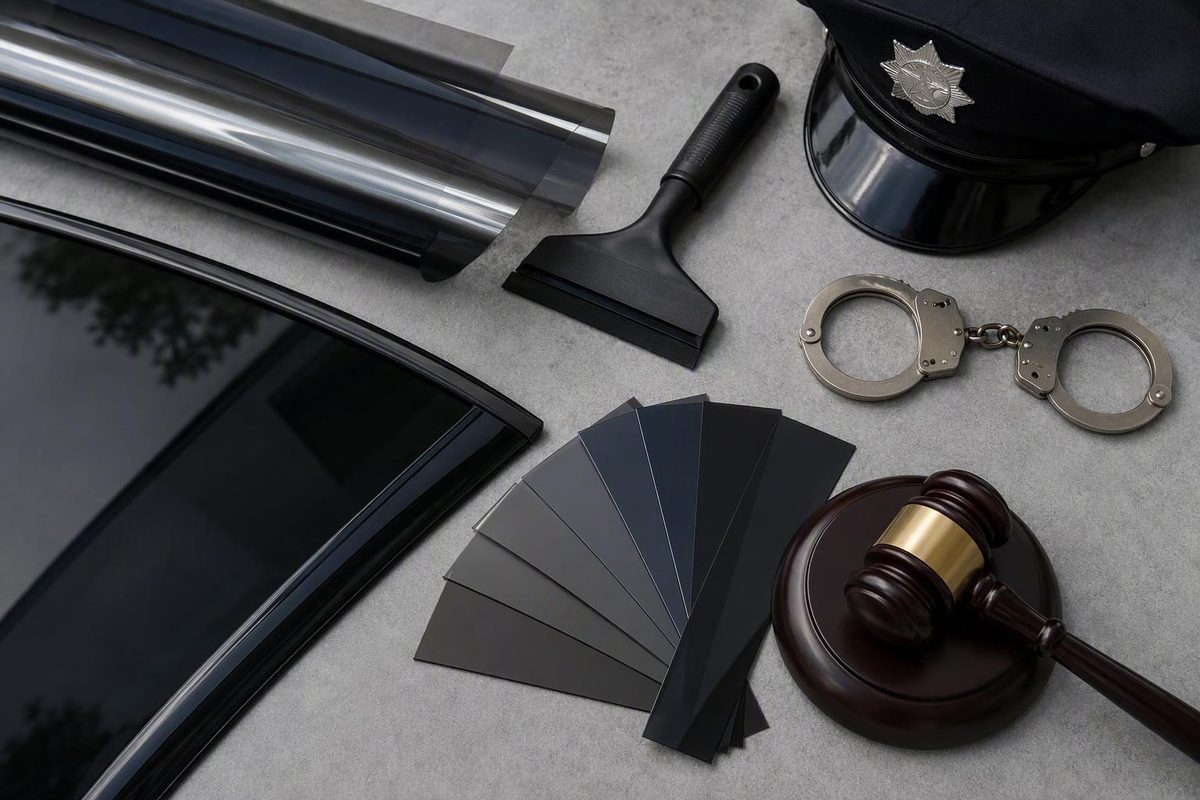
A basic window-tint ticket often adds zero license points because it is classified as an equipment or nonmoving violation. North Dakota made that distinction unusually clear in August 2026: a State Highway Patrol-backed proposal kept tint violations at 0 points while increasing a stop-sign violation from 0 to 2 points and its penalty from $20 to $50, with officials saying the system should focus on unsafe driving behavior (KVRR). That does not create a nationwide rule. Your jurisdiction, exact citation code, case outcome, licensing state, and any companion charges still control.
The Common Assumption Is Understandable but Too Broad
The received wisdom is that a tint citation works like any other traffic ticket: an officer writes it during a traffic stop, the violation enters the court system, and points appear on the driver’s license much as they would for speeding or following too closely.
That assumption is sometimes correct. A jurisdiction can designate an offense as point-bearing, and a tint stop can produce an additional moving, obstruction, or visibility charge that has its own point value. Ignoring a citation can also threaten driving privileges even if the underlying tint offense carries no points.
What the assumption misses is the legal distinction between driving conduct and vehicle condition. Point systems generally target conduct such as speeding, reckless driving, improper passing, or disobeying a signal. A basic tint charge often concerns equipment installed on the vehicle rather than how the driver operated it.
North Dakota’s proposal illustrates the distinction rather than eliminating tint enforcement. Troopers supported retaining zero points for tint while seeking more points for conduct such as running a stop sign. Officials described the goal as tracking drivers who engage in unsafe driving behavior, while the state’s equipment chapter treats covered equipment violations as noncriminal infractions (North Dakota Century Code Chapter 39-21). Tint limits remain enforceable safety and equipment requirements; the narrower point is that violating one need not be treated like unsafe driving for license-point purposes.
Check the Citation, Not the Phrase “Tint Ticket”
A citation’s informal description does not determine its point treatment. The decisive information is the issuing jurisdiction and every statute, ordinance, section, subsection, and violation code printed on the document.
Four events must be kept separate:
- An officer issues a citation alleging noncompliant tint.
- The driver pays, contests, requests a hearing, or uses an authorized correction procedure.
- A court or agency records a disposition.
- The licensing agency posts points if that disposition involves a point-bearing offense.
Receiving the ticket is not necessarily the same as receiving points. New York says points are added after conviction, and it calculates them from the violation date rather than the conviction date (New York DMV). Florida ties point assignments to the type of conviction (Florida Highway Safety and Motor Vehicles). Maryland posts applicable points when a conviction is recorded with the MVA (Maryland MVA).
Those examples explain the process but do not establish a universal timetable. A payment may be treated as an admission or conviction under local procedure, yet payment creates points only if the reported offense qualifies under the applicable schedule.
Choose your state and citation circumstances; the result identifies whether the available evidence supports zero points or requires verification.
Select the state and circumstances. “—” means the supplied research does not establish a tint-specific answer; it does not mean zero points.
50 states shown. “Supported” may still be an inference or third-party finding; read the authority column.
| State | Finding for Basic Tint | Points | Authority in Reviewed Material |
|---|---|---|---|
| Alabama | Not established | — | Verify official code and schedule |
| Alaska | Not established | — | Verify official code and schedule |
| Arizona | Not established | — | Verify official code and schedule |
| Arkansas | Not established | — | Verify official code and schedule |
| California | Not established | — | Verify official code and schedule |
| Colorado | Not established | — | Verify official code and schedule |
| Connecticut | Not established | — | Verify official code and schedule |
| Delaware | Not established | — | Verify official code and schedule |
| Florida | Nonmoving; no-point finding | 0 reported | 2018 attorney Q&A; 2025 local report |
| Georgia | Not established | — | Verify official code and schedule |
| Hawaii | Not established | — | Verify official code and schedule |
| Idaho | Not established | — | Verify official code and schedule |
| Illinois | Not established | — | Verify official code and schedule |
| Indiana | Not established | — | Verify official code and schedule |
| Iowa | Not established | — | Verify official code and schedule |
| Kansas | Not established | — | Verify official code and schedule |
| Kentucky | Not established | — | Verify official code and schedule |
| Louisiana | Not established | — | Verify official code and schedule |
| Maine | Not established | — | Verify official code and schedule |
| Maryland | Most nonmoving offenses have no points; tint not classified | — | Official MVA general guidance |
| Massachusetts | Not established | — | Verify official code and schedule |
| Michigan | Not established | — | Verify official code and schedule |
| Minnesota | Not established | — | Verify official code and schedule |
| Mississippi | Not established | — | Verify official code and schedule |
| Missouri | Not established | — | Verify official code and schedule |
| Montana | Not established | — | Verify official code and schedule |
| Nebraska | Not established | — | Verify official code and schedule |
| Nevada | Not established | — | Verify official code and schedule |
| New Hampshire | Not established | — | Verify official code and schedule |
| New Jersey | Not established | — | Verify official code and schedule |
| New Mexico | Not established | — | Verify official code and schedule |
| New York | Equipment violations generally receive no points | 0 inferred | Official DMV category guidance; tint not named |
| North Carolina | Not established | — | Verify official code and schedule |
| North Dakota | Equipment infraction; proposal retained zero | 0 proposed | Official equipment code and 2026 reporting |
| Ohio | Not established | — | Verify official code and schedule |
| Oklahoma | Not established | — | Verify official code and schedule |
| Oregon | Not established | — | Verify official code and schedule |
| Pennsylvania | Not established | — | Verify official code and schedule |
| Rhode Island | Not established | — | Verify official code and schedule |
| South Carolina | Not established | — | Verify official code and schedule |
| South Dakota | Not established | — | Verify official code and schedule |
| Tennessee | Not established | — | Verify official code and schedule |
| Texas | Not established | — | Verify official code and schedule |
| Utah | Not established | — | Verify official code and schedule |
| Vermont | Not established | — | Verify official code and schedule |
| Virginia | Not established | — | Verify official code and schedule |
| Washington | Not established | — | Verify official code and schedule |
| West Virginia | Not established | — | Verify official code and schedule |
| Wisconsin | Not established | — | Verify official code and schedule |
| Wyoming | Not established | — | Verify official code and schedule |
Sources: North Dakota Century Code Chapter 39-21; 2026 North Dakota proposal reporting; official New York, Florida, and Maryland point guidance; cited Florida legal commentary and local reporting. Unknowns are shown as —.
The lookup marks unverified states with an em dash because the supplied research does not contain an authoritative tint-specific classification for them. That is more useful than filling gaps with assumptions: a state’s general treatment of nonmoving violations does not prove how a particular tint code is classified.
Florida and New York Support the No-Point Pattern
Florida’s evidence is consistent but not fully official. Three attorney responses published in March 2018 said a Florida tint citation carried no points. One identified a charge under Florida Statutes section 316.2953 as a nonmoving civil infraction (Florida attorney Q&A). A January 2025 Orlando report likewise described a window-tint citation as nonmoving and no-point (ClickOrlando).
Florida’s official point page explains that points depend on the conviction type, but its displayed examples do not expressly identify window tint. The supported conclusion is therefore limited: the sources reviewed consistently describe a basic Florida tint citation as carrying no points, but the exact current code and complete official schedule still control.
New York offers stronger official category guidance. Its DMV says vehicle-equipment violations receive no points except for inadequate service brakes. Ordinary illegal tint appears to fall within that equipment category, although the cited DMV page does not expressly name window tint.
That makes a zero-point result a reasonable inference for a basic New York equipment citation, not permission to ignore its code. A separately charged visibility, obstruction, or moving offense could be classified differently.
Maryland demonstrates why “nonmoving” and “zero points” should not be treated as synonyms everywhere. Its MVA says parking violations and most nonmoving violations generally do not result in points. The available official guidance does not specifically classify tint, so a Maryland driver must still match the citation code to current state materials.
North Dakota Separates Equipment Enforcement From Unsafe Driving
The North Dakota proposal is significant because it compares tint directly with hazardous driving conduct. The State Highway Patrol-backed plan kept excessive-window-tint violations at 0 points while proposing 2 points for a stop-sign violation that previously carried 0. It also proposed increasing the stop-sign penalty from $20 to $50.
The proposal did not say tint laws should disappear. It preserved enforcement while reserving driver points for behavior lawmakers and troopers considered a better indicator of unsafe driving. That is the strongest evidence in the reviewed material that a tint citation can be procedural and equipment-based without functioning as a driving-safety penalty.
The limits matter. Reporting on a proposal does not establish that every provision was enacted or supply an effective date. The reviewed material also does not establish a nationwide trend or determine how another state classifies tint. Drivers should confirm the current North Dakota code and point schedule rather than relying on the proposal alone.
Companion Charges Can Change the Result
A no-point tint classification applies only to the tint count. The same stop can produce another citation for speeding, unsafe operation, obstruction, a visibility offense, or a different equipment problem.
Each count has its own code and disposition. Correcting the film does not resolve a speeding charge, and a zero-point tint rule does not erase points attached to a separate moving violation.
The citation should therefore be read line by line. If the officer wrote more than one count, match each code independently to the current point schedule. An officer’s verbal description, an installer’s opinion, or another driver’s experience cannot replace that classification.
An Out-of-State Ticket Creates a Second Classification Question
When the citation state differs from the state that issued the driver’s license, two systems may matter. The issuing jurisdiction determines how the case is handled and disposed of. The home licensing state determines what it records and whether it assigns points to an equivalent offense.
Florida, for example, says an out-of-state citation receives points on a Florida license only if Florida classifies the offense as eligible for points. A “zero points” label in the issuing state should not automatically be assumed to settle the home state’s treatment, but neither should a driver assume every out-of-state citation transfers as points.
Retain the final written disposition and ask the home licensing agency how it treats the exact out-of-state code. The name of the offense alone may not be enough to identify an equivalent classification.
Zero Points Does Not Mean Zero Consequences
License points are only one possible result. A no-point tint citation can still produce a fine, court costs, film-removal expenses, proof-of-correction requirements, an inspection problem, a record entry, or administrative action when a deadline is missed.
Insurance is a separate system. New York DMV says insurers may use their own point or rating methods and consider a driver’s record. Zero DMV points therefore do not guarantee that a carrier will disregard the event or leave a premium unchanged. The reviewed sources do not provide a universal insurance outcome.
The January 2025 Orlando report described a Florida procedure under which a cited driver could correct the tint within 30 days, have a law-enforcement officer inspect the vehicle and endorse the citation, and submit it to the county court clerk. The report said timely compliance could qualify the driver for a reduced fine and warned that failure to resolve the matter could lead to suspension.
That was a reported Florida example, not a nationwide deadline or a guaranteed procedure in every Florida county. A 2018 Florida attorney response also suggested that photographs and receipts showing correction could support a dismissal request. “Support a request” does not mean correction automatically dismisses the case.
A driver must answer six separate questions: whether points apply, whether the disposition enters a record, what fines and costs are due, whether correction or inspection is required, whether an insurer can consider the event, and what happens if the response deadline is missed.
Verify the Exact Point Treatment Before Responding
Start with the front and back of the citation. Record the issuing state or locality, licensing state, response date, court or agency, and every printed legal reference. If multiple charges appear, create a separate entry for each one.
Look up the cited provision through the official legislature, municipality, DMV, MVA, public-safety department, or court identified on the ticket. Match the exact code to the current point schedule or to a legally defined category such as vehicle equipment, nonmoving, moving, obstruction, or visibility.
If the schedule lists only broad categories, ask the named court clerk or motor-vehicle agency where the code belongs. Also ask when points attach, how payment is recorded, and whether an authorized correction procedure changes the disposition.
For an out-of-state stop, repeat that check with the licensing state. Confirm whether it assigns points to the foreign offense or an equivalent home-state offense.
Keep copies of the citation, current code, point schedule, correction instructions, photographs, installer or removal receipts, inspection documents, payment records, submissions, and final disposition. Removing tint does not close a court file by itself. Written confirmation should show that the documents were received, no further appearance or payment is required, and the case reached its final disposition.
Tint Compliance Still Matters When Points Do Not
A zero-point classification does not make dark film lawful. Tint limits vary by state and by glass location. A percentage allowed on rear glass may be prohibited on the front side windows or windshield.
Before replacing removed film, verify the current official limit for every window and ask the installer to document the film product, installation location, and measured compliance. Keep the invoice, film specifications, warranty, and any paperwork required by the court’s correction process.
Medical exemptions may exist, but they require the applicable approval and are not automatic or universal. Exemption paperwork should be confirmed through the responsible state agency before installing film that would otherwise exceed the ordinary limit.
Does a Nonmoving Tint Violation Always Mean No Points?
No. Nonmoving violations often carry no points, but each jurisdiction defines its own categories. Maryland’s guidance says most nonmoving violations generally receive no points; it does not specifically classify tint. The exact citation code remains decisive.
Can Removing the Tint Prevent Points?
Correction may help when the jurisdiction offers an authorized correction process, reduced penalty, or dismissal request. It does not automatically change the original charge or guarantee a no-point disposition. Follow the citation’s instructions and obtain written confirmation from the court or agency.
Can an Unresolved No-Point Ticket Suspend a License?
Potentially. Failure to pay, appear, provide required proof, or otherwise respond can trigger administrative consequences separate from the offense’s point value. The 2025 Florida report warned of possible suspension if the cited matter was not resolved within 30 days, but that deadline should not be generalized beyond the reported procedure.