
Front Windshield Tint: Check the Law and Finished VLT First
Compare windshield film and visor strips by legality, finished VLT, heat performance, cost, optical quality and vehicle compatibility.
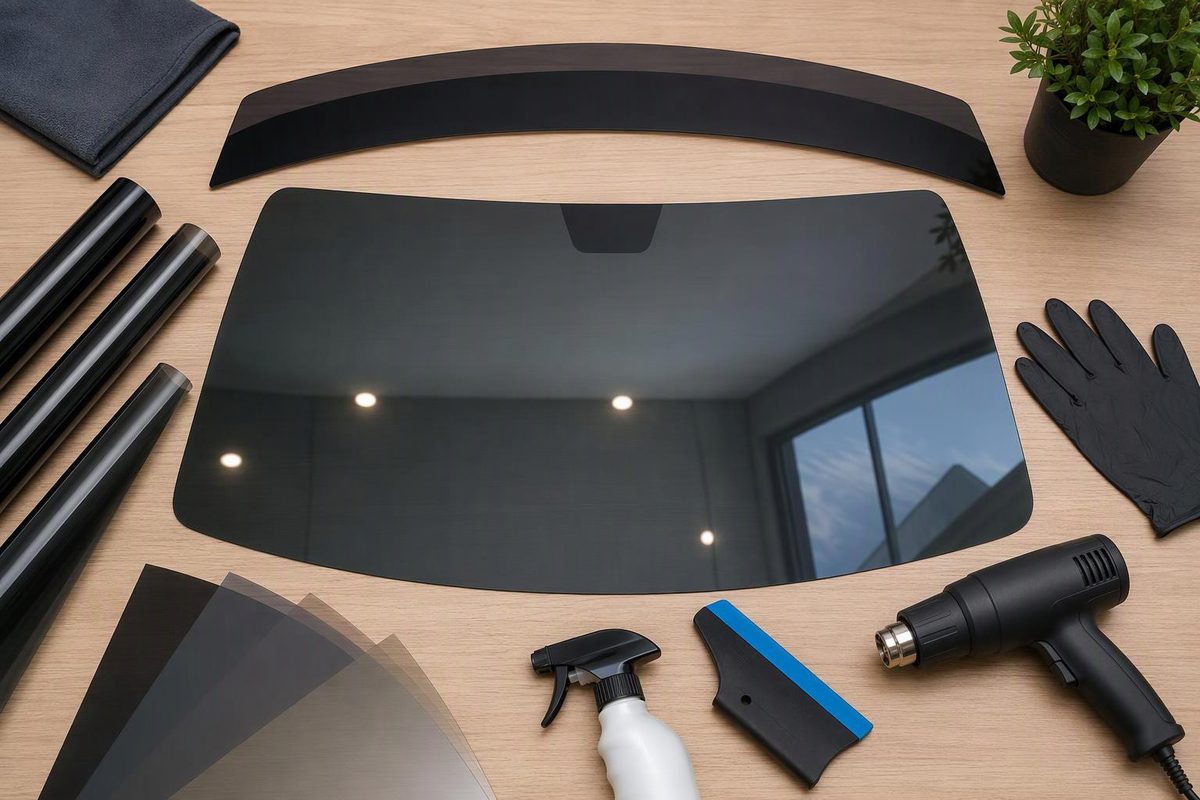
Front windshield tint can reduce solar heat and glare, but it requires more caution than film on other windows. It sits in the driver’s primary field of view, state rules vary, and a film sold as “70%” may produce a completed windshield below 70% visible light transmission (VLT).
For most drivers, the practical options are:
- A legal visor strip for high-angle sun glare.
- A nearly clear, high-performance film only if current law and the vehicle manufacturer allow full-windshield film.
- No film if the owner’s manual prohibits it, the finished VLT will not comply, or the film creates distracting haze, reflections or doubled images.
Full windshield film and visor strips are different
A visor strip covers only the upper windshield. Its lower edge may be controlled by the windshield’s AS-1 marking or a measurement specified by state law. NHTSA explains that the AS-1 line marks the boundary of a permitted factory shade-band area; state rules still determine what an owner may add and use on the road (NHTSA interpretation).
Full windshield film covers the forward viewing area. Products marketed for this use are commonly light films chosen for heat performance rather than privacy. Even 70% or 80% film reduces visible light.
Do not confuse either option with exterior windshield-protection film. Protection film is a separate product and price category intended primarily to resist road damage rather than control solar energy.
Calculate the finished VLT
VLT is the percentage of visible light passing through the glass-and-film assembly. Higher VLT means a lighter result.
A useful estimate is:
glass VLT × film VLT = approximate finished VLT
For example, 80% film over 75% glass produces an estimated 60% finished VLT:
0.80 × 0.75 = 0.60
Manufacturer data illustrate the difference between a product name and the installed result. In 3M’s Crystalline brochure, performance is estimated after film is applied to 73% VLT automotive green glass. CR BLK 80 measures 72% VLT on that reference glass, while CR BLK 70 measures 64% (3M performance brochure). Those figures do not predict every vehicle, but they show why a “70%” product does not guarantee a 70% windshield.
Ask the installer to meter the bare windshield and estimate the completed VLT before cutting film. Have the finished installation metered as well, and keep the invoice and film specifications.
Is front windshield tint legal?
There is no single U.S. limit for an owner’s aftermarket windshield tint. Federal equipment requirements and state vehicle-use laws serve different functions.
Federal Motor Vehicle Safety Standard No. 205 sets glazing requirements intended partly to preserve driver visibility (49 CFR 571.205). NHTSA has explained that glazing needed for driving visibility must transmit at least 70% of light. The federal “make inoperative” restriction limits what manufacturers, dealers, distributors and repair businesses may do, while states regulate vehicle operation and use (NHTSA interpretation).
State windshield rules differ substantially. As reviewed September 25, 2026:
- Texas: Material above the AS-1 line—or ending five inches below the top when there is no line—must provide at least 25% light transmission and no more than 25% luminous reflectance when combined with the glass. Texas DPS also says clear, untinted UV film is allowed anywhere on the windshield without a medical exemption (Texas DPS). Check the Texas window-by-window limits before selecting film.
- Florida: The 2026 statute permits transparent sunscreening material along a strip at the top, provided it does not enter the direct forward-viewing area defined by the AS-1 portion. That section does not provide general permission for full-windshield film (Florida Statutes §316.2952).
- California: Transparent material is permitted on the topmost portion if it meets placement, color, lettering and reflectance conditions. Clear full-windshield film is addressed through a medical provision: the material must have at least 88% VLT, the completed glazing must meet the federal 70% requirement, and the driver must carry a certificate from a licensed dermatologist (California Vehicle Code §26708). The California tint guide explains film VLT versus completed VLT.
Before installation, verify the current rule where the vehicle is registered and driven. Check the permitted area, completed VLT, reflectivity, restricted colors and any exemption documents. A shop’s willingness to install film does not establish legality.
Compare performance at a light shade
Darkness, heat rejection and UV rejection are separate specifications. For windshield film, compare:
- Completed VLT: Preserve forward visibility and allow a margin above any legal minimum.
- TSER at the selected shade: Total solar energy rejected measures overall solar-heat performance and is more useful than an infrared figure covering only a narrow wavelength range.
- Optical quality: View a large installed sample toward low sun, headlights and streetlights—not only a small indoor swatch.
- Interior reflectance: A light dashboard or bright trim can produce distracting reflections in some conditions.
- Written warranty terms: Check coverage for bubbling, delamination, cracking, color change and reinstallation labor.
“Ceramic” is not an automatic recommendation. Compare the exact product and shade. For example, 3M lists its Crystalline series in nominal VLT options from 30% through 80% and says it can reject more heat than many dark films; its published figures are estimates on specified reference glass (3M product page).
Warranty details also vary by product. A 2025 3M U.S./Canada warranty card covers specified series against defects including bubbling and delamination for as long as the original buyer owns the vehicle, includes reapplication labor for covered claims, and requires a completed warranty card plus the original invoice (3M warranty).
Check cameras, sensors and the head-up display
Read the owner’s manual before booking. Some vehicles explicitly prohibit windshield film. The 2026 Toyota Mirai manual, for example, says not to attach window tint to the windshield as part of its front-camera precautions (Toyota manual excerpt). That instruction is vehicle-specific, but it shows why cutting around a sensor is not always an acceptable workaround.
If the vehicle has a head-up display, evaluate the exact film for doubled images, blur and color shift before approving the job. Use the windshield tint and HUD checklist for the vehicle and film checks.
What windshield tint costs
Two published 2026 shop menus provide useful examples, not a national average:
- A Los Angeles shop lists clear ceramic windshield film from $190 (Hussle Customz).
- A Scottsdale shop lists windshield nano-ceramic film at $225 or $325, depending on the XPEL product line, and a visor strip at $65 (Fast Lane).
The final quote can change with the vehicle, film series, coverage and removal of existing film. Compare the full product name, expected finished VLT, removal charges, warranty and tax—not just the total. For broader vehicle pricing, see the window tint cost guide.
Inspect the installation from the driver’s seat
Before work begins, have the shop put the brand, series and shade on the invoice. Confirm how it will handle the camera area, inspection stickers and windshield-mounted equipment.
After the installer’s stated curing period, inspect the windshield in daylight and at night. Look for:
- waviness or doubled road markings;
- haze around headlights or low sun;
- creases, contamination or lifting edges;
- distracting dashboard reflections;
- problems with the HUD, rain sensor or forward-camera functions.
Do not accept lasting optical distortion merely because the film rejects heat well. On a windshield, clear vision, vehicle compatibility and a compliant meter reading take priority over darkness.