
Which Connecticut Windows Can Legally Have Darker Tint
See Connecticut’s tint limits by window, why 35% film can be too dark, and how mirror exceptions, windshield rules and DMV medical approvals apply.
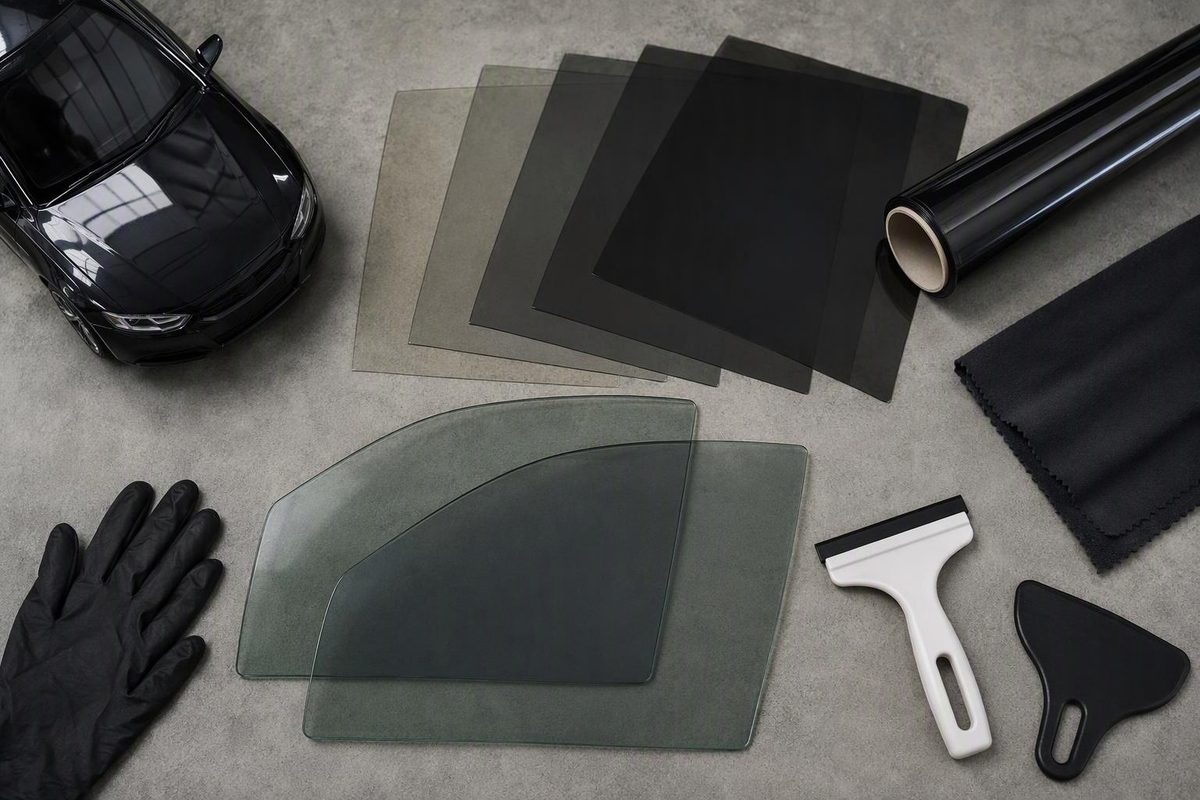
Legal tint in CT ordinarily requires at least 35% visible light transmission (VLT) on front side windows and passenger-car rear side windows, with a three-percentage-point tolerance. The regulations specify a measured minimum of 32%. This applies to the glass-and-film combination, not the film’s advertised shade. Darker rear tint can qualify for an exception when the vehicle has the required outside mirrors; that exception does not extend to front side windows. Connecticut General Statutes § 14-99g; DMV regulations § 14-99g-2
Enter your glass and film VLT to estimate the finished darkness on ordinary regulated side windows.
Finished Side-Window VLT Estimate
Below Connecticut’s 32% measured minimum for ordinary regulated side windows.
Estimate only—not a meter reading or legal approval.
Use values from 0 to 100. The 80% glass value is an example, not a measurement of your vehicle.
Scope And Calculation
Estimated finished VLT = glass VLT × film VLT ÷ 100 when entered as percentages. This comparison covers front side windows and ordinary passenger-car rear side windows without a medical exemption. It does not assess rear-window exceptions, reflectance, windshield strips or DMV stickers.
Connecticut’s nominal standard is 35%, with a three-point tolerance and a 32% measured minimum. Have the completed windows metered; do not treat an estimate near the threshold as approval.
Sources: Connecticut General Statutes § 14-99g and DMV regulations § 14-99g-2. Example estimates use 80% glass VLT.
Connecticut Tint Limits Depend On The Window
These are the ordinary rules without an approved medical exemption. Legally defined livery vehicles have a separate exemption.
| Window | Ordinary Requirement |
|---|---|
| Windshield | Material that changes color or reduces light transmission is generally prohibited, except for a qualifying top strip. |
| Front side windows and wing vents | 35% total VLT, with a three-point tolerance; measured minimum of 32%. |
| Passenger-car rear side windows | Same 35% standard and tolerance; measured minimum of 32%. |
| Qualifying MPV or truck rear side windows | No VLT minimum under the rear-window exception with qualifying left and right outside mirrors. |
| Rearmost window, including a car’s back glass | No VLT minimum under the exception with qualifying left and right outside mirrors. |
The mirror exceptions require a view of the highway for at least 200 feet behind the vehicle. They do not make darker front side tint legal. Statute § 14-99g(c)
For an SUV or van, check classification rather than assuming its appearance qualifies it. DMV directs owners to the manufacturer’s certification label in the driver’s door jamb to identify a multipurpose vehicle (MPV). The agency also lists darker-rear-window provisions for trucks, motor buses and motor homes with both outside mirrors. Connecticut DMV guidance
Legally defined livery vehicles are exempt from the statute’s ordinary tint provisions under § 14-99g(h). That exemption should not be assumed to cover any vehicle merely because it carries paying passengers.
Reflectance Has A Separate Limit
Connecticut’s regulations cap luminous reflectance at 30% on front side windows and wing vents, and 24% on rear side windows and the rearmost window. The statute also says ordinary regulated side-window tint must not be mirror-like. A permissible darkness level alone does not establish compliance. DMV regulations § 14-99g-3
A 35% Film Label Does Not Guarantee Legal Tint
Film labeled “35%” is not automatically legal on Connecticut front side windows. The statute measures transmission through the tint material and glazing together, so the existing glass matters.
Finished VLT ≈ glass VLT × film VLT, with both inputs expressed as decimals.
For glass that transmits 80% of visible light, the estimates are:
| Film VLT | Estimated Finished VLT | Ordinary Side-Window Target |
|---|---|---|
| 35% | ~28% | Below the 32% measured minimum |
| 50% | ~40% | Above the 35% nominal standard |
These are estimates, not inspection results. Have the installer meter the existing glass before choosing film and the completed windows afterward. Aim above the 35% nominal standard rather than building a quote around the 32% lower threshold. The regulations specify at least 32% measured transmission using a meter accurate to ±3% or better. DMV regulations § 14-99g-2
Without an exemption, 20% and 5% tint are too dark for front side windows and ordinary passenger-car rear side windows. They can fall within the rear-window VLT exceptions, but those exceptions are not blanket approval for every film or installation. For more on the difference between a film label and the finished result, see our 35 percent tint guide.
The Windshield Strip Uses A Seat-Based Measurement
Connecticut’s statute does not describe the allowed windshield strip simply as “above the AS-1 line.” It permits transparent material on the topmost portion only when:
- Its bottom edge is at least 29 inches above the undepressed driver’s seat, measured from a point five inches in front of the bottom of the backrest.
- The driver’s seat is in its rearmost and lowermost position, with the vehicle on a level surface.
- The material is not red or amber.
Do not assume full-windshield film is permitted because it looks nearly clear. The general prohibition includes transparent material that reduces windshield light transmission. § 14-99g(b) and (c)(11)
Aftermarket Tint Requires DMV Testing And A Sticker
DMV’s instructions say vehicles with aftermarket tint must have it tested to receive a tint compliance sticker affixed by DMV. A shop’s invoice or verbal assurance is not a substitute for that process. DMV identifies the Wethersfield inspection lane for owners who want their tint checked and warns that a failed check results in a warning ticket. Connecticut DMV tint inspection guidance
Medical Exemptions Require Approval And Validation
DMV directs medical-exemption applicants to Form E-220. The regulations require a written application supported by the recommendation of a Connecticut-licensed physician or optometrist, followed by the commissioner’s approval. A medical need alone is not permission to install darker tint. DMV regulations § 14-99g-7
DMV’s routine medical-exemption process covers tint between 32% and no less than 20%, with validation after measurement at Wethersfield. Carry the validated form in the vehicle; exempted vehicles should not receive compliance stickers. Tint below 20% fails the routine measurement process and is referred for further medical review—not automatically approved. DMV medical-exemption instructions
Before paying for installation, have the quote identify the vehicle classification, each window’s intended finished VLT, film reflectance, windshield-strip dimensions if applicable, and the DMV compliance steps. Ordering “legal 35% tint” without measuring the glass leaves the central compliance question unanswered.