
A Practical Budget for Tinting Your Car—Without Comparing Apples to Oranges
For professional tinting on an ordinary car, $150–$600 is a sensible starting budget, but it is useful only after the package is defined.
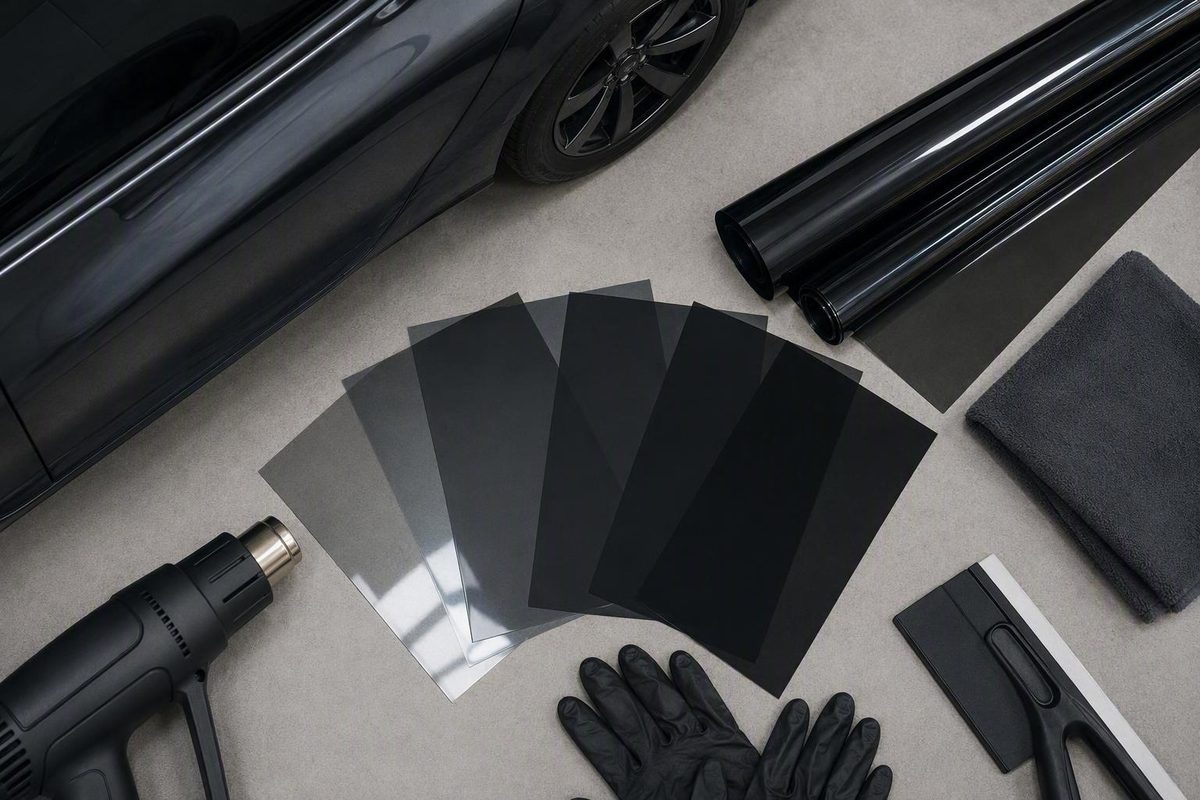
The short answer: a realistic car-window tint budget
For most ordinary cars, a sensible starting budget for professional window tinting is about $150–$600. A Maryland installer publishes that range for most vehicles, but it should be treated as a regional planning estimate—not a statistically representative national average, a guaranteed quote, or proof that an equivalent package costs the same everywhere. See the Maryland provider’s pricing qualifications.
Limited coverage can cost less. Tinting only the two front side windows is commonly quoted at about $80–$200, although some regional estimates for partial work reach $250. Premium film, a large vehicle, specialty glass, windshield or roof coverage, old-film removal, or a labor-intensive luxury vehicle or EV can push the total beyond $1,000. Review the Spokane provider’s front-window and full-vehicle ranges.
For initial planning, use three broad bands:
- Approximately $100–$300: limited coverage, entry-level film, or a relatively simple small vehicle.
- Approximately $300–$600: many mainstream professional side-and-rear packages.
- Approximately $600–$1,200 or more: premium film, extensive coverage, large vehicles, or complex glass.
A Michigan installer publishes the same entry-level, mid-range, and premium bands while emphasizing that the vehicle, selected film, and customization determine the actual price. Review the Michigan installer’s planning bands.
The most important qualification is that “full car” or “full vehicle” is not a standardized package. A common definition is all side windows plus the rear windshield, but another quote may cover a different number of panes. The front windshield, visor strip, sunroof, panoramic roof, old-film removal, taxes, supplies, and other charges may be separate.
| Job scope | Directional range | Common exclusions or variables |
|---|---|---|
| Two front side windows | $80–$200, sometimes up to $250 | Existing-film removal, premium film, difficult glass, taxes |
| Budget side-and-rear package | $100–$300 | Windshield, roof glass, removal, fees |
| Mainstream professional package | $300–$600 | Windshield, panoramic roof, old-tint removal |
| Premium or complex package | $600–$1,200+ | Exact coverage, specialty glass, extensive preparation |
| Full-windshield add-on | $100–$300 where lawful | Windshield size, access, film line, existing film |
| Panoramic-roof add-on | $150–$400 | Panel size, curvature, preparation, multiple sections |
The package bands come from the Michigan estimate above; the front-window figure appears in the Spokane guide, while the windshield and panoramic-roof ranges are published in a detailed San Antonio pricing guide. See the San Antonio add-on definitions.
These are synthesized commercial estimates from regional tint providers. They are useful when answering “how much does it cost to tint car windows?” at the budgeting stage, but they are not independently measured national averages. A useful local quote still requires your year, make, model, selected film, and exact coverage.
Before comparing prices, ask each shop to define its package in writing. A lower quote covering fewer panes is not necessarily cheaper than a higher quote that includes additional fixed glass, removal, preparation, and stronger written warranty terms.
Cost by film type: dyed, carbon, ceramic, and premium films
Film categories provide a useful starting point, but they do not fully identify a product. Manufacturers can sell several lines within the same category, and those lines may differ in construction, documented specifications, appearance, price, and warranty terms.
| Film tier | Directional installed range | Typical market position |
|---|---|---|
| Dyed | About $100–$300 | Budget tier |
| Carbon | About $200–$650 | Middle tier |
| Ceramic | About $350–$1,000+ | Premium common tier |
| Premium multilayer, crystalline, or infrared-focused film | About $400–$800+, potentially $1,200–$1,500 for large or complex work | High-end or specialty tier |
These normalized ranges draw on several commercial estimates. A product vendor lists dyed film at $100–$300, carbon at $250–$800, and ceramic at $350–$1,000; its higher carbon ceiling illustrates how vehicle size, coverage, and product line can blur category boundaries. Compare the vendor’s film-price ranges.
Dyed film is usually the least expensive category. It can be a reasonable choice when appearance, privacy, or a modest initial budget is the priority. Choosing the budget film tier does not automatically mean accepting poor workmanship; product selection and installation quality are separate decisions.
Carbon film generally occupies the middle of the market. It may appeal to buyers who want to move beyond an entry-level product without paying for a shop’s premium ceramic line. Prices overlap because a higher-priced carbon product on a large vehicle can cost more than an entry-level ceramic package on a compact car.
Ceramic film is commonly positioned as the premium mainstream option. The higher price may reflect the exact product, a flagship manufacturer line, installer authorization, warranty administration, labor, or local market positioning. Ceramic is not automatically the best value for every owner. Its case is stronger when the documented specifications of a particular product align with the owner’s climate, parking habits, driving time, desired appearance, and expected ownership period.
For a concrete regional example, a Spokane provider lists full-vehicle prices excluding the windshield at $150–$300 for dyed film, $200–$400 for carbon, $300–$600 or more for ceramic, and $400–$800 or more for crystalline or infrared-focused film. Those are local commercial estimates rather than universal prices. See the Spokane package definitions and film ranges.
A detailed San Antonio table shows why broader ceramic estimates can climb higher. Its side-and-rear ceramic packages range from $350–$550 for a compact sedan to $600–$1,000 for a luxury vehicle and $500–$1,200 or more for Tesla models. The standard package excludes windshield strips, panoramic roofs, and old-tint removal. Examine the San Antonio vehicle-by-film table.
At the broadest end of the available estimates, multilayer ceramic packages can reach $700–$1,500. That ceiling should not be applied automatically to an ordinary sedan: it reflects the possible combination of premium film, larger or specialty vehicles, and extensive coverage. Review the calculator’s film-tier ranges and qualifications.
Published ranges overlap for several reasons:
- Some apply to compact sedans, while others include SUVs, luxury vehicles, or EVs.
- Some are advertised starting prices rather than likely out-the-door totals.
- “Full vehicle” may describe different pane counts or coverage.
- Windshields and roof glass may be included, excluded, or left undefined.
- A category name does not identify the manufacturer or exact product line.
- Regional labor rates and shop positioning differ.
- Removal, preparation, warranty coverage, taxes, and other charges may be handled separately.
Do not compare products using category-wide performance claims alone. Ask for the manufacturer and exact film line, then request the corresponding specification sheet and written warranty. Product-specific documentation is more useful than assuming every film labeled “ceramic” or “carbon” performs identically.
Finally, darkness is not the same as film technology. Dyed, carbon, and ceramic products can each be sold in several shades. Selecting a lower visible-light-transmission level does not automatically mean selecting a more expensive technology.
Cost by vehicle type and glass complexity
The vehicle affects both material use and labor. Larger vehicles often require more film, but exterior size and passenger capacity are not the only variables.
Use the following as broad, nonbinding planning ranges across multiple film tiers and package definitions:
| Vehicle type | Broad directional range across film tiers |
|---|---|
| Coupe | Roughly $150–$700 |
| Sedan | Commonly about $150–$600 |
| Truck | Roughly $200–$900 |
| SUV or crossover | Roughly $250–$1,100 |
| Luxury vehicle or EV | Roughly $400–$1,500+ |
A commercial tint calculator publishes $180–$700 for coupes, $150–$600 for sedans, $200–$900 for trucks, $250–$1,100 for SUVs, and $400–$1,500 or more for luxury vehicles and EVs. The slightly lower coupe floor in the table reflects a separate Spokane estimate, and neither source presents these bands as guaranteed quotes. Review the calculator’s vehicle ranges.
Those broad bands span several film tiers and coverage definitions. They do not predict that every SUV will cost $1,100 or every EV will cost at least $400. A two-window truck job, for example, is not comparable with tinting every side pane and the rear glass on a crew-cab truck.
Narrower local examples may be more useful for an initial comparison. One Spokane guide lists:
- Four-door sedan: $200–$500
- SUV or crossover: $250–$600
- Truck: $250–$550
- Minivan: $300–$650
These figures are regional provider estimates, and the guide expressly says that film, vehicle, window complexity, and geographic market affect the final price.
Window count and total glass area matter, but installers may also account for features such as:
- A steep or compound-curved rear windshield requiring careful film shrinking
- Panoramic or multi-panel roof glass
- Oversized side or rear windows
- Frameless door glass
- Numerous small fixed panes
- Deep interior trim or restricted access to glass edges
- Existing film, adhesive, or contamination
- Rear defroster lines requiring cautious preparation
- Large patterns that are difficult to position and handle
Coupes demonstrate why pane count alone can mislead. A two-door vehicle may have fewer windows than a sedan, but longer doors, frameless glass, or a difficult rear windshield can offset the material savings. Minivans may have relatively straightforward shapes but a large total glass area and more individual panels. Trucks range from simple regular-cab layouts to crew cabs with several side panes and powered rear sliders.
Luxury vehicles and EVs also require model-specific treatment. A higher quote may reflect large glass areas, roof panels, frameless windows, access constraints, or the installer’s assessment of labor and risk—not merely the vehicle’s price or powertrain.
Owner-reported Rivian prices illustrate the importance of scope. One R1S owner reported $420 for ceramic film around the vehicle, plus $180 for the windshield and $200 for the glass roof, producing an $800 total. Another reported $610, but the scope was not fully itemized. These are anecdotes about particular Rivian installations, not representative EV prices. Read the Rivian owner reports and limitations.
For a useful local estimate, provide the shop with:
- Model year
- Make and exact model
- Body style or cab configuration
- Whether film is already installed
- The exact panes to be covered
- Whether the windshield or roof glass is included
- The film manufacturer, product line, and shade under consideration
Photos may help a shop identify existing tint, unusual fixed panes, roof configuration, or access issues. The installer may still need to inspect the vehicle before confirming removal work or a final price.
What a full-vehicle quote includes—and what usually costs extra
A common professional package covers all side windows plus the rear windshield, while excluding the front windshield and roof glass. That is a useful working definition, not an industry-wide standard. Never assume “full car,” “complete tint,” and “all around” describe identical coverage.
A shop may distinguish between movable door windows, fixed quarter windows, rear cargo-area panes, and the rear windshield. Ask for a written pane-by-pane list or coverage diagram rather than relying on the package name.
Limited front-window work commonly costs about $80–$200, with some regional partial-coverage estimates reaching $250. See the Florida guide’s partial-coverage range.
Common add-ons include:
| Add-on | Directional range | What can change the price |
|---|---|---|
| Old-tint removal | $50–$150 | Number of panes, film condition, adhesive residue, defroster lines |
| Windshield visor strip | $50–$100 | Width, shape, selected product |
| Full-windshield film | $100–$300 where lawful | Windshield size, access, film line, existing film |
| Sunroof tint | About $50–$200 | Panel size and number of sections |
| Panoramic-roof tint | $150–$400 | Large area, curvature, preparation, multiple panels |
The removal, windshield, and sunroof ranges are also reflected in a commercial tint calculator, which lists $50–$150 for old-tint removal, $60–$300 for windshield film, and $50–$200 for sunroof film.
Removal deserves particular attention. The common $50–$150 range is therefore a planning allowance, not a guaranteed cap.
Other supported quote modifiers include:
- Mobile installation
- Premium-dealer or premium-shop pricing
- A higher-tier product
- Additional warranty coverage
- Difficult adhesive removal
- Extra preparation
- Oversized, curved, or difficult-to-access glass
- Specialty windshield, sunroof, or roof applications
Taxes, supplies, disposal, preparation, and similar charges are not consistently addressed in the published provider guides. Rather than assuming they are included or typical, ask whether the quoted number is the final out-the-door total and request written disclosure of anything excluded.
A concise coverage checklist can prevent most misunderstandings. Send the same list to each shop and ask it to mark every item as included, excluded, or optional:
- Front driver and passenger side glass
- Rear side-door glass
- Fixed quarter or cargo-area windows
- Rear windshield
- Windshield visor strip
- Full front windshield
- Sunroof
- Panoramic or multi-panel roof
- Removal of existing film and adhesive
- Taxes, supplies, disposal, and other disclosed fees
Also ask whether the price is based on each individual piece of glass or on a broader opening or vehicle section. What appears visually to be one rear-side area may contain more than one pane, affecting the work required.
Why two shops can quote very different totals
Two quotes carrying the same broad label can describe materially different jobs. To compare them fairly, separate seven variables.
1. Exact film manufacturer and product line
“Dyed,” “carbon,” and “ceramic” are categories, not complete product identities. A manufacturer may sell entry-level and flagship lines within the same category, each with different documented specifications and warranty terms. If a quote does not identify the manufacturer and line, the product cannot be verified.
2. Vehicle size
More glass generally requires more material. SUVs, minivans, crew-cab trucks, and vehicles with large rear areas may therefore cost more than compact sedans. Size matters, but it should not replace an assessment of the actual glass layout.
3. Number of glass panels
Vehicles with similar exterior dimensions can have different pane counts.
4. Glass shape and access
A curved rear windshield can require more shrinking and handling than a flat door window. Frameless windows, tight seals, deep trim, oversized panels, and restricted interior access can increase labor even when the amount of film is modest.
5. Preparation or removal work
Removing existing film and adhesive is a separate task. Ask how the shop calculates removal and what conditions could change the estimate after inspection.
6. Installer labor and credentials
Labor prices can reflect experience, shop overhead, installation conditions, local demand, and the time budgeted for preparation and finishing. Installer authorization may matter to a particular product warranty, but a credential alone does not guarantee flawless work. Evaluate the process, recent comparable examples, written policies, and defect-handling procedure.
7. Local market
Commercial rent, wages, competition, and regional demand affect pricing. A promotional starting price in one city should not be treated as a national benchmark.
Material upgrades and labor premiums should be separated. Paying more for another film line is not the same as paying for adhesive removal, specialty glass, or a difficult rear windshield. Ask the shop to identify each component.
Warranty terms can also explain a price difference, but “lifetime warranty” is not a complete description. Confirm:
- Which defects are covered
- Whether fading, color change, bubbling, peeling, or adhesive failure is addressed
- Whether replacement film and labor are both included
- Whether accidental damage or glass breakage is excluded
- Whether proof of purchase is required
- Whether coverage transfers to another owner
- Whether installer authorization is required
- Who pays for removal and reinstallation
Darkness, normally expressed as VLT, is a separate characteristic from film technology. A lower-VLT shade is not automatically a higher technology tier or the main reason one quote costs more.
The lowest advertised number may be a starting price for a small vehicle, selected windows, or entry-level film. Once additional panes, removal, specialty glass, and disclosed fees are included, it may no longer be the lowest out-the-door total.
Use this equivalent-scope formula:
Same vehicle + same named film product + same VLT + same panes + same removal scope + same warranty basis + all taxes and fees = a meaningful comparison
If one of those components changes, record the difference before deciding which quote offers better value.
Sample budgets: from a basic sedan to a complex premium job
The following scenarios are illustrative calculations, not national averages or actual quotes. They demonstrate how coverage and add-ons affect a budget so you can substitute local figures.
Scenario 1: Budget sedan
Assume a sedan owner wants dyed film on the side windows and rear glass:
- Base dyed package: $150–$300
- Old-tint removal: $0, assuming bare glass
- Windshield or roof work: $0
- Taxes and other fees: not yet known
Illustrative subtotal: $150–$300 before taxes or other fees.
The package range corresponds to a Spokane provider’s full-vehicle dyed estimate, which excludes the windshield. The owner should still confirm every included pane, the exact film, and the written warranty.
Scenario 2: Mid-range sedan with removal and windshield film
Assume a carbon side-and-rear package, old-film removal, and full-windshield film where lawful:
- Carbon package: $250–$450
- Removal: $100
- Full windshield: $200
Arithmetic:
- Low example: $250 + $100 + $200 = $550
- High example: $450 + $100 + $200 = $750
Illustrative subtotal: $550–$750 before taxes or other fees.
The carbon range falls within detailed San Antonio sedan estimates, while the removal and windshield amounts are mid-range illustrative selections from that provider’s add-on bands. The windshield should be itemized by product and VLT rather than assumed to be part of “full-car” tint.
Scenario 3: SUV or crossover
Detailed San Antonio examples place a side-and-rear package for an SUV or crossover at approximately:
- Carbon: $350–$500
- Ceramic: $500–$800
- Roof glass: not included
- Existing-film removal: not included
Illustrative subtotal: $350–$800 before roof work, removal, taxes, or other fees.
The range is wide because film category is only one variable. Total glass area, individual pane count, rear-window shape, installer, and exact product line also matter.
Scenario 4: Two-front-window match
Assume the owner wants only the front driver and passenger windows tinted:
- Two front side windows: $80–$200
- Removal: $0, assuming bare glass
- Other charges: not yet known
Illustrative subtotal: $80–$200 before taxes or other fees.
That range is published by the Spokane provider for two front windows. Before approving the work, ask whether “match” refers only to appearance or to a target finished VLT as well.
Scenario 5: Complex EV or luxury vehicle
Assume ceramic side-and-rear coverage plus separate windshield or panoramic-roof work:
- Ceramic side-and-rear package: $600–$1,000
- Windshield or roof work: $200–$400
- Removal or preparation allowance: $0–$150
Arithmetic:
- Low example: $600 + $200 + $0 = $800
- High example: $1,000 + $400 + $150 = $1,550
Illustrative subtotal: approximately $800–$1,550.
This is a premium, extensive, or complex scenario—not an automatic surcharge for every EV or luxury badge. Detailed provider examples put luxury-vehicle ceramic packages at $600–$1,000 and some Tesla ceramic packages at $500–$1,200 or more, depending on model and roof coverage.
Build your own estimate
Use five lines:
- Base film package: $____
- Vehicle or complexity premium: $____
- Old-film and adhesive removal: $____
- Windshield, visor strip, sunroof, or panoramic roof: $____
- Taxes, supplies, disposal, and other disclosed fees: $____
Estimated out-the-door total: $____
Do not fill in the first line until the shop defines the product and coverage. “Ceramic package” is incomplete if it omits the manufacturer, product line, and panes. Likewise, a higher quote is not necessarily better unless the shop can explain what the additional price buys.
A sensible budget leaves room for legitimate preparation or specialty-glass work without becoming open-ended. If a final removal charge requires inspection, ask how the estimate is calculated and what conditions could raise it.
DIY versus professional tinting: compare more than the kit price
Pre-cut DIY kits are commonly advertised at approximately $30–$100, while another commercial guide says DIY options may begin around $50. Those figures describe the material entry point, not the complete cost or likely result.
| Cost or risk | DIY | Professional installation |
|---|---|---|
| Film | Kit or bulk-film price | Normally included in the quote |
| Tools | May require separate purchases | Supplied by installer |
| Cleaning and preparation | Owner’s responsibility | Usually part of installation; confirm |
| Cutting and alignment | Owner assumes difficulty and error risk | Included within quoted labor |
| Curved-glass shrinking | Can be technically demanding | Included when within scope |
| Time | Owner’s time | Shop turnaround time |
| Replacement material | Owner may need to repurchase | Depends on written defect policy |
| Finish | Depends on skill and working conditions | Depends on installer and process |
| Warranty | Kit terms may be limited | Product or workmanship coverage may apply |
| Rework | Owner handles it or hires a shop | Depends on written warranty terms |
The $30–$100 range comes from the Spokane provider, while OC Tint Solutions states that kits may start around $50.
DIY offers the clearest potential savings when the owner already has suitable tools, a clean workspace, patience, and relevant skill. Simple, relatively flat side glass is generally more approachable than a compound-curved rear windshield.
Professional pricing pays for labor, preparation, handling, and installation experience in addition to the film. It may also include a product or workmanship warranty, but buyers should read the scope and exclusions rather than assuming every defect, future removal, or labor charge is covered.
Nor should buyers assume every professional installation will outperform every DIY job. The practical trade-off is lower initial material cost versus the owner’s time, workspace, skill, and risk of buying replacement film or paying for rework.
Published turnaround estimates also vary. OC Tint Solutions says most vehicles take 1.5–3 hours, while a Miami installer lists two to three hours for sedans and three to four hours for SUVs. Removal, specialty glass, preparation, and shop scheduling can extend those estimates. See the Miami installer’s stated turnaround ranges.
DIY may be reasonable if you:
- Are patient and comfortable with precise film work
- Have a clean, sheltered workspace
- Accept the possibility of buying replacement film
- Are beginning with relatively simple glass
- Can verify that the product and finished VLT are lawful
- Value saving labor costs more than saving time
Professional quotes become more attractive when the vehicle has:
- A difficult curved rear windshield
- Expensive premium film
- Old adhesive or deteriorated tint
- Panoramic or oversized glass
- Frameless windows
- Numerous small fixed panes
- A schedule that leaves little room for rework
If you are undecided, compare the complete DIY cost—including tools and an allowance for replacement material—with several professional out-the-door quotes. The financial difference may look smaller once your time and the most difficult pane are included.
Choose a legal film and compare installer quotes fairly
VLT, or visible light transmission, is the percentage of visible light that passes through the glass-and-film system. A lower VLT means a darker finished result.
Film darkness and film technology are separate purchasing choices. Ceramic is not synonymous with dark, and dyed film is not necessarily the darkest option. Each technology may be offered in several VLT levels.
Tint requirements can vary by:
- State or other jurisdiction
- Window position
- Passenger-car or multipurpose-vehicle classification
- Windshield area
- Reflectivity
- Medical-exemption status
- Other conditions defined by local law
Compliance may depend on the combined transmission of the factory glass and applied film, not merely the VLT printed on a film sample. The San Antonio provider specifically notes this combined-transmission issue, although its state-specific legal summary should not substitute for current official rules.
Because laws can change, verify current requirements through the relevant official state authority, DMV, highway-safety agency, inspection authority, or statute before authorizing installation. Window Tint Central likewise characterizes its material as general information and advises readers to verify changing tint limits with their DMV; that is publisher guidance, not legal advice. Read the publisher’s legal-information notice.
When requesting quotes, send every installer the same information:
- Year, make, exact model, and body style
- Film manufacturer and exact product line
- Requested VLT for each window position
- Front side windows
- Rear side windows
- Fixed quarter or cargo-area windows
- Rear windshield
- Windshield visor strip
- Full windshield
- Sunroof or panoramic roof
- Existing-film and adhesive removal
- Vehicle or glass-complexity charge
- Taxes, supplies, disposal, and other disclosed fees
- Written product-warranty coverage
- Written workmanship-warranty coverage
- Whether warranty labor is included
- Whether the warranty transfers to another owner
- Expected turnaround
- Post-installation care instructions
- Final out-the-door total
Obtain multiple itemized quotes and compare identical coverage. A headline price has little value when the film line, panes, removal work, warranty, and fees remain undefined.
When evaluating film, rely on product-specific documentation rather than generic category promises. When evaluating an installer, consider preparation practices, examples of comparable vehicles, written defect policies, warranty administration, communication, and the clarity of the quote.
Window Tint Central says its coverage draws on hands-on automotive and storefront tinting experience, identifies sources for quoted prices and specifications, and is neither sponsored nor influenced by paid manufacturer placement. Those are the publisher’s own disclosures—not independent validation of the regional price estimates and not a claim that the publisher performs installations or provides legal advice. See Window Tint Central’s experience and editorial disclosure.
A sensible starting budget remains about $150–$600 for professional tinting on an ordinary car, but that number becomes useful only after the package is defined. Compare out-the-door quotes for the same named product and panes, then account separately for removal, windshield or roof work, warranty differences, difficult glass, taxes, and disclosed fees.
The cheapest headline price is not necessarily the cheapest equivalent job. The most expensive ceramic package is not automatically the right choice, either. Select the product and installer according to your budget, parking and driving conditions, desired coverage, documented specifications, workmanship expectations, and current official tint requirements.
Frequently asked questions
How much does it cost to tint only the two front windows?
Budget approximately $80–$200 for the two front side windows. Some regional estimates for partial work extend to about $250, particularly where the job involves premium film, more difficult glass, or a higher-priced local market. See the regional front-window and partial-coverage estimates.
Confirm whether the quote includes existing-film removal, preparation, taxes, and any charge associated with the selected product. If the objective is to match rear factory privacy glass, verify the finished VLT rather than relying only on visual similarity.
How much extra does old-window-tint removal cost?
Old-film removal is commonly listed at about $50–$150 extra. The actual charge can depend on the number of affected panes, film condition, adhesive residue, access, and the care required around rear defroster lines.
Ask how the shop calculates removal and whether the amount can change after inspection. Brittle film, stubborn adhesive, or several affected panes may require more work than a simple removal.
Is ceramic tint worth the higher price?
It can be, but not for every driver. Ceramic may be easier to justify when a particular product’s documented specifications address the owner’s priorities, the vehicle is parked outside frequently, driving time is substantial, or the owner expects to keep the vehicle for years.
Carbon or another mid-tier film may be the better value when the vehicle is usually garaged, the ownership period is short, or the ceramic upgrade would displace more important spending. One California installer advertises full-car carbon starting at $380 and ceramic starting at $480, but requires a vehicle assessment for an exact quote—an example of why the upgrade must be evaluated locally. See the provider’s starting prices and qualification.
Does a full-car tint price include the windshield and panoramic roof?
Often it does not. A common package includes side windows and rear glass while excluding the front windshield, sunroof, panoramic roof, old-tint removal, taxes, and other charges.
Ask for a pane-by-pane coverage list. As planning figures, full-windshield film is often quoted at about $100–$300 where lawful, while panoramic-roof work commonly falls around $150–$400, depending on size and complexity.
Does darker window tint cost more?
Not necessarily. Darkness is expressed through VLT, while dyed, carbon, and ceramic describe film categories or technologies. Each category may be available in several shades.
A shop may charge more for an uncommon product, custom design, or specialty shade, but a darker film is not automatically a more expensive technology. Compare the manufacturer, exact product line, VLT, coverage, and written warranty—not darkness alone.