
A Practical Budget for Automotive, Home, and Commercial Window Film
Many "full vehicle" estimates cover side windows and rear glass but exclude the windshield. Match film, removal and final totals when comparing quotes.
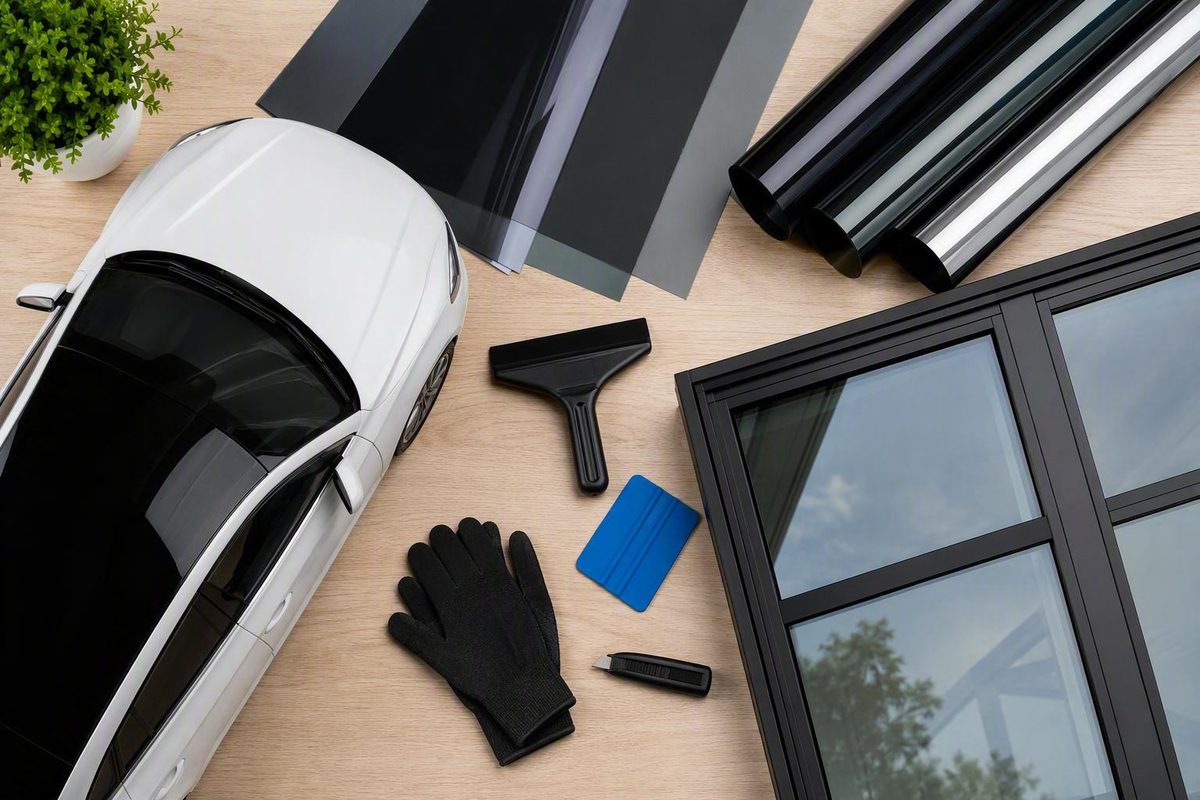
Window tinting cost at a glance
There is no useful universal answer to “how much does window tinting cost?” Automotive installers usually price by vehicle, film, and coverage. Residential and commercial installers are more likely to consider glass area, pane count, access, and film specification. Combining those markets into one average would be misleading.
For professional automotive tinting in the United States, a practical preliminary budget is:
- Basic or partial work: about $100–$300
- Full sedan: commonly about $200–$500
- Full SUV or crossover: commonly about $250–$600
- Premium ceramic, luxury, EV, or complex work: approximately $800–$1,500+
These are broad planning ranges synthesized from provider-published estimates, not a methodology-backed national average. The sedan and SUV figures align with a Spokane provider’s estimates for full-vehicle coverage excluding the windshield. The calculator lists luxury/EV vehicles at $400–$1,500+ and multilayer ceramic film at $700–$1,500 Car Window Tint Cost Calculator - OC Tint Solutions. Snow’s Auto publishes vehicle and film estimates, while OC Tint Solutions lists higher-end vehicle, film, and add-on ranges.
Residential pricing belongs in a separate budget. Thumbtack reports a $706 national average, a typical project range of $435–$1,145, and an estimated installed rate of $6–$8 per square foot. For larger commercial projects, it estimates approximately $5–$7 per square foot, but the available evidence does not support a dependable national commercial project total. Thumbtack explains its residential and commercial window-film estimates.
A useful preliminary budget is:
| Project | Planning range |
|---|---|
| Two front vehicle windows | $80–$200 |
| Full sedan, standard package | $200–$500 |
| Full SUV or crossover, standard package | $250–$600 |
| Premium or complex automotive installation | $800–$1,500+ |
| Residential installation | $435–$1,145 typical project range |
| Residential installation by area | $6–$8 per sq. ft. |
| Larger commercial installation | About $5–$7 per sq. ft. |
The vehicle figures synthesize the automotive provider estimates cited above; the residential and commercial figures come from Thumbtack. Treat every number as a starting point for collecting quotes, not an expected invoice.
Before comparing prices, define the scope. A quote for two front door windows is not comparable with a full car excluding the windshield. Likewise, one room in a home cannot be compared with every exterior window, and a ground-level storefront is not equivalent to a multistory office project.
Film product, glass coverage, removal, preparation, taxes, specialty glass, labor, access, and warranty terms can all move the final total.
Car tint prices by film type
The clearest way to compare automotive film prices is to standardize the job as professional full-vehicle coverage excluding the windshield. That generally means the side windows and rear glass, but package definitions differ, so every piece of glass should still be confirmed in writing.
The following table synthesizes multiple U.S. provider estimates rather than presenting a statistically representative national average:
| Film category | Full-vehicle planning range, excluding windshield | General market position |
|---|---|---|
| Dyed | $150–$300 | Entry-level |
| Carbon | $200–$500 | Mid-priced |
| Ceramic or infrared-rejection | $300–$800+ | Premium |
| Multilayer or specialty premium film | Often above $800 | Highest-priced tier |
Snow’s Auto explicitly defines its full-vehicle ranges as excluding the windshield and lists $150–$300 for dyed, $200–$400 for carbon, $300–$600+ for ceramic, and $400–$800+ for crystalline or infrared-rejection film. Other provider estimates extend carbon, ceramic, and multilayer ceramic above those bands for larger vehicles and complex applications.
A Florida installer offers a regional illustration of the variation, listing $130–$250 for dyed, $200–$400 for carbon, and $350–$700 for ceramic. Those are promotional regional estimates, not national survey findings. J3ss-InTime publishes Florida estimates by coverage and film type.
The defensible conclusion is not that every product has a fixed price. It is that providers generally position:
- Dyed film as the least expensive tier
- Carbon film as the middle tier
- Ceramic and specialty infrared-rejection film as premium tiers
- Multilayer ceramic and other specialty products at the upper end
Metallic, hybrid, photochromic, crystalline, and multilayer ceramic are additional labels that may appear on estimates. One seller’s “ceramic” package may use a different product line, preparation process, glass coverage, or warranty from another seller’s ceramic package.
Ask for the film manufacturer and exact product line, not only the technology label. That makes it possible to compare documentation and prevents two superficially similar quotes from being treated as equivalent when they are not.
Film technology should also be separated from shade darkness. It does not identify whether the film is dyed, carbon, ceramic, or another construction.
There is no reliable universal rule that darker film always costs more—or that darkness can never affect price. One Ohio installer says shade typically does not change its price, while another provider’s calculator suggests that some lower-VLT selections may cost more. These are seller-specific practices, not market-wide rules. Finesse Customs describes its Ohio pricing and treatment of shade versus film technology.
Do not pay a premium based only on broad promises about UV blocking, infrared rejection, cabin-temperature reduction, lifespan, or financial payback. Request performance documentation for the exact product being installed and read the applicable product and workmanship warranty terms.
Car tint prices by vehicle and coverage
Vehicle type is useful for setting an initial budget, but it is only a shortcut for the amount and difficulty of the glass. For a standard full-vehicle package that generally excludes the windshield, reasonable provider-based planning ranges are:
| Vehicle type | Planning range |
|---|---|
| Coupe | $150–$400 |
| Sedan | $200–$500 |
| SUV or crossover | $250–$600 |
| Extended- or crew-cab truck | $250–$550 |
| Minivan | $300–$650 |
These ranges come from the same Spokane pricing guide that defines full-vehicle film pricing as excluding the windshield. They should be treated as broad provider estimates rather than national averages.
Broader estimates can reach approximately $1,100 for SUVs, $900 for trucks, and $1,500+ for luxury vehicles or EVs when premium film, additional glass, and difficult applications enter the quote. Those are upper planning limits from an automotive calculator, not typical standard-package prices.
Partial work should be budgeted separately:
| Partial automotive job | Planning range |
|---|---|
| Two front windows | $80–$200 |
| One side window | $40–$100 |
| Rear windshield | $75–$200 |
| Other partial packages | $100–$250 |
The first three ranges are provider-published individual-window estimates. The broader $100–$250 partial-package range appears in regional Florida and New Jersey provider guides and may cover different combinations of front or rear glass.
Local advertisements can show what is available in a particular market, but they are not national benchmarks. A Canton, Ohio installer advertises starting prices of $149 for two front windows, $349 for full-vehicle carbon film, and $449 for full-vehicle ceramic film. The word “starting” matters: those figures do not establish a fixed out-the-door price for every vehicle.
Vehicle labels alone cannot capture labor complexity. Two sedans may receive different quotes because one has steep, compound-curved rear glass. A large SUV may have more glass but simpler access. Variables that can influence the work include:
- Number of windows
- Total glass area
- Steep or compound curves
- Large rear glass
- Panoramic roofs
- Small quarter windows
- Tight trim or gasket access
- Window-mounted sensors
- Embedded antennas
- Defroster lines
- Existing film or adhesive
Curved or irregular windows and glass carrying defrosters, antennas, or sensors may require additional care and labor. Tint World’s High Point guide outlines vehicle, glass, labor, and warranty variables.
For a useful quote, provide:
- Vehicle year
- Make and model
- Body style or trim if it changes the glass
- Existing-film status
- Desired manufacturer and film product
- Preferred VLT
- Exact windows to be tinted
- Windshield or roof-glass requirements
- Installation location if mobile service is available
A request that says only “How much to tint my SUV?” leaves too many variables open and makes the resulting estimate difficult to compare.
Windshields, sunroofs, removal, and other added costs
Many advertised “full-car” packages exclude the windshield. Some include all side windows and the rear windshield; others use less precise wording. Before accepting a price, ask the installer to list every piece of glass covered.
Provider-published windshield estimates include:
-
Windshield strip: approximately $50–$100
-
Broader windshield estimate from one calculator: approximately $60–$300
Sunroof tint is commonly estimated at approximately $50–$200. Panoramic roofs and unusually large glass components may cost more. One regional provider places some full-windshield and panoramic-roof applications at approximately $100–$400 per component. The Florida provider guide lists partial and specialty-glass estimates.
Old-tint removal is commonly listed as an additional $50–$150. That range does not establish how every installer calculates the fee.
One automotive provider’s calculator also assumes:
- Mobile installation: an additional $50–$100
- Premium dealer installation: 20% more
- Extended-warranty selection: 15% more
These are calculator assumptions, not universal fees. The same calculator lists windshield tint at $60–$300, sunroof tint at $50–$200, and removal at $50–$150.
Add-ons can quickly turn a modest advertised package into a larger total:
- Base tint package: $350
- Old-tint removal: $100
- Windshield work: $150
- Illustrative subtotal before tax: $600
This is arithmetic, not a sourced quote: $350 + $100 + $150 = $600. Its purpose is to show why the base package may not equal the final invoice.
Use this checklist before booking:
- Exact film manufacturer and product line
- VLT for each window
- Every side window included
- Rear windshield included or excluded
- Front windshield included or excluded
- Windshield strip versus broader coverage
- Sunroof or panoramic roof included or excluded
- Existing-film removal
- Adhesive cleanup and glass preparation
- Specialty or unusually curved glass
- Mobile-service charge
- Minimum service charge
- Disposal fees
- Taxes
- Warranty cost and terms
- Final out-the-door total
Windshield and front-window work may be restricted by applicable law. A service appearing on an installer’s menu does not establish that every configuration is lawful in your jurisdiction.
Home and commercial window-tinting costs
Residential and commercial film should not be estimated from automotive prices. Property projects are commonly quoted by square footage, pane, window, or complete project, with access and glass configuration often playing a larger role.
Thumbtack publishes the following residential estimates:
| Residential pricing measure | Published estimate |
|---|---|
| Typical project range | $435–$1,145 |
| Reported national average | $706 |
| Materials and installation | $6–$8 per sq. ft. |
A simple area calculation provides a preliminary budget:
100 square feet × $6–$8 per square foot = $600–$800
That is not a final quote. It assumes the measured area and square-foot rate apply to the same scope, with no extra removal, difficult-access, minimum-service, or specialty-film charges. Thumbtack says pane count, shape, installation complexity, and film choice can affect the total, while larger projects or straightforward panes may receive a lower per-square-foot rate. Thumbtack provides the residential figures and pricing factors.
Residential price drivers include:
- Total measured glass area
- Number of panes
- Pane dimensions
- Film type and product line
- Window shape
- Divided or French panes
- Existing film or coatings
- Interior and exterior access
- Ladder or lift requirements
- Furniture or fixture protection
- Removal and cleanup
- Minimum project charges
Square-foot pricing can work well for large rectangular panes. It may be less predictive for many small divided panes because measuring, cutting, positioning, and edge work must be repeated. Conversely, a per-window quote can be misleading when one “window” is a large multi-pane assembly.
Regional per-window figures can provide context but should not replace local measurement. One Texas provider publishes these installed estimates:
| Residential film category | Texas provider estimate per window |
|---|---|
| Basic solar film | $35–$65 |
| Ceramic film | $65–$120 |
| Safety or security film | $80–$150 |
| Decorative or frosted film | $50–$100 |
| Switchable smart film | $150–$300+ |
The same provider estimates $800–$2,500 for a 15–25-window home in Austin or Houston. It also quotes Texas commercial projects at $1,500–$8,000, depending on building size, floor height, access, and film specification. These are regional seller examples, not national benchmarks. Shades of Texas publishes its residential and commercial estimates.
For larger commercial work, the more cautious general planning figure is approximately $5–$7 per square foot, with no dependable national project total supported by the available evidence. Commercial costs can change substantially based on:
- Storefront versus multistory installation
- Ground-level versus elevated access
- Lift or staging requirements
- Film specification
- Glass dimensions and pane count
- Existing-film removal
- Work-hour restrictions
- Occupied-space protection
- Mobilization and minimum charges
Do not build a property-film budget around unsupported promises of universal energy savings, fixed payback periods, or identical warranties across products. Ask for documentation for the exact film and a written description of the installer’s workmanship coverage.
Why two window-tint quotes can be far apart
Large differences do not necessarily mean one installer is overcharging. Often, the quotes describe different jobs. Compare the price drivers in six groups.
1. Film product and brand
“Ceramic” is a broad category, not a complete specification. Different manufacturers and product lines may have different wholesale costs, construction, published performance, appearance, and warranties. A quote should identify the manufacturer, line, and VLT—not merely “premium ceramic.”
2. Amount of glass
More windows and larger panes can require more material and labor. A sedan package excluding its windshield is not equivalent to one including windshield work. A full SUV with quarter glass cannot be compared directly with two front door windows.
3. Glass shape and equipment
A curved rear windshield may require more fitting and shrinking than a flat door window. Panoramic roofs, difficult trim, sensors, antennas, and defrosters can alter preparation and installation requirements. On property projects, small divided panes and difficult upper-story access may matter more than raw square footage.
4. Preparation and old-film removal
Clean, untreated glass is a different job from glass covered with aging film and adhesive. Ask whether removal, adhesive cleanup, interior protection, and disposal are included. An unspecified removal charge can erase the apparent advantage of a low base price.
5. Installer and local labor market
Published automotive figures come from commercial providers in markets including Spokane, Florida, New Jersey, Nashville, Ohio, and North Carolina. Residential examples also include Texas. Most sources do not disclose representative datasets, consistent package definitions, or detailed calculation methods.
Some regional provider pages also use very similar structures and ranges, so they should not automatically be treated as independent confirmation of a national market price. Local figures are better used as examples of possible pricing than as proof of a nationwide norm.
6. Warranty and service model
Shop installation, mobile service, dealer installation, and subcontracted work may carry different costs. Warranty duration alone does not establish value. Determine which defects are covered, who supplies replacement labor, what exclusions apply, and whether coverage transfers to another owner.
Published numbers may be starting prices, calculator outputs, typical estimates, regional examples, or package prices. They may not include taxes, removal, preparation, disposal, specialty glass, or minimum service charges.
The safest comparison rule is simple: never compare a partial package with a full package, a windshield-excluded price with a windshield-included price, or an unidentified film with a specified product. The lowest advertised figure may not produce the lowest comparable out-the-door total.
DIY versus professional installation
U.S. provider guides commonly list pre-cut automotive DIY kits at approximately $30–$100, while another automotive provider says kits can begin around $50. One provider estimates that professional installation may cost $100–$200 more than DIY, but that is not a universal labor premium or guaranteed amount of savings. It depends on the vehicle, kit, film, and professional package being compared. Snow’s Auto publishes its DIY kit and professional-installation comparison.
A professional quote may include:
- Glass cleaning and preparation
- Film fitting and installation labor
- Interior protection
- Cleanup
- Workmanship coverage
- A defined correction policy
- Product-warranty support
A DIY buyer should separately consider:
- Squeegees, blades, sprayers, and other tools
- Cleaning and preparation materials
- A suitable working environment
- Time required to prepare and fit the film
- Wasted film from cutting or fitting errors
- Replacement material after a failed attempt
- Limits or absence of workmanship coverage
These are budgeting questions rather than assumed dollar amounts. The difference between a $50 kit and a $350 professional package, for example, is not automatically $300 in savings because the products, scope, labor, risk, and support may not be equivalent. Those figures are an illustration based on the provider-published starting prices already discussed, not a claim that every comparison will have that spread.
Canadian prices should remain separate from U.S. estimates. An Orleans provider lists DIY kits at CA$30–CA$100, two front windows at CA$80–CA$150, and full ceramic work at CA$400–CA$800+. These Canadian-dollar figures should not be blended into a U.S. cost table. Orleans Auto Club publishes its CA$ vehicle and DIY estimates.
Professional installation does not necessarily outperform every careful DIY job, nor does every professionally installed product automatically last longer. Compare:
- Exact film product
- Total glass coverage
- Preparation included
- Installer workmanship terms
- Product warranty
- Correction or replacement policy
- Complete out-of-pocket cost
Ceramic should be treated as a budget decision, not an automatic recommendation. Calculate the incremental installed price over carbon or dyed film, then compare it with your desired features, climate, expected ownership period, exact product specifications, and warranty terms. Marketing labels alone cannot determine whether the premium is worthwhile for you.
How to compare quotes and avoid a misleading price
Obtain multiple itemized local quotes for an identical scope. Do not ask one installer for the least expensive dyed package, another for ceramic on additional glass, and a third for mobile installation, then compare only the totals.
For automotive work, send each installer the same request:
Please quote my [year, make, model, body style] with [existing tint/no existing tint]. I want [exact windows] tinted using [manufacturer and product line, if known] at [desired VLT]. Please state whether the windshield, windshield strip, rear glass, sunroof, or panoramic roof is included. Itemize removal, preparation, installation location or mobile service, taxes, warranty charges, and any other fees. Provide the estimated or guaranteed out-the-door total.
For residential or commercial work, provide:
Please quote [measured glass area] across [pane count] panes with attached dimensions and photographs. The glass or pane type is [description], access is [ground level/interior/elevated/etc.], and existing film or coatings are [present/absent/unknown]. Please specify the proposed film manufacturer and product line, removal, preparation, lifts or special equipment, after-hours work, taxes, warranty terms, and the estimated or guaranteed final total.
Ask every installer to label the number clearly as one of the following:
- Advertised starting price
- Preliminary estimate
- Estimate subject to inspection
- Fixed quote
- Guaranteed out-the-door total
For the warranty, ask:
- What film and workmanship defects are covered?
- Is replacement film included?
- Is replacement labor included?
- Are removal and cleanup included?
- What conditions or maintenance practices are excluded?
- Is proof of purchase required?
- Does coverage transfer to a later owner?
- Who handles a claim if the installer closes?
Do not assume “lifetime” means uniform protection across products, installers, defects, labor, and owners.
Product-performance claims should be checked against documentation for the exact manufacturer and film line. A category-wide statement about “ceramic tint” cannot establish the performance of every ceramic product.
Tint laws vary by jurisdiction and can change, particularly for front side windows and windshields. Verify current requirements through the relevant state, provincial, or local government authority before installation. Do not rely on a provider’s general VLT chart as current legal authority.
Use this comparison matrix to align competing quotes:
| Quote item | Installer A | Installer B | Installer C |
|---|---|---|---|
| Starting price or final total? | |||
| Film manufacturer | |||
| Exact product line | |||
| VLT by window | |||
| Side windows included | |||
| Rear windshield included | |||
| Front windshield included | |||
| Roof glass included | |||
| Existing-film removal | |||
| Preparation and cleanup | |||
| Specialty-glass charge | |||
| Mobile or access charge | |||
| Taxes and disposal | |||
| Product warranty | |||
| Workmanship warranty | |||
| Replacement labor covered | |||
| Out-the-door total |
The most useful answer is a range tied to a precisely defined job, not a single headline average. First identify whether the project is automotive, residential, or commercial. Then standardize the film product, glass coverage, removal, specialty work, warranty, taxes, and legal constraints. Published prices can establish a preliminary budget, but the final decision should rest on multiple itemized local quotes for the same scope.
Frequently asked questions
Does a full-car tint price include the windshield?
Often it does not. Many published “full vehicle” estimates cover the side windows and rear glass while expressly excluding the windshield. Ask the installer to list each piece of glass, including the rear windshield, front windshield, strip, sunroof, and panoramic roof.
How much does it cost to tint only two front windows?
A practical U.S. planning range is approximately $80–$200. Film type, window size, vehicle design, and local labor can move the price. One Ohio installer advertises a $149 starting price, which is a local example rather than a national average. Finesse Customs publishes its Ohio starting prices.
How much does old window tint removal add?
Old-tint removal is commonly listed at an additional $50–$150. Ask whether that is a flat project fee, a per-window charge, or a preliminary allowance subject to the condition of the film and adhesive.
Is ceramic tint worth the higher price?
Sometimes, but not automatically. Compare the additional installed cost with the exact product’s documented features, your climate, how long you expect to own the vehicle, the glass included, and the written warranty. “Ceramic” alone does not identify a product line or prove that the upgrade will pay for itself.
Does choosing a darker tint increase the price?
Not under a reliable universal rule. Some installers say shade darkness usually does not change their price, while others may price certain VLT and product combinations differently. Ask for the price of the same film line at each available legal shade so film technology and darkness are not confused.