
When Budget Dyed Window Tint Is Worth Buying
Compare dyed window tint on cost, heat rejection, fading, warranties and finished VLT, and see when carbon or ceramic film justifies the added cost.
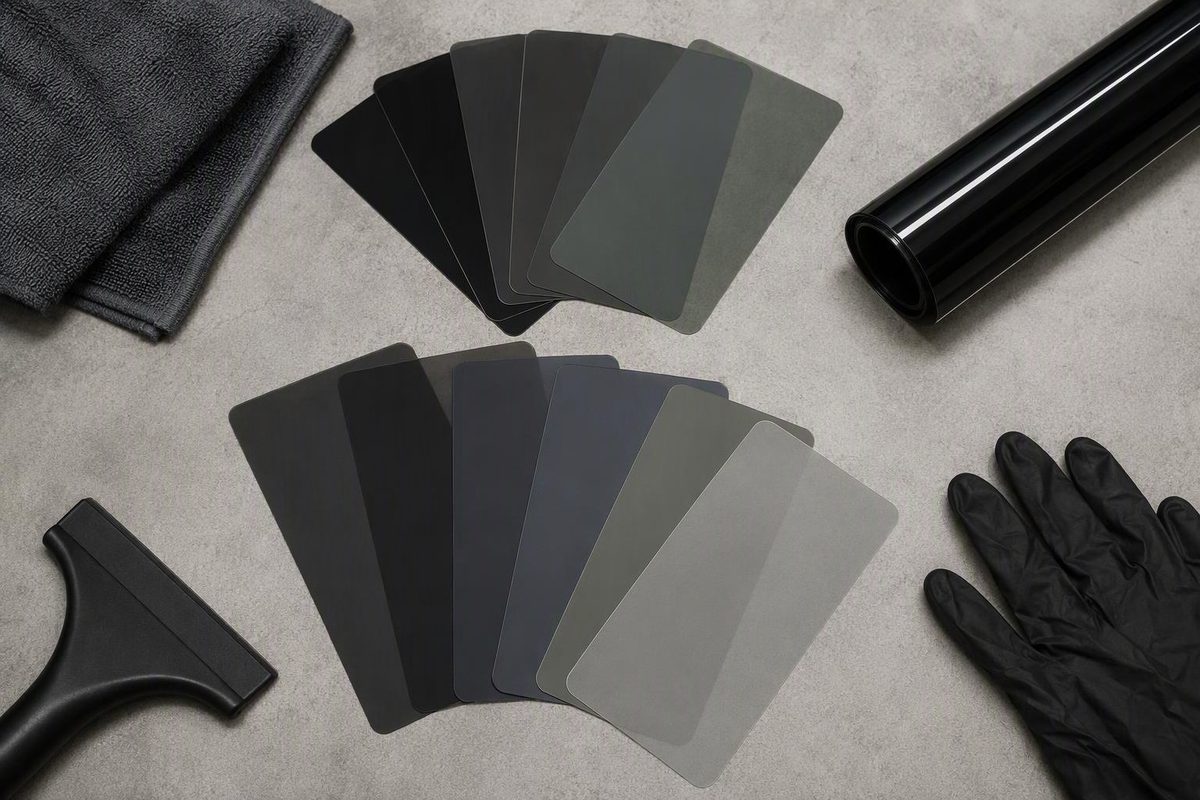
Dyed film window tinting is usually the least expensive way to reduce glare, add daytime privacy and darken a vehicle’s appearance. It makes sense when purchase price matters more than maximum heat rejection, provided you choose a named film with a written warranty rather than an unidentified bargain roll.
Enter the glass and film ratings to estimate the finished VLT.
Finished VLT Estimate
This combines the rated transmission of the existing glass and the new film. It does not determine whether the result is legal.
Estimated finished VLT
Nominal ratings can differ from a meter reading.
Source: glass VLT × film VLT, using the calculation described in the accompanying article. Legal limits are not supplied because they vary by jurisdiction and window position.
What Dyed Window Tint Is
Automotive dyed film uses dye within or between polyester layers to absorb part of the incoming light. Installers normally apply it to the inside of the glass and heat-shape it to fit curved windows.
Its usual strengths are:
- A dark, non-reflective appearance
- Daytime privacy and glare reduction at a low entry price
- Multiple visible light transmission (VLT) choices
- No signal interference when the selected product is nonmetallized
That last point should be verified for the specific product rather than assumed from the generic “dyed” label. For example, 3M describes its Obsidian line as nonmetallized and says it will not interfere with electronics, satellite radio, GPS or mobile devices (3M Obsidian).
The main limitation is that darkness does not guarantee strong heat control. A darker film blocks more visible light, but heat performance must be checked separately. Look for total solar energy rejected (TSER) at the shade you intend to buy, not only an infrared-rejection percentage measured over a narrow wavelength range.
One manufacturer’s data shows why those measurements cannot be substituted for one another. In 3M’s Obsidian brochure, film tested on 73% VLT automotive glass ranges from 48% TSER at its nominal 50 shade to 60% at its darkest shade. The same table lists 8%–9% infrared rejection under its narrower IRR measurement, while its broader IRER result is 54%–55%. The headline maximum applies to the darkest configuration under the stated test conditions (3M Obsidian performance brochure).
If cabin comfort is the priority, compare dyed, carbon and ceramic products at similar VLT levels, using the same performance metric and glass basis. A light premium film can outperform a dark low-cost film on heat rejection. Our automotive film comparison covers the broader trade-offs.
Not All Dyed Tint Turns Purple
Purple discoloration is associated with dye degradation, but there is no reliable universal timeline for all dyed films. Climate, outdoor exposure, film construction and product quality all affect color stability.
Current manufacturer offerings show how much the category varies:
- LLumar says its FormulaOne Classic incorporates charcoal color into the polyester rather than applying dye only to the surface. It carries a transferable lifetime limited warranty, subject to restrictions (LLumar FormulaOne Classic).
- SunTek says its Standard and Standard Pro lines infuse charcoal dye into the film layers. Standard has a three-year limited warranty. Standard Pro adds protection against color change and a manufacturer’s lifetime limited warranty, with restrictions applying to both (SunTek dyed charcoal tint).
- 3M describes Obsidian as an infused film intended to improve color retention and fade resistance compared with many dyed films (3M Obsidian). Its 2025 U.S./Canada warranty says Obsidian will maintain its color for as long as the original purchaser owns the vehicle. The wording for 3M Color Stable goes further, promising that it will not fade to purple (3M warranty).
These warranties do not make every premium dyed product equal. They do show why “all dyed tint quickly turns purple” is too broad to guide a purchase. Ask for the exact manufacturer, series and written warranty. A quote that says only “premium dyed” does not identify what is being installed.
Professional Dyed Tint Usually Starts Around $150
For professional dyed-film installation on a typical car, $150–$300 is a useful 2026 starting budget, but only after defining which windows and services the quote includes.
A Southern California installer publishes a range of $150–$250 for dyed film on a sedan and $200–$350 on an SUV or truck (Tint City’s 2025–2026 pricing). A Miami installer says basic dyed jobs start around $150 and separately lists $100–$150 for old-film removal (CWD Wrap’s 2026 guide). These are local, installer-published figures, not a national price survey.
A windshield, panoramic roof, old-film removal or unusually difficult glass may be priced separately. Review our dyed-film cost assumptions before comparing totals.
Put competing quotes on the same basis by confirming:
- The exact film brand, series and shade
- Every included window, especially the windshield and roof glass
- Whether removal and adhesive cleanup are included
- The warranty term, exclusions, transferability and labor coverage
- Tax and any vehicle-complexity charge
A $99 offer is not automatically defective, but it deserves close scrutiny. Confirm the product identity, preparation, job scope and written warranty rather than judging it by price or the word “dyed” alone.
Finished VLT Depends on Both Film and Glass
A film marked “35” does not necessarily leave the completed window at 35% VLT. The existing glass already reduces light transmission.
A useful planning estimate is: glass VLT × film VLT = approximate finished VLT.
For example, 80% glass with 35% film produces about 28% finished VLT. A meter reading can differ because the actual glass and film values may not exactly match their nominal ratings. See the worked examples in our 35 percent tint guide.
Tint limits also vary by state, window position and sometimes vehicle class. Federal glazing requirements apply to new-vehicle compliance, while federal law limits modifications by manufacturers, distributors, dealers and repair businesses. States regulate vehicle use and may impose their own registration and inspection requirements. NHTSA explains that distinction in a 1998 interpretation of Standard No. 205 (NHTSA interpretation).
Verify the current rule for every window in the states where the vehicle will be registered and driven. A shade name, package rating or calculator result does not prove that the completed installation is legal.
Dyed Film Fits Price-First Priorities
A named, warranted dyed film is a practical choice when upfront price is the main constraint and the goal is appearance, daytime privacy or glare reduction. It can also suit a leased or seasonal vehicle, a car likely to be sold within a few years, or one that is usually garaged. Its measured heat performance still needs to be adequate for the vehicle and climate.
Carbon or ceramic film is easier to justify when heat rejection at a legal, relatively light VLT is central to the purchase, the vehicle stays outdoors in a hot climate, or long-term durability matters more than the initial saving.
Before approving the job, inspect a sample from the actual film line, read the warranty exclusions and make sure the invoice records the manufacturer, series and VLT. Those details provide more protection than an installer’s verbal description of the film as “premium.”
After installation, temporary haze and small moisture pockets can be part of curing. Madico says automotive film may take up to three weeks to cure depending on weather and film type (Madico installation guidance). Persistent contamination, peeling edges or bubbles that do not diminish should be taken back to the installer rather than accepted as an unavoidable feature of budget film.