
How Dark Can Your Vehicle Windows Be in Kentucky?
A 2023 law-firm summary reports over 35% VLT beside the driver, over 18% on passenger-vehicle rear glass and over 8% on multipurpose-vehicle rear glass.
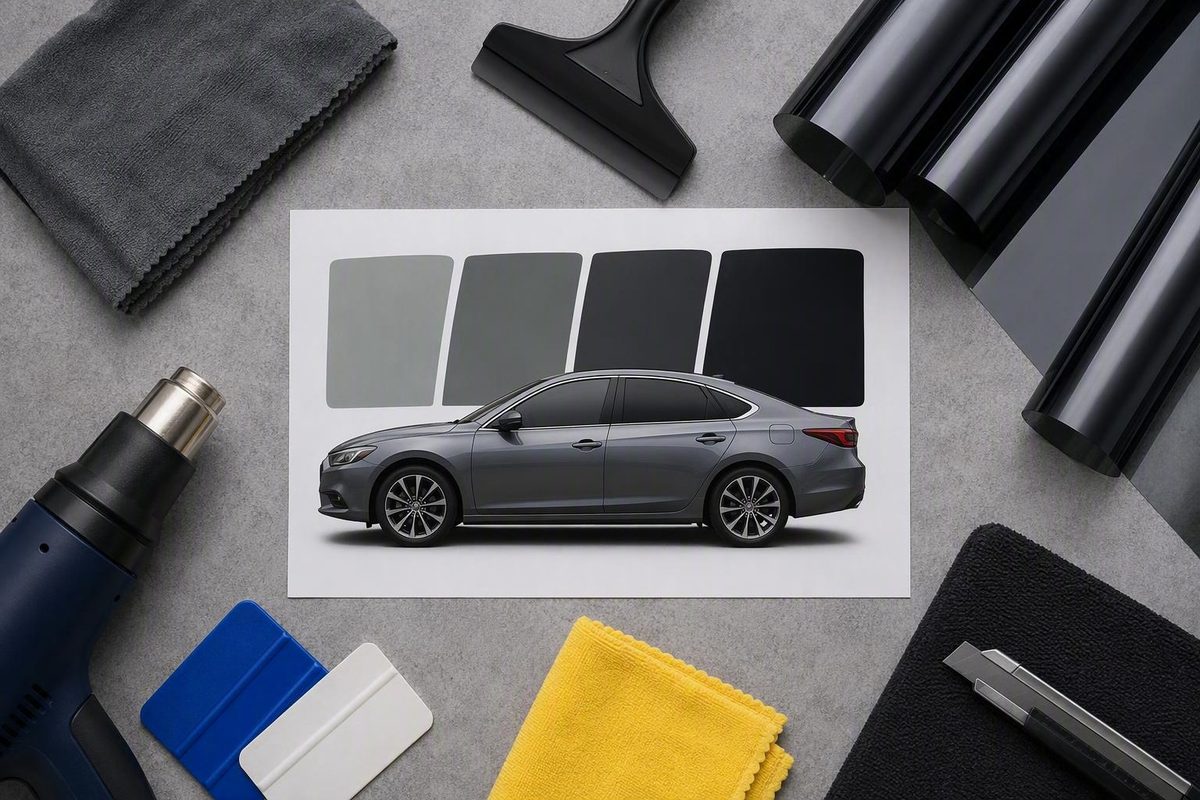
Kentucky tint summaries commonly report three key numbers: 35% VLT for windows beside the driver, 18% for passenger-car glass behind the driver, and 8% for applicable rear glass on qualifying multipurpose vehicles. Those are useful screening figures, but they are not a definitive statement of current law.
This guide is based on secondary sources reviewed through August 21, 2026. The supplied research does not include readable, current versions of KRS 189.110, KRS 189.990, or the final codified language associated with Senate Bill 46. It also reveals conflicts involving vehicle classifications, exact threshold wording, reflectivity, measurement variance, medical exemptions, and penalties.
Reporting from 2024 describes Senate Bill 46 as expanding Kentucky’s windshield provision, but the amendment’s present codification and practical scope should be confirmed from official Kentucky materials before installing windshield film.
Kentucky tint limits at a glance
Secondary-source reading as of August 21, 2026—not a definitive quotation of current Kentucky law: A 2023 Kentucky law-firm summary reports more than 35% VLT beside the driver, more than 18% on passenger-vehicle rear glass, and more than 8% on multipurpose-vehicle rear glass. Review the reported window-by-window limits.
| Window | Passenger car | Qualifying multipurpose vehicle |
|---|---|---|
| Windshield above the manufacturer’s AS-1 line | Nonreflective material commonly reported as allowed | Nonreflective material commonly reported as allowed |
| Windshield material described in 2024 reporting | At least 70% combined light transmission with the windshield glazing; not red or yellow | At least 70% combined light transmission with the windshield glazing; not red or yellow |
| Windows beside or adjacent to the driver | Commonly reported threshold: 35% VLT | Commonly reported threshold: 35% VLT |
| Rear side windows | Commonly reported threshold: 18% VLT | Commonly reported threshold for applicable glass: 8% VLT |
| Rear window | Commonly reported threshold: 18% VLT | Commonly reported threshold for applicable glass: 8% VLT |
A 2024 Lexington Herald-Leader report gives the 35%, 18%, and 8% figures and quotes Senate Bill 46 language describing windshield material that, when used with the windshield’s safety glazing, has light transmittance of at least 70% and is not red or yellow. The report was published while the legislation was awaiting its expected effective date, so its account should be checked against the enacted and currently codified law. Read the 2024 report on Senate Bill 46.
The reported 8% threshold is vehicle-class dependent. Do not assume that every vehicle marketed as an SUV, crossover, pickup, van, camper, or RV necessarily falls within the controlling legal category.
The table also separates two reported windshield concepts:
- The traditional AS-1 allowance: Secondary summaries consistently recognize nonreflective material above the manufacturer-marked AS-1 line.
- The reported 70% provision: The 2024 reporting describes material that, together with the windshield’s safety glazing, must transmit at least 70% of visible light and cannot be red or yellow.
The available evidence does not establish that every product labeled “70%” may cover an entire windshield. It also does not settle whether the newer material may always be combined with a darker AS-1 strip.
Exact wording matters. Secondary sources alternate among “at least,” “more than,” and “no less than” when stating the reported thresholds. Whether a reading of exactly 35%, 18%, or 8% satisfies current Kentucky law depends on the controlling text, any legally recognized variance, and the applicable test procedure.
What VLT means—and why the film label is not the final reading
Visible light transmission, or VLT, is the percentage of visible light that passes through a window. Lower VLT means darker glass:
- 8% VLT is darker than 18%.
- 18% VLT is darker than 35%.
- 35% VLT is darker than 70%.
Mathematical illustration—not Kentucky’s official meter procedure: Suppose untreated glass transmits 80% of visible light and the proposed film transmits 35%. Basic multiplication gives:
0.80 × 0.35 = 0.28
The estimated combined transmission is approximately 28% VLT, not 35%.
This simplified illustration does not reproduce an official enforcement test. It does not account for every optical variable, meter characteristic, installation difference, or measurement protocol. It shows only why “35% film” and “a finished window measuring 35%” are not equivalent.
The same principle applies to windshield material. If a hypothetical windshield transmits 80% and a film transmits 70%, the basic estimate is:
0.80 × 0.70 = 0.56
That equals approximately 56% combined VLT. A film marketed as “70%” therefore does not necessarily meet a standard requiring at least 70% through the completed film-and-windshield assembly.
This distinction is especially important near a legal boundary.
A prudent pre-installation process is to:
- Measure the untreated glass.
- Estimate the completed VLT using the glass and film transmission figures.
- Choose a product that leaves a practical margin above the reported threshold.
- Test the completed glass-and-film assembly with a suitable tint meter.
- Record the reading for each regulated window.
These steps are risk-reduction practices, not a representation of Kentucky’s official testing procedure.
Kentucky’s windshield rule changed in 2024
Secondary reporting says Kentucky enacted a windshield amendment in 2024, but the supplied evidence does not establish the amendment’s current codification, effective status, or every practical boundary. Until the official enacted text is reviewed, the safest description is that 2024 reporting presented Senate Bill 46 as adding a windshield option beyond the traditional AS-1 strip.
Older Kentucky tint charts generally describe only nonreflective material above the windshield’s AS-1 line. The AS-1 line is a manufacturer marking near the top of the windshield, and its exact position can vary by vehicle. It should not be replaced with an assumed universal measurement such as “the top five inches.”
The Herald-Leader quoted Senate Bill 46 as permitting windshield material used with the windshield’s safety glazing if it has light transmittance of at least 70% and is not red or yellow. The phrase “with the safety glazing materials of the windshield” indicates that the combined assembly matters, not merely the film’s advertised rating. Review the quoted Senate Bill 46 language.
The available evidence does not justify an unconditional statement that:
- every film labeled 70% qualifies;
- a specific film may cover every part of every windshield;
- a given windshield-and-film combination will meter at 70% or higher;
- a darker AS-1 strip may always be combined with the newer material; or
- identical rules apply without qualification to every specialty vehicle.
Many online charts still describe Kentucky as having an AS-1-only windshield rule. Some may predate the reported amendment, while others may have been published later without incorporating it. One law-firm article published in September 2024, for example, continued to state that tint was prohibited below the AS-1 line while listing the familiar side- and rear-window limits. See the September 2024 secondary summary.
Publication date alone therefore does not establish accuracy. Before accepting a windshield recommendation, ask the installer:
- How does this recommendation account for the 2024 legislation?
- Is the quoted percentage for the film or the completed windshield?
- What is the untreated windshield’s measured transmission?
- What will the completed windshield measure?
- What current legal text supports the proposed placement?
An answer based only on the film box or an AS-1-only chart is not enough.
Passenger cars versus multipurpose vehicles
Kentucky summaries generally separate windows beside the driver from windows behind the driver.
For windows beside or adjacent to the driver, the sources broadly report a 35% VLT threshold for passenger cars and multipurpose vehicles. For glass behind the driver, vehicle classification becomes important.
Passenger-car rear side windows and rear windows are commonly reported at an 18% threshold. Several sources report an 8% threshold for applicable rear glass on multipurpose vehicles.
That does not mean a sales description resolves the classification. Terms such as “SUV,” “crossover,” “truck,” “van,” “camper,” and “RV” may be useful consumer categories without proving which statutory definition controls. Vehicle records and manufacturer information may help identify the vehicle, but the supplied evidence does not establish that any one document conclusively determines its legal tint category.
The secondary sources also conflict directly. A 2026 TintLaws guide says SUVs, vans, and trucks may use any darkness on their rear side and rear windows. That differs substantially from several sources reporting an 8% minimum for qualifying multipurpose vehicles. The same guide says it was still re-verifying its information against statutes and agency guidance. Compare the conflicting 2026 vehicle-class summary.
Two examples illustrate why the distinction matters:
- 20% VLT on passenger-car rear glass: A window measuring 20% is lighter than an 18% window because it admits more visible light. It is therefore above the commonly reported 18% threshold, subject to the exact statutory wording and other applicable requirements.
- 8% VLT on the rear glass of an SUV or truck: This may fit the commonly reported multipurpose-vehicle threshold, but only if the vehicle and affected window legally qualify. If the passenger-car threshold applies, 8% would be substantially darker than the reported 18% requirement.
Do not rely on “any darkness” without current official confirmation. Before choosing the darker rear-glass option, compare the vehicle’s records and characteristics with the current statutory definition. If the classification remains unclear, seek written guidance from the Kentucky authority responsible for interpreting or enforcing the provision, or consult a qualified Kentucky attorney.
The reported three-point variance does not make every 35% film safe
Several secondary sources report a three-percentage-point VLT variance. Their recurring example is a window measuring 32% against a nominal 35% threshold.
A Tint Wiz summary presents that example while also alternating between “more than” a threshold and allowing readings below it. The publisher expressly warns that it does not guarantee the accuracy or currency of its material. Review the secondary account of the reported variance.
The 32% example should not be treated as settled current law. The supplied evidence does not include readable statutory language or official testing instructions establishing:
- where the variance appears in current law;
- whether it applies to every VLT threshold;
- whether it operates above and below each threshold;
- how meter accuracy is treated;
- how enforcement equipment is calibrated;
- whether readings are rounded; or
- where and how a window must be measured.
A legal variance is not the same as:
- a tint meter’s stated accuracy;
- manufacturing variation in film;
- differences in factory-glass transmission;
- installation variation;
- rounding on a meter display; or
- enforcement discretion.
Those factors can affect a reading, but they do not automatically expand the legally permitted range.
Even if the reported variance is confirmed, it is a poor installation target. A combination expected to measure exactly 32% would make compliance depend on the accuracy of every assumption.
Leave a practical margin instead. Measure the original glass, estimate the combined result, and test the completed installation. Recording the film product, measurement date, meter, and final readings is a voluntary risk-management practice unless current official rules specifically require otherwise.
If an installer says that “35% film is safe because Kentucky gives three points,” ask whether the statement concerns the film rating or the completed-window reading. Then ask for the current legal provision and testing guidance supporting the claimed variance.
Reflectivity, mirrors, certified film, labels, and colors
Darkness is only one component of reported tint compliance. A window may satisfy a VLT threshold while raising a separate issue involving reflectivity, rearward visibility, product certification, labeling, or color.
Reflectivity concerns how much light the surface reflects. It is different from VLT, which measures how much visible light passes through.
Several sources report a maximum front-side-window reflectivity of 25%. The reported rear-side limit conflicts: some sources give 25%, while a 2023 law-firm summary gives 35%. That summary also reports dual outside mirrors when the rear window is tinted, manufacturer-certified film, and a compliance sticker inside the driver-side door jamb. Review the reported reflectivity, mirror, and labeling rules.
Other summaries qualify the mirror rule by saying dual outside mirrors are required when rear-window tint limits visibility. The supplied evidence does not resolve the exact trigger, so owners should verify whether the rule applies whenever rear glass is tinted or only when rearward visibility is impaired.
Manufacturer certification and door-jamb labeling also appear repeatedly in the secondary sources. However, the evidence does not conclusively establish:
- the label’s required contents;
- whether it must state the VLT;
- who must provide or install it;
- what constitutes acceptable manufacturer certification; or
- how these duties are divided among the manufacturer, seller, installer, and owner.
Treat certification and labeling as reported requirements to verify. Ask the installer what documentation and label it provides, where the label will be placed, and which current Kentucky provision requires them.
Color restrictions require equally careful treatment. The clearest supplied account is the quoted 2024 windshield language excluding red and yellow material from the reported 70% provision. Broader third-party claims refer variously to amber, multicolored, or emergency- and signal-like colors on other windows. Those claims are too inconsistent to support one statewide rule covering every color and window.
Use this inspection checklist:
- Final VLT: Measure the completed glass-and-film assembly.
- Reflectivity: Verify the current limit separately for front and rear side windows.
- Rearward visibility: Evaluate the rear window and both outside mirrors from the normal driving position.
- Film certification: Ask what manufacturer certification accompanies the installed product.
- Door-jamb label: Confirm whether current law requires one, where it belongs, and what it must contain.
- Color: Apply the reported red-and-yellow windshield restriction cautiously and verify any broader color rule.
- Documentation: Retain product and measurement records as a voluntary compliance aid.
Do not assume that a film is lawful for a specific vehicle merely because a Kentucky retailer sells it.
Medical exemptions and penalties remain disputed in secondary sources
The available secondary sources do not agree on whether Kentucky authorizes darker tint for medical reasons.
A September 2024 law-firm summary says Kentucky allows no medical tint exemptions. Read the no-exemption position. By contrast, a 2026 TintLaws page says a medical exemption is available for a qualifying condition and that physician certification is typically required, while directing readers to confirm the process with Kentucky State Police. Read the conflicting exemption account.
Neither position should be treated as established current law from the supplied evidence. A recent publication date does not prove that a page reflects current statutes, regulations, forms, or agency practice.
If you need darker film for medical reasons:
- Contact the appropriate Kentucky authority before installation.
- Ask whether a tint exemption or accommodation currently exists.
- Request the controlling statute, regulation, form, or written instructions.
- Confirm who and which vehicle would qualify.
- Confirm the authorized windows and VLT levels.
- Ask what documentation, if any, must remain in the vehicle.
- Do not rely solely on an installer’s assurance or a general physician recommendation.
A medical need and legal authorization are different questions. A clinician may document a medical condition, but only the controlling Kentucky process can establish whether that documentation changes a vehicle-equipment requirement.
Penalty accounts also conflict. The 2024 Herald-Leader report attributes a $20–$100 fine to KRS 189.990 and describes a Class B misdemeanor. Other articles discuss a general maximum fine of up to $250, possible jail exposure for repeat violations, or a correction procedure. A 2026 law-firm article presents several of those outcomes using qualified terms such as “may” and “could.” Review the qualified penalty account.
The relevant charge, statutory subsection, circumstances, citation history, and court procedure may matter.
The supplied evidence does not establish:
- mandatory jail;
- a guaranteed correction period;
- a universal “fix-it ticket” procedure;
- license points;
- a predictable insurance consequence; or
- one penalty that applies to every tint violation.
The narrowest supported conclusion is that noncompliant tint may lead to enforcement and may have to be removed or corrected. The exact charge and consequence should be checked against current KRS 189.110, KRS 189.990, and the facts stated on the citation.
How to verify tint before installation or after buying a used vehicle
Verification is most useful before money changes hands or before a vehicle with questionable tint is put into regular use.
Before installation
- Identify the possible legal vehicle class. Do not rely only on whether the vehicle looks like an SUV, truck, van, or passenger car.
- Map the windows. Separate the windshield, windows beside the driver, rear side windows, and rear window.
- Locate the AS-1 marking. Use the manufacturer’s actual mark rather than an assumed number of inches.
- Measure the untreated glass. Record the starting VLT for each window that will receive film.
- Estimate combined VLT. Multiply the glass and film transmission figures as a screening calculation.
- Leave a practical margin. Do not design the installation around an unverified variance.
- Address the reported 2024 windshield provision. Ask how the existing glazing and proposed material will achieve the required combined result.
- Check reflectivity and color separately.
- Measure after installation. Test each regulated window rather than relying on the film label.
Ask the installer to provide or record:
- the film manufacturer and product line;
- the nominal film VLT and reflectivity;
- any manufacturer certification represented as applicable in Kentucky;
- untreated-glass readings, if taken;
- final readings for each regulated window;
- the meter and measurement date; and
- any reported compliance label placed in the driver-side or left door jamb.
Unless confirmed by current law, treat this documentation as prudent recordkeeping rather than a complete list of legally required records. An installer’s experience can be useful, but an installer cannot guarantee how a statute will be interpreted or how a particular enforcement test will read.
After buying a used vehicle
A prior owner’s installation does not prove that the tint satisfies current Kentucky requirements. Audit the vehicle as though the film were being installed now:
- Measure every side window and the rear window.
- Test the windshield if it has material below the AS-1 area.
- Locate the actual AS-1 marking.
- Inspect the driver-side door jamb for a compliance label.
- Check the film for substantial reflectivity or potentially restricted colors.
- Confirm that both outside mirrors provide usable rearward views.
- Investigate the vehicle’s legal classification before relying on the reported 8% rule.
- Retain available product and measurement records.
Dealership inventory, an out-of-state registration history, or years without a citation do not establish present compliance.
Before installing, purchasing, or continuing to use questionable tint, review the current official versions of KRS 189.110 and KRS 189.990, plus the enacted record and current codification associated with Senate Bill 46 from the 2024 Regular Session. Use the Kentucky General Assembly’s official statute and legislative-record pages rather than relying exclusively on a tint chart. If the official text remains unclear, seek written agency guidance or advice from a qualified Kentucky attorney.
Secondary sources reviewed: August 21, 2026
Change log:
- August 21, 2026: Reframed the guide as a secondary-source review. The reported 2024 windshield amendment is treated separately from older AS-1-only summaries. Conflicts involving vehicle classification, reflectivity, variance, medical exemptions, colors, labeling, and penalties remain identified for official verification.
Window Tint Central provides general information, not legal advice. Tint laws vary by state and change over time; readers should verify current requirements before installation, as explained in the site’s terms and general-information disclaimer.
Is 20% tint legal on front side windows in Kentucky?
It appears substantially darker than the commonly reported 35% threshold for windows beside the driver, so it should not be treated as compliant without contrary official authority.
The relevant number is the completed glass-and-film VLT—not merely a film advertised as 20% or 35%. Verify the current statutory wording and meter the completed window.
Can you tint the full windshield in Kentucky at 70% VLT?
Do not assume so merely because a product is labeled 70%. The 2024 reporting describes material that, together with the windshield’s safety glazing, transmits at least 70% of visible light and is not red or yellow.
The supplied evidence does not conclusively establish every placement detail, confirm that every full-windshield application qualifies, or establish whether a darker AS-1 strip may always be combined with the newer option. Check the enacted and currently codified text and measure the completed windshield.
Is 5% tint legal on the rear windows of a Kentucky SUV or truck?
Do not assume that it is. Several sources report an 8% threshold for applicable rear glass on qualifying multipurpose vehicles. A 5% window is darker than an 8% window because it transmits less visible light.
One 2026 guide instead claims that any rear darkness is allowed for SUVs, vans, and trucks, but that conflicts with several other summaries. The answer depends on the current statutory language, the legal vehicle class, and the affected window—not merely the vehicle’s marketing label.
Does Kentucky allow a three-percentage-point tint variance?
Several secondary sources say yes and use a 32% reading against a nominal 35% threshold as an example. The supplied evidence does not establish the variance’s current legal source, scope, or official test procedure.
Do not use 32% as an installation target. Leave a margin, measure the completed window, and confirm whether any variance applies to the relevant threshold and enforcement device.
Can you get a medical exemption for darker window tint in Kentucky?
The secondary evidence conflicts. Some sources say Kentucky has no medical tint exemption, while newer pages say qualifying drivers may be able to obtain authorization supported by physician documentation.
Do not install darker film based on either position alone. Obtain current written guidance from the appropriate Kentucky authority confirming whether an exemption exists, who qualifies, which windows it covers, the authorized VLT, and what documentation is required.
Final compliance checklist:
- Identify the vehicle’s applicable statutory class.
- Evaluate each window separately.
- Use combined glass-and-film VLT, not the film label alone.
- Locate the actual AS-1 marking.
- Confirm the current windshield provision.
- Test the completed installation.
- Verify reflectivity, color, mirrors, certification, and labeling separately.
- Keep product and measurement records.
- Confirm disputed requirements through current official Kentucky sources.
The familiar 35%, 18%, and 8% figures are useful starting points. They are not an unqualified legal verdict for every window, meter reading, or vehicle.