
Where 50% Front-Window Tint Became Legal in 2026
See Iowa and Delaware’s 2026 front-side tint changes, effective dates, unchanged window rules, and a calculator for finished glass-and-film VLT.
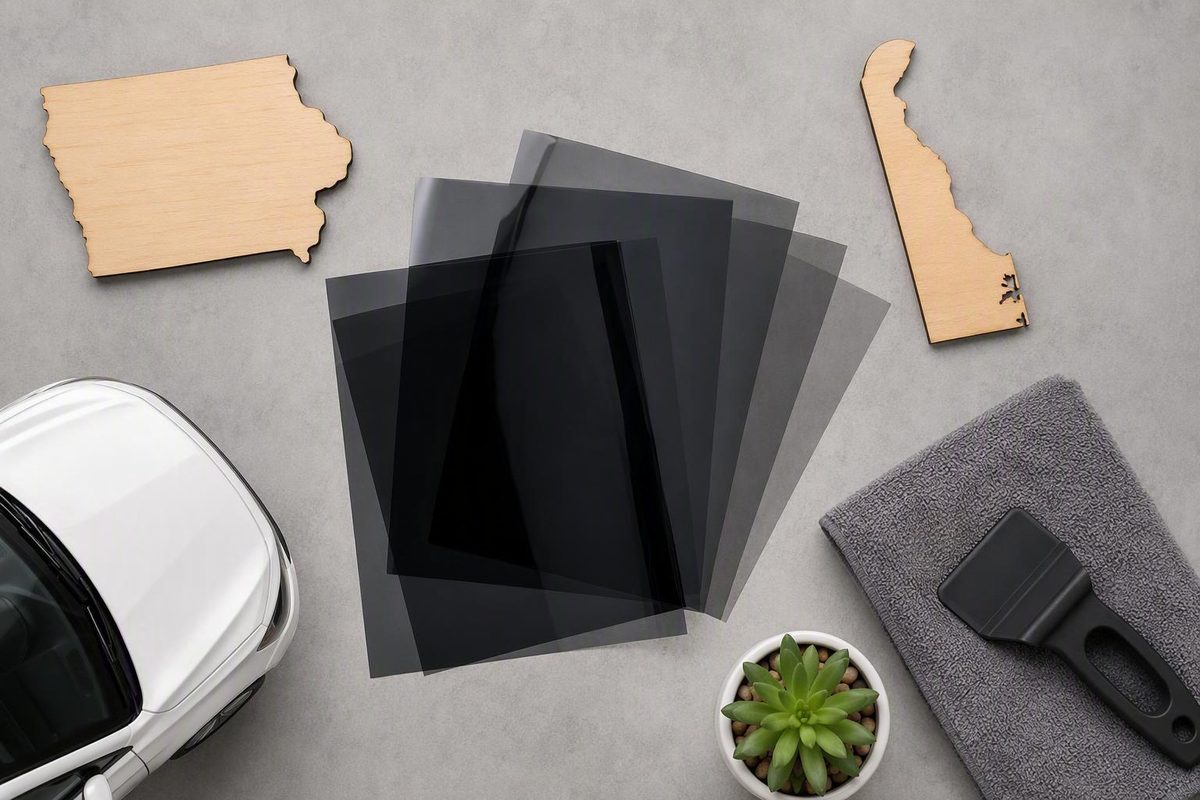
Iowa and Delaware loosened their front-side-window tint limits in 2026. Iowa HF 766 took effect July 1, and Delaware SS 1 for SB 255 took effect August 17; both lowered the general minimum from 70% to 50% visible light transmission (VLT) without requiring a medical waiver. The change means a finished front side window measuring from 50% through 69% VLT may now satisfy the new numerical limit even though it failed the former 70% rule. Iowa’s windshield minimum remains 70%, Delaware’s windshield rule did not change, and neither measure created a new rear-window limit.
Choose Iowa or Delaware, then enter the factory-glass and film ratings for each window.
Select a state and change the factory-glass and film VLT values. Net VLT is an approximation; compare the completed window with the old and new thresholds.
Effective July 1, 2026. Front side windows moved from 70% to 50%; the windshield remains at 70%.
| Window | Glass VLT | Film VLT | Net VLT | Old Rule | New Rule | Medical Statement |
|---|---|---|---|---|---|---|
| Windshield | 56.0% | Fail 70% | Fail 70% | Verify an exception | ||
| Front side windows | 56.0% | Fail 70% | Pass 50% | Old: needed; now: no | ||
| Forward side wings | 56.0% | — | Pass 50% | Now: no | ||
| Rear windows | 56.0% | — | No new limit shown | — |
Default example: 80% glass with 70% film gives ~56% net VLT. It fails the old 70% front-side rule but passes the new 50% rule without a medical statement.
Effective August 17, 2026. Front side windows moved from 70% to 50%; the windshield did not change.
| Window | Glass VLT | Film VLT | Net VLT | Old Rule | New Rule | Medical Statement |
|---|---|---|---|---|---|---|
| Windshield | 56.0% | Fail 70% | Fail 70% | Verify an exception | ||
| Front side windows | 56.0% | Fail 70% | Pass 50% | Old: needed; now: no | ||
| Side wings | 56.0% | — | Pass 50% | Now: no | ||
| Behind driver/rear | 56.0% | — | No VLT minimum under act | No for this VLT floor |
Default example: 80% glass with 70% film gives ~56% net VLT. It fails the old 70% front-side rule but passes the new 50% rule without a medical statement.
A passing result covers only the displayed VLT threshold. Windshield placement, reflectivity, vehicle class, meters, tolerances, and other equipment rules may still apply.
Sources: Iowa HF 766 enrolled text and KCCI effective-date reporting; Delaware official bill record for SS 1 to SB 255. The ~80% glass example is illustrative.
The Two Effective 2026 Changes
The reviewed records establish effective front-side-window changes in two states. This is a focused tracker of those measures, not a claim that every 2026 tint-related action in all 50 states has been cataloged.
| State | Former Minimum | New Minimum | Effective Date |
|---|---|---|---|
| Iowa | 70% VLT | 50% VLT | July 1, 2026 |
| Delaware | 70% VLT | 50% VLT | August 17, 2026 |
Iowa HF 766 applies the 50% minimum to the side windows immediately beside the driver and to side wings forward of the driver. It retains a 70% light-transmittance requirement for the windshield. The official enrolled text of HF 766 contains the window-specific thresholds, while KCCI’s guide to Iowa laws taking effect July 1 provides the effective-date reporting.
Delaware’s Senate Substitute 1 for Senate Bill 255 applies the new 50% minimum to front side windows and side wings. The official Delaware legislative record lists the measure as Volume 85, Chapter 425 and records its signature and effective date as August 17, 2026. A CoastTV report also describes the reduction from 70% to 50%.
The new 50% limits are general limits. A driver does not need a medical statement merely to use tint that leaves the covered front side windows at 50% VLT or higher. Tint below 50% does not meet the new general threshold; whether a separate medical exception permits it must be checked under the current state rules.
Film That Was Illegal in Spring May Be Legal Now
A finished front side window that measures at least 50% but less than 70% VLT is the clearest example of tint affected by these laws. It failed the former 70% general minimum but meets the new 50% minimum after the applicable effective date.
The effective date controls. In Iowa, that window did not become compliant under HF 766 before July 1. In Delaware, the corresponding change did not apply before August 17. A bill’s passage, enrollment, or announced signature does not authorize darker tint before its operative date.
A finished window below 50% still fails the new general front-side limit. A window at exactly 50% is on the numerical boundary, so choosing film solely by its advertised rating creates little room for the factory glass, meter results, or any applicable testing rules.
The change also does not retroactively prove that a spring citation or inspection result was wrong. The relevant question for an earlier event is the law in force when that event occurred.
Net VLT, Not the Film Label, Determines the Result
Visible light transmission is the share of visible light that passes through the completed window. Lower percentages mean darker glass.
The percentage printed on a film package is not normally the finished-window percentage. Factory glass already blocks some light, and adding film reduces transmission again. Approximate net VLT equals factory-glass VLT multiplied by film VLT and divided by 100.
For example, factory glass transmitting approximately 80% of visible light combined with film rated at 70% produces approximately 56% net VLT. That finished combination would fall below the former 70% front-side minimum but above the new 50% minimum.
The 80% glass figure is only an illustration. The supplied records do not establish a standard factory-glass rating for every vehicle, nor do they establish identical meters, tolerances, testing procedures, or rounding rules in Iowa and Delaware. The vehicle’s actual glass-and-film combination should be measured rather than inferred from the film label alone.
This distinction matters even with film labeled 50%. Applying 50% film to glass that transmits less than 100% produces a finished result below 50%. A product marked with the legal minimum therefore does not guarantee a legal completed window.
Iowa HF 766 Changes the Driver-Side Window Rule
HF 766 establishes at least 50% light transmittance for the side windows immediately to the driver’s right or left. It also sets a 50% minimum for side wings forward of and to the driver’s left or right.
The windshield remains subject to a 70% minimum. A net result of 50% to 69% may pass on the covered side windows while failing on the windshield. The new side-window number should never be transferred to the windshield.
The measure directs the department to adopt rules establishing a measurable transparency standard. It also contains an exception for vehicles owned or leased by a federal, state, or local law-enforcement agency when operated as part of official duties. That exception does not extend to an ordinary privately owned vehicle.
HF 766 does not establish a new rear-window percentage in the reviewed material. That means the 2026 change should be described narrowly: the windshield stays at 70%, specified front side windows and forward side wings move to 50%, and the measure does not supply a new rear-window rule.
Delaware’s 50% Rule Covers Front Sides and Side Wings
Delaware’s act lowers the general minimum for front side windows from 70% to 50% and applies the 50% threshold to side wings. A finished front side window at or above 50% therefore satisfies that particular numerical requirement without medical documentation.
For side windows behind the driver and the rear window, the act states that no VLT minimum applies under the act. That is not a blanket statement that any material or installation is lawful. It addresses the VLT floor, not every other vehicle-equipment rule.
The measure does not establish changes to windshield tint, reflectivity, prohibited materials, mirror requirements, inspection procedures, measurement tolerances, or penalties in the supplied evidence. Those issues must be checked separately in the current Delaware Code and applicable agency guidance.
The act also addresses vehicles operated by law-enforcement officers. That provision should be read according to its stated scope rather than treated as an exception for private vehicles or every government-owned vehicle.
Windshield and Rear-Window Rules Did Not Become 50%
Neither 2026 change makes 50% a universal whole-vehicle limit.
In Iowa, the windshield remains at 70% while the specified side windows and side wings move to 50%. The reviewed measure does not document a new rear-window threshold.
In Delaware, the amendment concerns front side windows and side wings. The windshield rule did not change. Windows behind the driver and the rear window have no VLT minimum under this act, but that treatment was not created as a new 50% rule.
Installers and owners should keep the window positions separate:
- A 56% finished front side window may pass the new 50% threshold.
- The same 56% result does not satisfy a 70% windshield minimum.
- A rear window cannot be evaluated by copying the front-side number.
- Side wings are expressly covered by the new 50% language in both measures.
Vehicle classification and other equipment provisions may also affect the final legal result. The supplied records do not provide enough information to state every applicable rule for passenger cars, multipurpose vehicles, commercial vehicles, or vehicles registered in another jurisdiction.
Medical Documentation Is Not Needed for 50%–69% Front Tint
Before these changes, a driver seeking front-side tint below the general 70% minimum could not rely on the ordinary numerical rule. Medical documentation was relevant where state law provided an applicable medical exception.
After the effective date, a finished front side window measuring from 50% through 69% meets the new general VLT threshold in Iowa or Delaware. A medical statement is not required merely because that window is darker than 70%.
That does not mean a medical statement automatically legalizes tint below 50%. The current exemption requirements, qualifying conditions, forms, vehicle restrictions, and documentation rules must be verified separately. The reviewed measures do not support a universal answer for every sub-50% installation.
New York, Virginia, and Georgia Are Not Confirmed Changes Here
The records supplied for New York, Virginia, and Georgia do not establish additional effective 2026 limits.
A commercial New York report said S9226/A5306 passed both legislative houses and proposed reducing the minimum from 70% to 50% on every window except the windshield. The same dated report said the measure remained unsigned as of late July 2026. That snapshot does not establish whether later executive action occurred, so the proposed limit should not be treated as effective without current official confirmation.
Virginia SB12 was introduced and included Virginia Code § 46.2-1052 among several statutes. The reviewed material did not establish a new VLT percentage, final passage, gubernatorial approval, or an effective date. Mentioning a tint statute in an introduced bill is not proof that the state changed its limit.
The Georgia material was a commercial overview that identified no specific 2026 bill, session law, amendment, or effective date. A webpage carrying a 2026 label does not by itself prove that the underlying statute changed that year.
Those states are excluded from the effective-change table because the supplied evidence does not complete the necessary chain from proposed language to enactment and effective date. That is different from claiming no later action occurred.
What to Verify Before Installing 50% Film
For Iowa or Delaware front side windows, first calculate the finished VLT rather than relying on the film package. Confirm that the relevant effective date has passed, identify the exact window position, and have the installed combination measured when practical.
Check the current statute and motor-vehicle guidance for rules beyond darkness, including windshield placement, reflectivity, colors or materials, mirrors, inspection procedures, certificates, stickers, and medical-exemption paperwork. The supplied evidence does not give figures for all of those requirements.
A 50% film product is particularly risky if the goal is a 50% finished minimum because factory glass reduces the net result. The legal comparison is against the completed window, not an isolated roll of film.
For a window that measures from 50% through 69%, the 2026 change resolves the central question: it can meet the new general front-side VLT limit in Iowa after July 1 and in Delaware after August 17 without a medical waiver. Windshields, rear windows, and installations below 50% require separate analysis.