
Iowa’s Tint Limits Apply to Glass and Film Together
See Iowa’s current tint limits by window, calculate finished VLT, and check the July 2026 changes, medical exemption restrictions and scheduled fine.
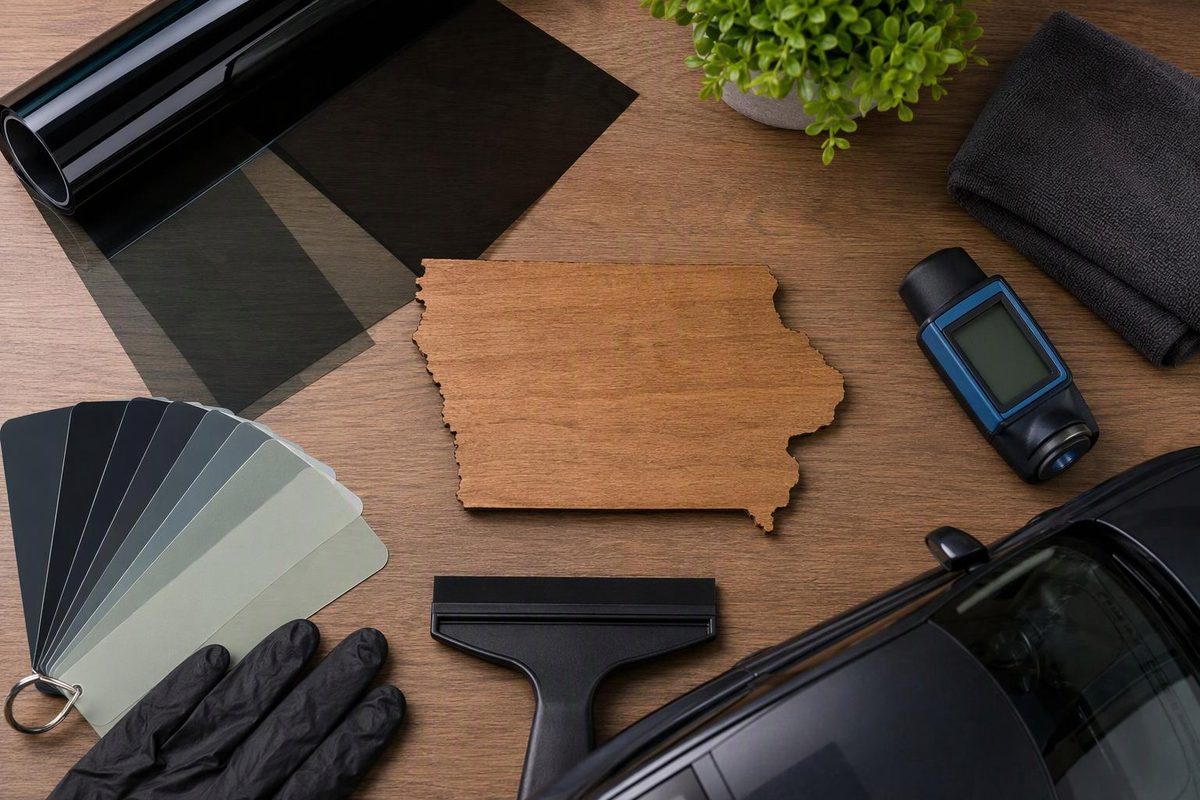
Iowa requires at least 50% visible light transmission (VLT) through the front side windows and at least 70% through the windshield. Rear side windows and the rear window may use any tint darkness, according to the Iowa Department of Transportation’s current tint guidance.
These limits apply to the finished glass-and-film combination—not the percentage printed on a film box. Film sold as “50% tint” can leave your front side windows below Iowa’s legal minimum when installed over factory glass.
Choose your front window and enter the glass and film VLT percentages to estimate the finished result.
Estimate Your Finished Front-Window VLT
Estimated finished VLT
~56%
Meets Iowa’s 50% front-side floor by this estimate.
6 percentage points above the state minimum.
A meter reading is needed to confirm the completed window. This is not approval for a professional installation; federal restrictions still apply.
Enter percentages from 0 to 100. The default 80% glass and 70% film are an example, not measurements of your car. Without JavaScript, only that example is shown.
Sources: Iowa DOT tint guidance and HF 766 for state limits; NHTSA window-film guidance for combined transmission. Estimate: glass VLT × film VLT ÷ 100.
Iowa Requires 50% Front-Side VLT and 70% Windshield VLT
VLT measures how much visible light passes through a window. Lower percentages mean darker glazing.
| Window Position | Current Iowa Requirement |
|---|---|
| Front windshield | At least 70% VLT |
| Driver and front passenger side windows | At least 50% VLT |
| Sidewings forward of and to the left or right of the driver | At least 50% VLT |
| Rear side windows | Any tint darkness permitted |
| Rear window | Any tint darkness permitted |
The front-window limits come from House File 766; the rear-window guidance comes from Iowa DOT. These state rules do not set separate passenger-car and SUV front-window percentages. Iowa also retains a general requirement that windshields and windows permit clear vision under section 321.438(1).
A 35%, 20% or 5% finished-VLT front side window is not legal for ordinary road use in Iowa. Those darkness levels are permitted on rear windows under DOT’s guidance, but permission to use dark rear tint does not remove the clear-vision requirement.
For windshield work, use the 70% requirement as your starting point. The front-side change does not permit a dark full windshield. Do not assume another state’s AS-1 visor-strip rule applies in Iowa; confirm a proposed strip with Iowa DOT before installation.
The Front-Side Limit Changed on July 1, 2026
House File 766 lowered the front-side minimum from the previous 70% standard to 50%, while retaining a 70% windshield minimum. Governor Kim Reynolds signed it on May 15, 2026, and the official legislative history records July 1, 2026, as its effective date.
Older charts showing 70% for Iowa’s front side windows reflect the earlier rule. Use the updated DOT guidance rather than an undated tint chart. Our 2026 tint-law change tracker compares Iowa’s change with Delaware’s.
A 50% Film Can Produce an Illegal Front Window
Glass and film both reduce light transmission. NHTSA’s window-film guidance explicitly distinguishes combined glazing-and-film transmission from film transmission alone.
For planning, finished VLT ≈ glass VLT × film VLT ÷ 100.
Assuming your bare front side glass measures 80% VLT:
| Film VLT | Estimated Finished VLT | Meets 50% State Floor? |
|---|---|---|
| 50% | 40% | No |
| 70% | 56% | Yes, by this estimate |
These are calculations, not measured installation results. The calculator uses the same approximation. An estimated result at or above the minimum is not proof that a completed window complies.
Have the bare glass metered before choosing film, leave room above the applicable minimum, and check the completed window. A shade name does not establish finished VLT, and the cited guidance does not supply an enforcement tolerance to use as a safety margin.
For more examples of film shade versus finished darkness, see our 35 percent tint guide. Keep heat-control claims separate from VLT: compare film performance specifications rather than assuming the darker option is better.
Iowa’s State Limit Does Not Waive Federal Installer Restrictions
Passing Iowa’s road-use limit does not settle a professional installer’s obligations. NHTSA explains that manufacturers, distributors, dealers and repair businesses may not install tint that reduces windows covered by Federal Motor Vehicle Safety Standard No. 205 below its 70% transmission requirement.
NHTSA distinguishes those business restrictions from owner modifications and state operating rules. A front side window estimated at 56% VLT clears Iowa’s 50% state floor, but that calculation does not establish that a business may legally perform the installation.
Ask the installer how the proposed job complies with both sets of requirements. Iowa’s 50% limit does not itself waive the federal requirement.
Medical Exemptions Are No Longer Authorized
Iowa DOT says new medical tint exemptions cannot be granted, and previously approved exemptions are no longer authorized as of July 1, 2026. It also says the old Form 432020 is unavailable and cannot be replaced. A physician’s note or an old exemption form is therefore not a current route to darker front glazing. See the Iowa DOT medical-exemption FAQ.
If UV protection is your priority, DOT points to nearly transparent UV-blocking films as an alternative. The finished window must still meet the applicable VLT requirement; a UV-blocking claim does not establish legal light transmission.
A Tint Violation Carries a $70 Scheduled Fine
Iowa’s scheduled fine for a section 321.438 violation is $70 under section 805.8A(3)(ai). That is the scheduled fine, not a guaranteed all-in ticket total. The cited draft sources do not provide an all-in total.
A separate registration consequence is also possible. DOT says law enforcement may request suspension of registration and plates for an unsafe or mechanically unfit vehicle. If DOT sends a suspension notice, its guidance gives you 20 days to appeal or return the law-enforcement-certified compliance form. Follow the notice’s instructions; that deadline is not a general grace period for every tint ticket. See the Iowa DOT enforcement FAQ.
Before paying for tint—or keeping tint already on a used car—have the front windows measured. Specify a compliant finished VLT in the work order, confirm the installer’s federal obligations, and verify the current rules with Iowa DOT before installation.