
What New York Drivers Should Do While the 50% Tint Proposal Is Unresolved
The reviewed record cannot confirm a signature or veto. Before installing 50% film, verify official action, the effective date and live DMV guidance.
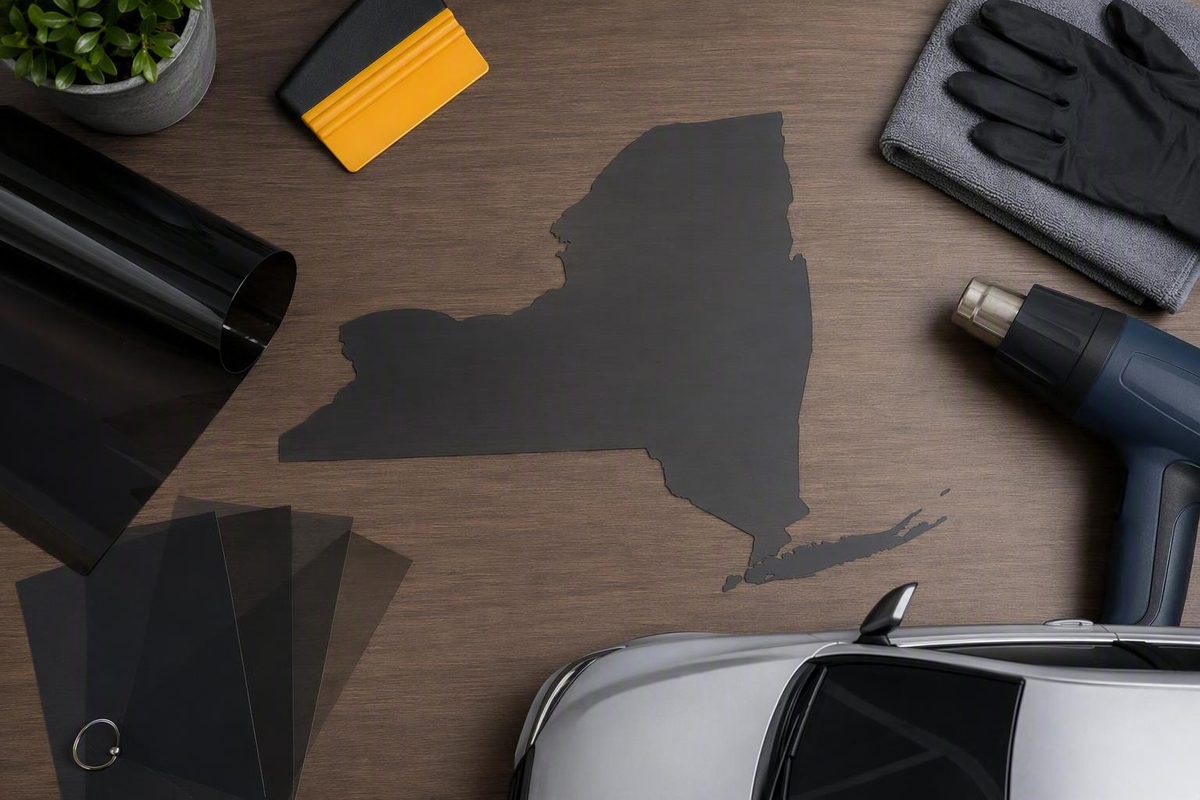
The reviewed records do not establish whether Governor Kathy Hochul ultimately signed or vetoed New York’s proposed 50% VLT bill. They show that S9226/A5306 passed the Legislature and was awaiting gubernatorial action when the official bill record was retrieved, but they do not confirm what happened afterward. They also do not support predicting how the governor would act.
For drivers, that means legislative passage alone is not enough reason to install 50% film. Before choosing tint, verify the live official bill status, determine whether any enacted change has reached its effective date and check the New York DMV’s live guidance for the relevant vehicle and window positions.
The short answer: a signature cannot be predicted or confirmed from this record
The official New York Senate record for S9226 showed the proposal awaiting the governor’s action when that page was retrieved. The record does not establish that this remained the bill’s status on September 20, 2026, and it offers no evidence about whether Governor Hochul intended to sign or veto it.
Passing both legislative chambers and becoming effective law are separate events. Even if a governor signs a bill, its provisions may not take effect immediately. In this case, the cited proposal says it would take effect 60 days after becoming law.
The reviewed DMV guidance publishes a requirement that at least 70% of outside light pass through specified vehicle windows. Because the evidence does not confirm a subsequent gubernatorial action, effective date or revised DMV rule, it cannot support a claim that 50% VLT is legally effective now.
A secondary report from a New York tint shop reached the same limited conclusion in late July 2026: S9226/A5306 had not been signed at that time, and the shop said the existing 70% requirement still applied. That dated Auto Images account cannot establish the bill’s status after late July, but it illustrates why an older article or installer summary should not be treated as a live legal check.
The practical answer is therefore not a prediction: do not choose 50% film merely because someone says New York “passed the tint law.” Check for an official gubernatorial action and effective date immediately before installation.
How S9226/A5306 reached the governor’s stage
S9226, sponsored by Senator Jeremy Cooney and substituted by Assembly bill A5306, is the relevant 2026 proposal in the reviewed official record. Its documented legislative timeline is:
- February 18, 2026: S9226 was introduced.
- April 21, 2026: The Senate Transportation Committee advanced it.
- June 2, 2026: The Senate passed it by a 50–11 vote.
- At the time of retrieval: The official record displayed the measure as awaiting the governor’s action.
These dates, the Senate vote and the substitution by A5306 appear in the official S9226 legislative history.
The International Window Film Association reported on June 3, 2026, that the Assembly and Senate had approved the proposal and that it would be sent to Governor Hochul. IWFA had advocated for the legislation, and its announcement acknowledged that a gubernatorial signature was still needed. It therefore documents the organization’s account of legislative passage, not a subsequent signature, veto or enactment.
Four stages should not be collapsed into one:
- The Assembly and Senate approve a bill.
- The bill is formally delivered to the governor.
- The governor acts, or another outcome occurs under the applicable legislative process.
- An enacted measure reaches the effective date specified in its final text.
The supplied evidence does not identify a delivery date. No delivery date or later gubernatorial action should be inferred from a report that both chambers passed the proposal.
The rule drivers should use before choosing film
The reviewed New York DMV tinted-windows guidance says at least 70% of outside light must pass through the windshield and front side windows. It also applies the 70% requirement to rear side windows on passenger cars. For the rear window, the guidance describes an exception for vehicles equipped with dual side mirrors. That rear-window exception should not be extended to front or rear side windows or assumed to apply identically across vehicle classes.
DMV also says examination of tinted windows has been part of New York vehicle inspections since January 1, 2017. Vehicle type, window position and mirror configuration can affect how the published rules apply.
Use the following sequence when making an installation decision:
| Situation you verify | Meaning | Installation decision |
|---|---|---|
| No enactment is verified | Legislative passage alone has not established an effective 50% rule | Follow the live DMV guidance |
| A signature is verified, but the proposal’s 60-day period has not elapsed | The proposed text provides for delayed effectiveness | Do not assume the 50% threshold is effective |
| Effective law and updated official instructions are verified | The required legal process has been completed | Follow the final enacted text and DMV instructions |
The middle row describes the effective-date provision in the reviewed proposal. If the bill was enacted, the final enrolled or chaptered text should be checked rather than assuming that every provision remained unchanged.
Do not treat a film label as proof that a vehicle will comply. The supplied records do not establish that nominally labeled 50% film guarantees a compliant finished measurement or that a vehicle fitted with it will pass inspection. Ask the installer what result will be measured on the completed window, but rely on the applicable official standard rather than a product label or verbal assurance.
What the proposed 50% standard would change
As written in the reviewed S9226 record, the proposal would establish a 50% visible-light-transmittance standard for automobile windows other than the windshield. The proposal also includes a measurement tolerance of plus or minus seven percentage points and says it would take effect 60 days after becoming law.
The tolerance is a testing provision. It is not evidence that drivers may deliberately select a finished 43% VLT result, disregard the stated 50% standard or assume that any film marketed as “50%” will comply.
| Window position | Proposed treatment | Treatment before a change is verified |
|---|---|---|
| Windshield | No proposed 50% change established | Follow live DMV windshield guidance |
| Other automobile windows | Proposed 50% VLT standard, subject to final enacted text | Apply DMV’s published rules and vehicle-specific qualifications |
This comparison should not be read as a complete rule for every passenger car, SUV, van, truck or commercial vehicle. The reviewed evidence does not resolve how every vehicle classification and window configuration would be handled in final implementation.
That distinction matters at the tint counter. A simplified statement such as “New York changed to 50%” leaves out at least three necessary checks: whether the proposal became law, whether its effective period elapsed and how official guidance applies to the particular vehicle and window.
Do not confuse S9226/A5306 with other New York tint bills
Several New York bill numbers appear in tint-law discussions, but they are separate measures with different histories.
| Bill | Identity | Status in the reviewed record |
|---|---|---|
| S9226/A5306 | Relevant proposal for a 50% VLT standard outside the windshield | Passed the Legislature; displayed as awaiting governor action when retrieved |
| A4026 | Separate tint-safety and enforcement proposal | In the Assembly Transportation Committee |
| S04572 | Earlier light-transmittance proposal | Labeled “Dead” by BillTrack50 |
A4026 is not the proposal described above as establishing a 50% VLT standard. Its inspection language retains a 70% minimum light-transmittance threshold for front side windows and includes proposed enforcement provisions. The official A4026 record showed the bill in the Assembly Transportation Committee, with referrals dated January 30, 2025, and January 7, 2026.
S04572 is another distinct measure. The BillTrack50 entry for S04572 labels it “Dead” as of June 5, 2026 and lists “recommit, enacting clause stricken” as an earlier action. Because BillTrack50 is a third-party tracker and parts of its description are identified as AI-generated, its entry should not replace the official record for S9226/A5306.
Before paying for a 50% installation, complete these four checks:
- Open the live official S9226/A5306 record.
- Look for an official gubernatorial action and its date.
- If enactment is confirmed, check the final text and whether the stated 60-day period has elapsed.
- Recheck the live DMV tint guidance for the vehicle class and each window position.
Can a New York driver apply for a medical tint exemption while the bill’s present status is being verified?
Yes. New York DMV provides a medical-exemption process through Form MV-80W. An application is limited to qualifying medical circumstances and requires a medical statement completed by a New York-licensed physician, physician assistant or nurse practitioner. The reviewed form also requires a copy of the provider’s New York professional license and a copy of the vehicle registration.
The qualifying medical examination must have occurred within 60 days before submission. The form covers specified photosensitivity-related conditions and allows consideration of another disorder causing severe photosensitivity when direct-sun shielding is medically required and the form’s other conditions are met. Drivers should review the official DMV Form MV-80W before applying.
A legislative proposal does not itself create an individual exemption. Do not assume that a medical need authorizes darker tint unless DMV has approved the application under its exemption process.