
Should You Put Color-Shifting Film on Your Car?
Its color-shifting look may appeal, but the label proves neither heat control nor legality; check product tests, glass measurements and warranty terms.
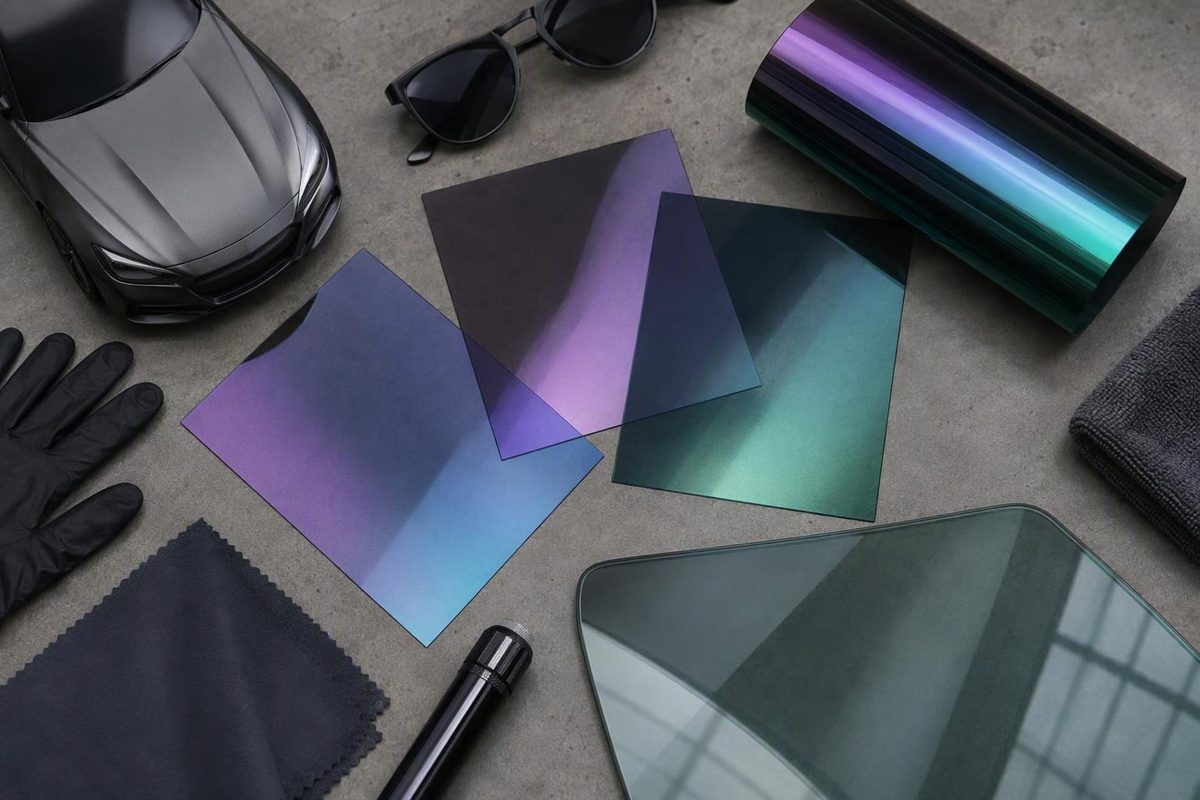
Chameleon tint is worth considering when its color-shifting appearance is the main attraction. The label alone does not establish darkness, heat control, optical clarity, durability, or legality. Before buying, inspect the exact film on glass, review product-specific test and warranty documents, verify current rules for the intended window, and have the vehicle’s glass measured before and after installation.
Related: Carbon Tint vs Ceramic Tint: Heat, Clarity and Cost.
What chameleon tint is—and why its color changes
Chameleon tint is automotive window film whose reflected color changes with lighting and viewing angle rather than remaining uniformly black, gray, or charcoal. Depending on the product, the exterior may appear blue, purple, pink, red, orange, or gold, but not every film displays every color.
Weather, surroundings, temperature, glass curvature, and the viewer’s position may also change the perceived result.
EuroLuxe, a commercial detailing and tinting business, describes some chameleon films as multilayer optical constructions with metal-oxide layers between polyester substrates. According to its explanation, those layers reflect different visible wavelengths as the viewing angle changes. It also says some products incorporate ceramic materials, meaning “chameleon” and “ceramic” are not necessarily mutually exclusive categories. These construction descriptions should not be assumed to apply to every color-shifting film.
The exterior color may also differ from the view inside. Super Tinting’s UltraVision listings describe Sunset as subtly blue from the cabin, while ClimaComfort and Optimum have faint golden interior hues. A dramatic exterior reflection can therefore coexist with a much less colorful interior view.
Inspect a physical sample from inside and outside, ideally on your vehicle, in direct sun, overcast light, and lower-light conditions. For windshield film, concentrate on the view through the glass and any distracting reflection or color cast—not just the exterior appearance.
How to read chameleon-film specifications
- VLT describes transmitted visible light.
- UV rejection describes how much of a specified ultraviolet range the seller claims the film rejects.
The supplied listings range from a seller-claimed 17% to 83%.
| Named product | Advertised VLT | Advertised IR rejection | Advertised UV rejection |
|---|---|---|---|
| A ABSOPRO blue-purple film | 17% | 93% | 99.5% |
| Cotton Candy | 70% median; 2 mil thick | Not disclosed | 99% |
| UltraVision Sunset, ClimaComfort, and Optimum | Sunset: 80% ClimaComfort: 83% Optimum: 60% |
Sunset: 50%–60% ClimaComfort: 53% average Optimum: 90% |
99% for each |
| Named product | Advertised appearance | Evidence limitation |
|---|---|---|
| A ABSOPRO | Blue-purple | Marketplace seller claims; no independent report or test method supplied |
| Cotton Candy | Pink-purple | Vendor specifications; no independent test or certification supplied |
| UltraVision Sunset | Red, orange, purple, and blue | Installer-published figures; no test method or independent report supplied |
| UltraVision ClimaComfort | Light blue; subtle golden interior hue | Installer-published figures; no test method or independent report supplied |
| UltraVision Optimum | Deep blue; subtle golden interior hue | Installer-published figures; no test method or independent report supplied |
Cotton Candy’s seller also states that VLT can vary by as much as seven percentage points across the film. A nominal or median specification may therefore differ across an installed pane, particularly when the result is checked at multiple points.
Before comparing products, request:
- TSER, reflectivity, haze, and optical-clarity figures;
- the test standard and tested film configuration;
- the wavelength range used for any infrared claim;
- supporting manufacturer or laboratory reports;
- the exact product code, thickness, and VLT;
- written warranty terms covering fading, color change, bubbling, peeling, haze, distortion, and edge lift.
Specifications for one color, VLT, formula, or production version should not be transferred to another product carrying the same broad brand or “chameleon” label.
Chameleon tint versus ceramic tint
Choose chameleon film when changing reflected color is the priority. Investigate dedicated ceramic film when documented thermal performance and a more neutral appearance are the priorities. Compare exact products rather than assuming every ceramic film outperforms every chameleon film.
Commercial sellers generally market chameleon tint around visual customization and ceramic tint around heat control. That is a useful shopping distinction, not a category-wide performance rule. Some chameleon products reportedly incorporate ceramic materials, and similar marketing labels can cover different constructions.
| Decision factor | Chameleon film | Dedicated ceramic film | Evidence to request |
|---|---|---|---|
| Appearance | Changing reflected color | Usually neutral or conventionally shaded | Installed physical sample |
| Performance emphasis | Often IR and UV claims | Often thermal-control claims | TSER, VLT, reflectivity, test method |
| Optical concerns | Color cast, reflection, haze, distortion | Haze, clarity, shade consistency | Interior inspection in varied light |
| Installation | Commercial installers report that some multilayer products are harder to shape | Difficulty varies by product and glass | Experience with the exact film and vehicle |
A credible heat comparison requires both products to be tested under comparable conditions.
The available product pages do not support a universal conclusion about cooling, clarity, durability, or lifespan. A documented chameleon-ceramic hybrid may be preferable to a poorly documented conventional ceramic film, while dedicated ceramic film may be the stronger option when neutral appearance and substantiated solar performance matter most.
Is chameleon tint legal?
The label “chameleon” does not determine legality. No product page can establish that a film is lawful on a particular window, vehicle, and jurisdiction.
Relevant rules may address completed glass-plus-film VLT, window position, windshield coverage, reflectivity, restricted colors, vehicle classification, certificates, stickers, and exemptions. The film’s advertised VLT is not proof of the finished window’s transmission because the existing vehicle glass also affects the result. Use a suitable meter rather than relying on the film label or an informal calculation.
Follow this workflow before installation:
- Identify the window and vehicle class. Rules may differ for windshields, front side windows, rear side windows, and rear glass.
- Consult the current official source. Check the applicable DMV, transport agency, or statutory website rather than relying on a seller or national summary.
- Check restrictions beyond darkness. Ask whether reflectivity, color, windshield placement, certificates, stickers, or exemptions are separately regulated.
- Meter the original glass. Record its reading before choosing the film.
- Meter the completed installation. Check multiple points, especially when the seller reports variation across the film.
A film sold in a windshield-sized sheet is not thereby certified as legal for windshield use. Sheet dimensions describe the product format, not lawful placement.
Legislative status also matters. For example, Delaware Senate Bill 255 proposes changes to the state’s tint provisions, including front-side-window VLT language. It is bill text, however, and does not by itself prove that the proposed provisions were enacted or are currently effective.
Verify the rules immediately before installation because tint laws can change. Drivers who regularly cross jurisdictional boundaries should also ask how the installation may be treated where the vehicle is registered and commonly operated.
Single-layer film or chameleon plus ceramic?
It changes the optical stack, combined VLT, installation and removal process, and potentially the warranty position.
UltraVision offers one seller example: a $300 package containing separate chameleon and ceramic films. Its instructions say to install the chameleon layer first and the ceramic layer second. The seller claims that the second layer improves heat rejection and creates deeper, brighter color, but it supplies no independent comparative results.
The package page does not disclose combined VLT, standardized thermal data, optical-clarity results, compatibility with every type of automotive glass, removal effects, or whether all relevant warranties permit stacking.
Before approving a layered installation, obtain written answers covering:
- the expected finished VLT on the measured vehicle glass;
- permission to layer under both film warranties;
- compatibility with the specific glass and factory coatings;
- responsibility for haze, distortion, bubbling, peeling, or edge lift;
- whether removal labor and resulting damage are covered;
- which layer must be replaced if one fails.
Do not stack the films unless the installer and relevant manufacturers answer these questions in writing. When heat control and color shift are both important, a single product with documented hybrid construction may be easier to assess than two separately warranted layers.
Installation, care, and the pre-purchase checklist
Commercial installer and training sources describe some multilayer chameleon films as more demanding to shape and install than conventional products. Reported practical concerns include contamination, creases, bubbles, uneven edges, haze, and distortion. Difficulty varies with the exact film, glass geometry, workspace, and installer.
Professional installation is therefore prudent, particularly for a large, compound-curved windshield, although it is not universally mandatory for every film or pane.
A Tint Academy installation guide describes wet application, exterior heat shaping, and the use of a heat gun, scraper, squeegee, and precision knife. Its brief procedure should not be treated as complete training or vehicle-specific instruction. The same guide recommends allowing 24–48 hours for curing before cleaning.
For windshield work, ask about cameras, driver-assistance sensors, rain sensors, antennas, toll tags, head-up displays, factory coatings, inspection equipment, and other embedded systems. The supplied product and training pages do not resolve compatibility with any particular vehicle, and the absence of a warning is not proof of compatibility.
Use this checklist before paying a deposit:
- Inspect the exact film from inside and outside in several lighting conditions.
- Record the manufacturer, product line, formula, color, thickness, and VLT.
- Request TSER, reflectivity, haze, optical-clarity, and test documentation.
- Read the written warranty and establish who covers labor if the film fails.
- Ask how often the installer has used that film on your vehicle model.
- Meter and record the original glass.
- Confirm lawful placement through a current official source.
- Ask about coatings, electronics, defrosters, sensors, antennas, and displays.
- Put responsibility for bubbles, contamination, haze, distortion, and peeling in writing.
- Meter the completed installation at multiple points.
After installation, follow the manufacturer’s and installer’s written care instructions. Tint Academy recommends waiting 24–48 hours before cleaning, while EuroLuxe recommends ammonia-free cleaner and a soft microfiber cloth. Product-specific warranty instructions should take precedence over generic advice.
Chameleon tint can provide a distinctive color-changing finish, but a sound purchase depends on the exact product—not the category name. Base the decision on an installed sample, credible performance documents, written warranty terms, current legal requirements, installer experience, and measured VLT rather than edited photographs or broad marketing promises.