
How 20% Tint Looks, Measures and Performs
See what 20 percent tint looks like, calculate final VLT, compare visibility and heat rejection, and check whether it is legal on each window.
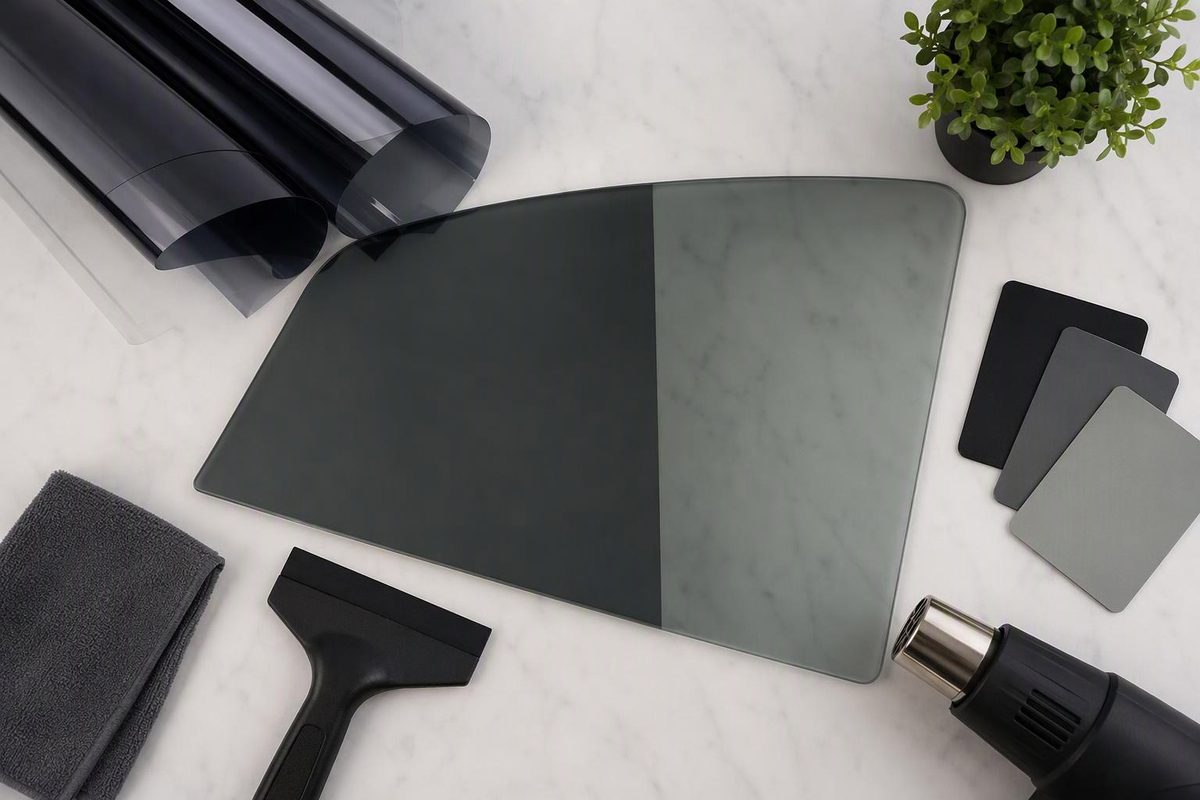
A true 20 percent tint film nominally transmits 20% of visible light. It is a dark shade that can provide substantial daytime privacy and glare reduction, but it also leaves much less light available for seeing through the glass after dark. On a vehicle, the completed window will usually meter below 20% because the film is applied over glass that already filters some light.
The practical verdict: 20% can suit rear side or rear glass where permitted. It is often too dark for front side windows, and it is not a sensible default for a windshield. Legality depends on the completed glass-and-film reading, window position, vehicle class and jurisdiction.
What 20% tint looks like
In daylight, 20% tint gives glass a distinctly dark, smoked appearance. People outside may see silhouettes or interior details at close range, especially when sunlight enters through the windshield. A black interior, small cabin and shaded surroundings can make the same film look darker; pale upholstery and a bright cabin make it look lighter.
It is privacy, not invisibility. At night, cabin lights can make occupants and valuables easy to see from outside.
From the driver’s seat, 20% is noticeably darker than 35%. The difference is easiest to miss on a brightly lit sample board and easiest to notice when reversing, checking a side mirror or turning onto an unlit road. A useful shade comparison is:
| Tint level | General appearance | Main compromise |
|---|---|---|
| 35% | Medium-dark; occupants often remain visible | Moderate privacy, with less low-light loss than 20% |
| 20% | Dark; substantial daytime privacy | Side and rear visibility deteriorates more in dim conditions |
| 5% | Very dark, often called limo tint | Severely restricted outward visibility at night |
These are relative descriptions, not a substitute for viewing samples on the actual vehicle. The broader tint-level comparison covers 5% through 70%, while the 35% tint guide examines the lighter alternative in more detail.
Older research should not be stretched into a universal crash-risk estimate, but it explains the low-light concern. A Transport Canada analysis found that reducing transmittance lowers background luminance and can reduce the visibility of objects, particularly under low illumination; its work modeled visual performance using five film-and-glass samples rather than an on-road crash trial (Transport Canada paper hosted by UNECE).
In a separate 24-participant dusk experiment, average effects across four vehicles trended toward more failures to detect a stationary pedestrian in rear-view mirrors and shorter detection distances, but those group effects were not statistically significant. Exploratory analyses found associations between greater tint and poorer detection, and the authors cautioned that the stationary test did not represent every aspect of driving (Virginia Transportation Research Council report).
If you frequently drive at night, test 20% and 35% from inside a similar vehicle in a dim parking area—not only from outside in daylight.
A 20% film usually produces less than 20% final VLT
Visible light transmittance, or VLT, is the percentage of visible light that passes through the complete window. Lower numbers mean darker glass.
Estimate the completed result by multiplying bare-glass VLT by film VLT:
Glass VLT × film VLT = estimated final VLT
For a true 20% VLT film:
| Measured bare-glass VLT | Film VLT | Estimated final VLT |
|---|---|---|
| 70% | 20% | 14% |
| 80% | 20% | 16% |
| 90% | 20% | 18% |
For example, 0.80 × 0.20 = 0.16, or an estimated 16% final VLT. This is why ordering “20% film” does not guarantee a 20% meter reading after installation.
The shade printed in a product name may not equal its published transmittance, either. LLumar’s August 2025 North American data lists ATC 20 and ATR 20 at 25% VLT. Its CTX 15 and IRX 15 products are both listed at 20% VLT. The manufacturer says the figures were measured on specified clear glass and that actual performance varies with glass properties and normal manufacturing variation (LLumar automotive performance data).
Ask the installer for three numbers before authorizing the work:
- The bare glass’s meter reading
- The specific film’s published VLT—not only its shade name
- The predicted and completed window readings
Is 20 percent tint legal?
There is no single U.S. answer. State rules can change by windshield, front side window, rear side window, rear window and vehicle classification. They may also regulate reflectivity and require labels, mirrors or medical-exemption documents.
As checked September 26, 2026, two official state sources show why a generic “20% is legal” claim is unreliable:
- Texas: The side windows immediately beside the driver must provide at least 25% light transmission when the original glass and film are measured together. A true 20% film cannot produce a 25% completed window, even over perfectly clear glass. Texas exempts side windows behind the driver from this VLT rule and uses separate rear-window and mirror conditions (Texas Department of Public Safety).
- New York: The windshield and front side windows must transmit at least 70% of outside light. The same threshold applies to the rear side windows of listed passenger-car body styles, while the rear-window requirement changes when qualifying outside mirrors are fitted (New York DMV).
Federal requirements are a separate issue: NHTSA explains that FMVSS No. 205 requires 70% light transmittance in glazing areas needed for driving visibility when vehicles and glazing are manufactured for sale. That does not create a nationwide permission for owners to apply 20% aftermarket film; state operating and aftermarket rules still need to be checked (NHTSA interpretation).
Verify the current rule with the motor-vehicle agency for the state where the vehicle is registered and any jurisdiction where it is regularly driven. Check each window separately, then leave enough margin for the underlying glass and product tolerances.
Darkness does not tell you how much heat the film rejects
A dark film is not automatically a high-performance heat-control film. In LLumar’s cited data, the dyed ATC 20 product is listed at 25% VLT and 38% total solar energy rejection (TSER). The ceramic CTX 15 is listed at 20% VLT and 53% TSER, while the infrared-rejecting ceramic IRX 15 reports 20% VLT and 59% TSER. These are manufacturer figures on specified test glass, not promised results for every vehicle, but they show why films of similar darkness can perform differently.
Compare TSER at a similar VLT and on the same stated test glass. Do not rank films using an isolated infrared-rejection headline because wavelength ranges and test methods can differ. Ceramic is also not automatically the best value; compare the actual product data, warranty and installed quote. The carbon-versus-ceramic comparison explains that purchasing decision.
Choose 20% when its dark appearance, daytime privacy and glare reduction are worth the low-light compromise and the completed reading is legal on the intended glass. For front side windows or frequent night driving, 35% or 50% is usually the more conservative starting point. For rear factory privacy glass, meter it first: adding 20% film can make an already dark window far darker than expected.