
How Dark Can You Tint Each Car Window in Texas?
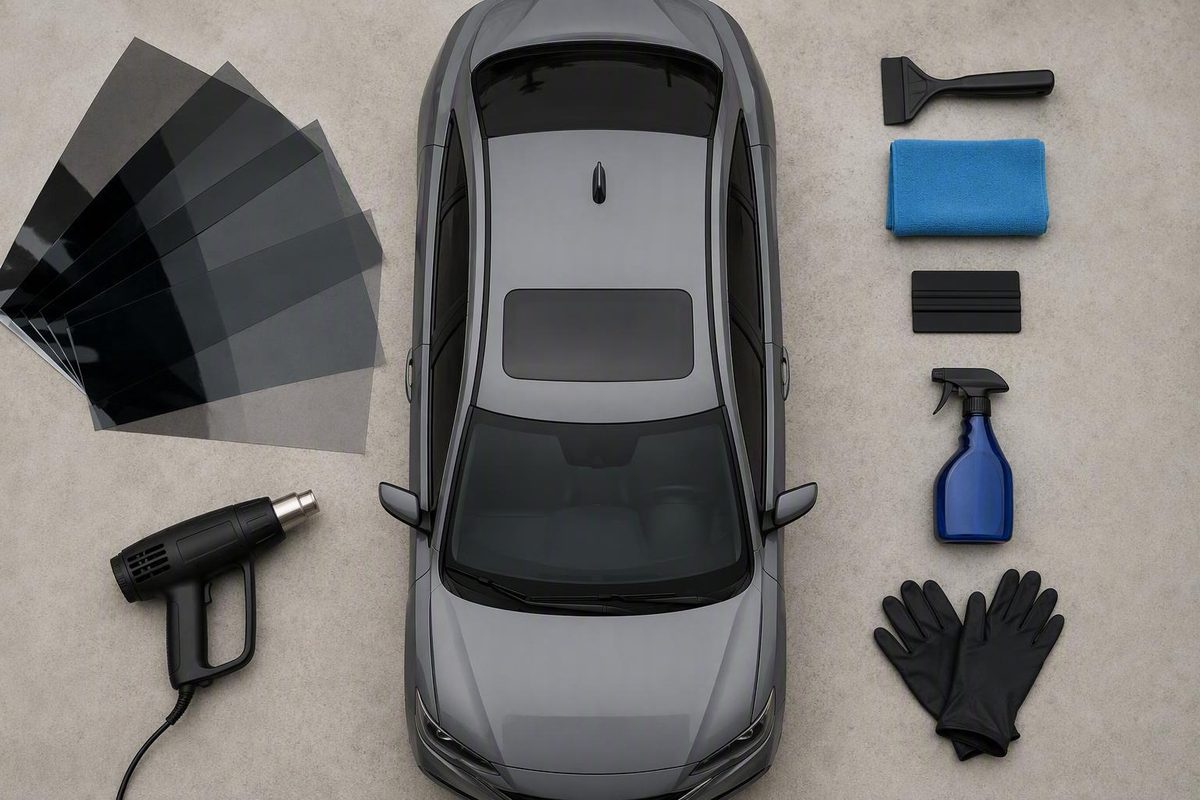
The short answer: Texas tint limits by window
According to the Texas Department of Public Safety window-tint guidance dated September 4, 2020, the side windows immediately beside the driver must provide at least 25% net visible light transmission (VLT). Exactly 25% meets that stated minimum. A lower VLT percentage means darker glass, so a reading below 25% generally falls short unless an applicable exception covers the vehicle or occupant.
Texas does not use one tint percentage for the entire vehicle. Under the cited guidance, rear side windows are treated differently, rear-window darkness depends on the vehicle’s outside mirrors, and windshield tint has separate placement, transmission, reflectivity, and color restrictions.
| Window position | Darkest generally permitted under the cited 2020 guidance | Other conditions |
|---|---|---|
| Windshield | Upper strip with at least 25% net VLT | The strip must remain above the AS-1 line or, if no AS-1 line exists, end no more than five inches below the top. Luminous reflectance may not exceed 25%. Red, amber, and blue sunscreening devices are prohibited on the windshield. Clear, untinted UV film may be applied anywhere on the front windshield. |
| Front side windows | At least 25% net VLT | Applies to the windows immediately to the right and left of the driver. Luminous reflectance may not exceed 25%. |
| Rear side windows | No darkness restriction stated | The guidance says side windows behind the driver are exempt from regulation. The supplied official evidence does not conclusively resolve the separate question of rear-side-window reflectivity. |
| Rear-facing window | Unrestricted darkness with qualifying outside mirrors on both sides | Each mirror must give the operator a roadway view extending at least 200 feet behind the vehicle. Without qualifying mirrors, the rear window must provide at least 25% net VLT and no more than 25% luminous reflectance. |
Under that guidance, 5% “limo tint” may be permissible on the rear side windows but would generally be too dark for the windows beside the driver. A 5% rear-facing window may also be permissible when both outside mirrors satisfy the stated rearward-view condition.
These are provisions reported by official guidance published in 2020, not a substitute for checking the law in force in 2026. Before selecting film, verify the current Texas Transportation Code, Texas Administrative Code, and DPS materials.
What 25% VLT means—and why a 25% film may still be too dark
Visible light transmission is the percentage of visible light that passes through a window:
- A higher VLT percentage means more light passes through and the window appears lighter.
- A lower VLT percentage means less light passes through and the window appears darker.
The critical term is net VLT. The cited Texas guidance measures the applied film in combination with the original glass. A 2025 commercial summary describes the measurement the same way: VLT is the light passing through the window and tint together, not merely the rating printed on the film package in its explanation of Texas tint measurements.
Consider this simplified illustration:
- Factory glass transmits 80% of visible light.
- Applied film transmits 30%.
- Approximate combined VLT:
0.80 × 0.30 = 0.24, or 24%.
This calculation illustrates the principle; it does not establish the actual reading of a finished window. The completed glass-and-film system should be measured with an appropriate tint meter.
The example also explains why film marketed as “25% tint” is not automatically suitable for a regulated front side window. When 25% film is applied over glass that already reduces light transmission, the combined result will ordinarily be lower than 25%. The film label may be accurate even though the completed window is darker than the stated minimum.
A practical approach is to:
- Determine the approximate transmission of the existing glass.
- Select film based on the expected combined result.
- Leave a reasonable margin above the applicable minimum.
- Meter the completed installation rather than relying on the film-box percentage.
That margin is not an official tolerance. One commercial guide reports a three-percentage-point variance, but the supplied DPS guidance establishes a 25% minimum without identifying that figure as a general permission to target 22% in the guide’s discussion of Texas tint limits. Unless current official authority confirms otherwise, choose film based on the stated threshold rather than an assumed enforcement allowance.
VLT must also be distinguished from luminous reflectance:
- VLT measures the visible light passing through the window.
- Luminous reflectance measures the light reflected from its surface.
A window can satisfy the transmission requirement but still be too reflective. Conversely, a low-reflectivity film can still be too dark if its net VLT falls below the applicable minimum.
Front side windows: where the 25% minimum applies
The regulated front side windows are those immediately to the driver’s right and left. In an ordinary passenger vehicle, these are generally the driver-door window and corresponding front-passenger window.
Under the September 2020 DPS guidance, each completed glass-and-film combination must have:
- At least 25% net VLT
- No more than 25% luminous reflectance
The practical distinction is straightforward:
- A finished front side window that meters 25% net VLT meets the stated transmission threshold.
- A finished window that meters 20% net VLT is darker and generally does not meet that threshold without an applicable exception.
Some commercial articles alternate between saying the windows must transmit “more than 25%” and describing 25% as the legal limit. For example, an October 2024 dealership article uses both formulations in its Texas window-tint overview. For the historical rule described here, the official DPS wording—“25% or more”—is the stronger source.
This still does not make nominal 25% film a safe choice. The installer must account for the original glass, so a lighter film may be necessary to keep the finished reading at or above 25%.
Trying to land at precisely 25.0% also leaves little room for differences between the expected and measured result. Ask for a product expected to finish comfortably above the minimum, then have both front side windows metered after installation.
Most importantly, do not apply the front-window percentage to every piece of glass. Calling Texas a “25% tint state” is incomplete because it ignores the rear-side exemption, the mirror-dependent rear-window rule, and the separate windshield requirements.
Rear side windows and the rear window follow different rules
The phrase “rear windows” can refer to two distinct categories:
- Side windows located behind the driver
- The rear-facing window, also called the back glass or rear windshield
The cited DPS guidance treats them differently.
Rear side windows
The guidance says that side windows behind the driver are exempt from regulation. On that basis, a very dark shade such as 5% VLT may be permissible there even though it would generally be too dark beside the driver.
The outside-mirror condition discussed below applies to unrestricted darkness on the rear-facing window. It should not automatically be added to the separate rear-side-window darkness rule.
Darkness and reflectivity are also different measurements. Although the supplied official evidence clearly addresses the rear side windows’ exemption, it does not conclusively establish whether a separate current reflectivity restriction applies to them. Verify that issue with current official authority before selecting highly reflective or mirror-like rear-side film.
Rear-facing window
Under the cited guidance, unrestricted rear-window darkness is conditional. The vehicle must have an outside mirror on each side, and those mirrors must provide the operator with a roadway view extending at least 200 feet behind the vehicle. A later commercial overview reports the same mirror-and-view standard in its rear-window summary.
The decision rule is:
- Two qualifying outside mirrors: The guidance places no darkness restriction on the rear-facing window.
- No qualifying mirror on each side: The rear window must provide at least 25% net VLT and no more than 25% luminous reflectance.
Two mirror housings do not necessarily prove that the condition is satisfied. The standard concerns the view the mirrors provide. A missing, damaged, obstructed, or poorly configured mirror may not provide the specified rearward view.
Example 1: Two qualifying mirrors and 5% rear tint
A vehicle whose outside mirrors satisfy the rearward-view requirement may be able to use 5% tint on the rear-facing window. Its rear side windows may also be very dark under the separate rear-side-window exemption.
Example 2: Only one qualifying mirror
If one mirror is missing or does not provide the required view, the vehicle should be evaluated under the restricted rear-window standard described in the guidance. A 5% rear-window reading would then be well below the stated 25% minimum.
This is why “Texas allows any tint on the back” is unreliable shorthand. It fails to distinguish rear side glass from the rear-facing window and omits the mirror condition.
Texas windshield tint: placement, darkness, reflectivity, and color
The ordinary windshield allowance described by the 2020 DPS guidance is an upper sunscreening strip, not visibly dark film across the entire windshield.
The strip must:
- Remain above the manufacturer’s AS-1 line
- End no more than five inches below the top if no AS-1 line exists
- Provide at least 25% net VLT
- Have no more than 25% luminous reflectance
Placement and transmission are separate compliance questions. A strip might admit enough light but extend too far down the windshield. It might also stop at the correct line but be too dark or reflective.
Before installation, inspect the actual windshield for an AS-1 marking. If the line is present, the guidance uses that line rather than a generic measurement. The five-inch alternative applies when no AS-1 line exists.
Some third-party pages have published a six-inch alternative or different windshield percentages for particular vehicle categories. Those claims conflict with the official guidance used here. A commercial Texas tint explanation also reports the AS-1-or-five-inch placement rule and separately recognizes clear full-windshield film in its windshield-tint overview, but current official law should control if sources disagree.
The cited DPS guidance also prohibits red, amber, and blue sunscreening devices on the windshield. That statement should be kept narrow: the supplied official evidence expressly establishes the prohibition for the windshield, not a universal color rule for every window and every possible vehicle classification.
Clear windshield film is a separate allowance
The DPS guidance distinguishes an ordinary tinted visor strip from clear, untinted UV film. It says clear, untinted UV film may be applied anywhere on the front windshield without a medical exception.
This is not permission to cover the whole windshield with visibly dark film. It also does not remove the placement, transmission, reflectivity, or color conditions governing an ordinary tinted upper strip.
“Ceramic” is not synonymous with “clear.” A full-windshield product should qualify as clear and untinted under the applicable rule; its marketing category alone does not answer that question.
Ask the installer to identify the exact product and explain whether it is clear and uncolored. Because the official guidance supplied here is dated 2020, confirm current eligibility before applying any product below the AS-1 line.
Medical exceptions for darker front-window tint
The cited Texas guidance recognizes a medical exception that may permit darker tint on the two side windows immediately beside the driver. A medical condition alone does not make every tint configuration compliant; the documentation and scope of the exception matter.
The supporting proof described by the guidance is a signed statement from a licensed physician or licensed optometrist. The statement must:
- Identify the affected driver or occupant
- State that the sunscreening device is necessary to safeguard that person’s health
- Remain in the vehicle
- Be presented when requested during an inspection or traffic stop
Commercial summaries report the same core documentation requirement, including identification of the affected person and a statement of medical necessity in their discussion of Texas medical tint exceptions.
The supplied official evidence supports an exception for darker tint on the two front side windows. It does not establish that a medical statement automatically authorizes:
- Any darkness the owner chooses
- Dark tint on every vehicle window
- Visibly dark film across the full windshield
- A tinted windshield installation below the AS-1 line
Before installation, confirm the current procedure and permitted coverage with Texas DPS or another current official authority. Give the installer the documentation requirements in advance and ensure the proposed work remains within the verified scope.
Keep the required signed statement in the vehicle rather than at home. An installer’s invoice, a diagnosis written on unrelated paperwork, or a verbal explanation is not a substitute for the specified statement.
Compliance labels and a pre-installation checklist
The September 2020 DPS guidance requires a compliance label in the rearmost bottom corner of the driver-side window and treats a corresponding passenger-side label as optional. A commercial tint-law guide similarly describes a driver-side certification label placed between the film and glass in its Texas labeling guidance.
Arrange the label before paying for the installation. Do not assume every shop will add it automatically.
1. Identify every window being tinted
List the product proposed for each applicable category:
- Windshield visor strip
- Full-windshield clear film, if any
- Driver-side front window
- Front-passenger window
- Rear side windows
- Rear-facing window
A quote stating only “25% all around” does not demonstrate that the installer has applied the window-by-window distinctions.
2. Confirm the expected net VLT
Ask for the expected finished VLT through the original glass and applied film together. Do not use the film-box percentage as proof of the completed window’s transmission.
For regulated windows, choose a product expected to leave a reasonable margin above the stated minimum.
3. Check luminous reflectance
Confirm the expected reflectance of the front side-window film and windshield strip. If the rear-facing window must follow the restricted standard because qualifying mirrors are absent, confirm its reflectance as well.
Verify rear-side-window reflectivity separately through a current official source before selecting mirror-like film.
4. Locate the windshield AS-1 line
Inspect the windshield itself rather than relying on a generic vehicle diagram. Under the cited guidance, an ordinary tinted strip must remain above an existing AS-1 line. Use the five-inch alternative only if the line is absent.
Also confirm that the proposed windshield strip is not red, amber, or blue.
5. Inspect both outside mirrors
If the rear-facing window will be darker than 25%, verify that:
- There is an outside mirror on each side.
- Both mirrors are functional and unobstructed.
- They provide the required rearward roadway view.
Mirror housings alone do not demonstrate that the view requirement is met.
6. Arrange the compliance label
Confirm that the required driver-side label will be placed in the specified corner. Ask the installer to show it to you when the vehicle is collected.
7. Prepare medical documentation, if applicable
Before requesting darker front-side tint, obtain the signed statement from a licensed physician or optometrist. Check that it identifies the affected driver or occupant and states that the tint is necessary to safeguard that person’s health.
Confirm the current scope of the exception and keep the required statement in the vehicle.
8. Meter the completed front side windows
Ask the installer to test the finished glass-and-film combination on both sides. Record the readings with the invoice if possible.
The invoice should identify the film product, nominal VLT, and windows covered. That paperwork may document what was installed, but it does not replace a compliant meter reading or satisfy other conditions such as reflectivity, windshield placement, mirrors, or labeling.
9. Separate heat rejection from darkness
Do not assume that the darkest film is the only option for reducing heat. Film construction and VLT are separate product considerations, and some products are designed to reject infrared energy without using extremely dark shades. Window Tint Central’s film-type overview distinguishes infrared heat rejection from tint darkness.
Compare products at an expected legal finished VLT rather than selecting 5% film solely for heat control. Product performance varies, so review specifications for the particular film being considered.
10. Choose an installer who can explain the rules
A suitable installer should be able to:
- Distinguish front side windows, rear side windows, and rear-facing glass
- Estimate net VLT using the existing glass
- Meter the finished installation
- Identify the windshield’s AS-1 line
- Explain the rear-window mirror condition
- Address the required compliance label
- Decline a configuration that plainly conflicts with the verified requirements
Shop confidence is not a substitute for current official authority. An inability to explain these basic distinctions is nevertheless a warning sign.
Verify the rule before installation: what the evidence does not settle
The principal official source supplied for this article is dated September 4, 2020. It identifies Texas Administrative Code, Title 37, Part 1, Rule 21.3 as the location of window-tint standards, but readers should verify the current rule text, applicable Transportation Code provisions, and the latest DPS window-tint materials before installing, replacing, or modifying tint.
The supplied evidence does not conclusively settle the following issues for 2026:
- Whether an official meter tolerance currently applies around the 25% threshold
- The current statewide penalties in each enforcement situation
- How tint violations are handled following changes to vehicle-inspection procedures
- Whether and how a reflectivity ceiling applies to rear side windows
- Whether particular vehicle classifications or uses have additional requirements or exemptions
- How current authorities evaluate the required 200-foot mirror view
- Whether the medical-exception procedure or permitted coverage has changed
- Whether compliance-label requirements have been amended since the cited guidance was published
Commercial tint-shop, film-vendor, and dealership articles can help explain terminology, but they should not override official authority. The supplied commercial sources conflict over “at least” versus “more than” 25% VLT, five versus six inches of windshield coverage, and special windshield percentages for certain vehicle types.
Penalty estimates also conflict and are not adequately supported as uniform statewide amounts. Do not select tint based on an assumed fine, inspection result, or enforcement outcome.
Use this compact compliance sequence:
- Check the current official Texas rules.
- Identify the rule for each window position.
- Choose film based on expected net VLT, not merely nominal film VLT.
- Confirm windshield placement, color, transmission, and reflectivity.
- Verify the outside-mirror condition before using very dark rear glass.
- Meter the completed regulated windows.
- Obtain any currently required compliance label.
- Keep applicable medical documentation in the vehicle.
The bottom line
Under the September 2020 DPS guidance, the practical answer is at least 25% net VLT for the windows beside the driver—not 25% for the entire vehicle. Exactly 25% meets the stated threshold, but nominal 25% film may produce a darker finished reading when installed over factory glass.
Rear side windows may be darker under the cited exemption. Unrestricted darkness on the rear-facing window depends on two qualifying outside mirrors providing the specified rearward view. Windshield tint remains subject to separate placement, transmission, reflectivity, and color conditions.
Final compliance depends on the window position, completed glass-and-film reading, reflectivity, windshield placement, mirror configuration, labeling, and any medical documentation. Verify the current Texas requirements and meter the finished installation before relying on the result.
Frequently asked questions
Is exactly 25% tint legal on Texas front windows?
Under the cited September 2020 DPS guidance, exactly 25% net VLT meets the stated minimum for the side windows immediately beside the driver.
“Net” means the original glass and applied film must meter at 25% or higher together. Film advertised as 25% VLT is not automatically compliant because the original glass also reduces transmission. Confirm the current rule and test the finished windows.
Can I put 5% tint on the rear side windows or rear windshield in Texas?
Under the cited guidance, 5% tint may be permissible on the side windows behind the driver because those windows are exempt from darkness regulation.
For the rear-facing window, 5% may be permissible only when the vehicle has an outside mirror on each side and the mirrors provide the required roadway view extending at least 200 feet behind the vehicle. Without qualifying mirrors, the guidance calls for at least 25% net VLT and no more than 25% luminous reflectance.
Does factory glass count when Texas measures tint VLT?
Yes, under the cited guidance. The relevant figure is the transmission through the original glass and applied film together.
For example, glass transmitting 80% combined with film transmitting 30% produces approximately 24% VLT in a simplified calculation. The actual completed window should be checked with a tint meter.
Can clear UV or ceramic film cover the entire windshield in Texas?
The September 2020 guidance allows clear, untinted UV film anywhere on the front windshield. That is separate from the ordinary tinted visor strip, which is limited to the area above the AS-1 line or the top five inches when no AS-1 line exists.
“Ceramic” identifies a type of film construction, not necessarily a clear shade. Confirm that a proposed full-windshield product qualifies as clear and untinted under the current rule.
What paperwork is needed for a Texas medical tint exception?
The cited guidance calls for a signed statement from a licensed physician or licensed optometrist. It must identify the affected driver or occupant and state that the tint is necessary to safeguard that person’s health.
The statement must remain in the vehicle and be presented when properly requested during an inspection or traffic stop. Confirm the current procedure and permitted window coverage before installation because medical documentation does not automatically authorize unrestricted tint on every window or across the full windshield.