
North Carolina Tint Laws: 35% VLT, Windshield Rules and Exceptions
Check North Carolina’s 35% VLT rule, 32% meter threshold, SUV and pickup exceptions, windshield limit, medical permits and 2025 inspection change.
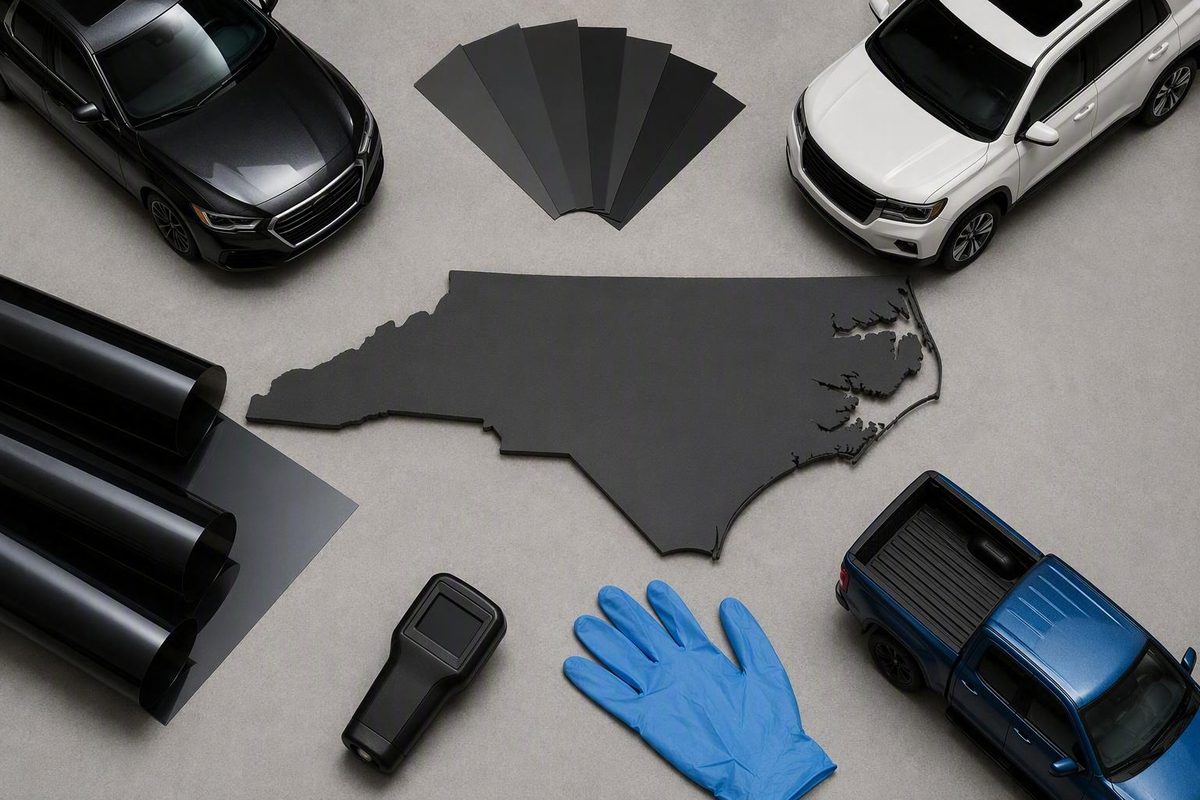
Reviewed September 21, 2026. North Carolina generally requires a tinted window to have at least 35% total visible light transmission (VLT). An approved meter reading above 32% is conclusively presumed compliant. That does not mean “32% tint” is the legal specification: 35% is the statutory minimum, while above 32% is the testing threshold written into the law. The rule applies to the completed glass-and-film combination, not merely the percentage printed on a film box. (N.C. Gen. Stat. § 20-127)
NC tint limits at a glance
| Window or requirement | North Carolina rule |
|---|---|
| Windshield | Tint strip may reach five inches from the top or the AS-1 line, whichever allows the longer strip |
| Front side windows | At least 35% total VLT; an approved meter reading above 32% is presumed compliant |
| Rear side windows, passenger car | At least 35% total VLT |
| Rear window, passenger car | At least 35% total VLT |
| Windows behind the driver, qualifying multipurpose vehicle | The 35% VLT and 20% reflectance limits do not apply |
| Reflectance where regulated | 20% or less |
| Film color and appearance | Must be nonreflective and cannot be red, yellow or amber |
The multipurpose-vehicle exception matters for many SUVs, minivans and pickups. The statute defines this category as a passenger vehicle carrying no more than 10 people that is built on a truck chassis or has features for occasional off-road use; it expressly identifies minivans and pickups as multipurpose vehicles. Only windows behind the driver receive this exception. The front side windows remain subject to the ordinary limits. (N.C. Gen. Stat. § 20-127)
Other statutory exceptions include specified windows on motor homes, ambulances, limousines and law-enforcement vehicles, plus the rear window of a property-hauling vehicle. A vehicle registered in another state is also excepted if it meets its registration state’s requirements. Commercial vehicles covered by federal 49 C.F.R. Part 393 follow that federal framework instead. (N.C. Gen. Stat. § 20-127)
Windshield tint is a separate decision
North Carolina allows a tinted strip only at the top of the windshield. It may extend to the AS-1 line or five inches down from the top, whichever measurement is longer. The statute also allows untinted, clear UV-reducing film that does not obstruct vision. A dark full-windshield film does not fit that ordinary rule. (N.C. Gen. Stat. § 20-127)
Do not assume that a light-looking film automatically passes. VLT compounds through the existing glass. For example, 50% film installed over glass that transmits 70% of light produces an estimated 35% combined VLT: 0.50 × 0.70 = 0.35. Our ceramic tint percentage guide explains this calculation in more detail. Ask the installer to meter the bare glass before recommending film and to check the finished window afterward.
Safety inspections no longer include a tint check
Since December 1, 2025, North Carolina safety inspections have not included a window-tint check, and the former additional $10 tint-inspection fee has been eliminated. The legal tint limits did not disappear: NCDMV says aftermarket tint must still comply with § 20-127. During a traffic stop, a driver with tinted windows must lower the window on the side from which the officer approaches. (NCDMV inspection guidance)
In practical terms, passing the annual inspection no longer establishes that a tint job is legal. A driver can still violate the law by operating a vehicle with noncompliant tint. The statute classifies unlawful application or driving with unlawful tint as a Class 3 misdemeanor. It also provides a defense to the driving charge when the tint is removed within 15 days and the driver supplies the required DMV or Highway Patrol compliance certificate. (N.C. Gen. Stat. § 20-127)
Medical tint permits
A person whose medical condition causes photosensitivity to visible light may apply to NCDMV’s Drivers Medical Evaluation Program with a physician-completed medical evaluation. A permit can last up to five years, may cover specified vehicles, windows and tint levels, and must be carried in the applicable vehicle. The law allows up to four valid permits at once. (N.C. Gen. Stat. § 20-127)
NCDMV’s current application is dated March 2026 and directs applicants to complete the applicant and vehicle sections while a physician completes the medical section. Obtain the permit before choosing tint outside the standard limits rather than treating a diagnosis or doctor’s note alone as authorization. (NCDMV Tinted Window Waiver Application)
For an ordinary sedan, the conservative buying specification is straightforward: keep the completed front, rear-side and rear windows at or above 35% VLT, use only the permitted upper windshield strip, and have the installer verify the final reading with a meter. For an SUV, minivan or pickup, confirm that the vehicle actually meets North Carolina’s multipurpose-vehicle definition before relying on the behind-the-driver exception.