
How to Choose a Ceramic Tint Shade Without Guessing
A shade chart compares privacy, glare and low-light visibility, then shows why 35% film over 80% glass produces 28% final VLT.
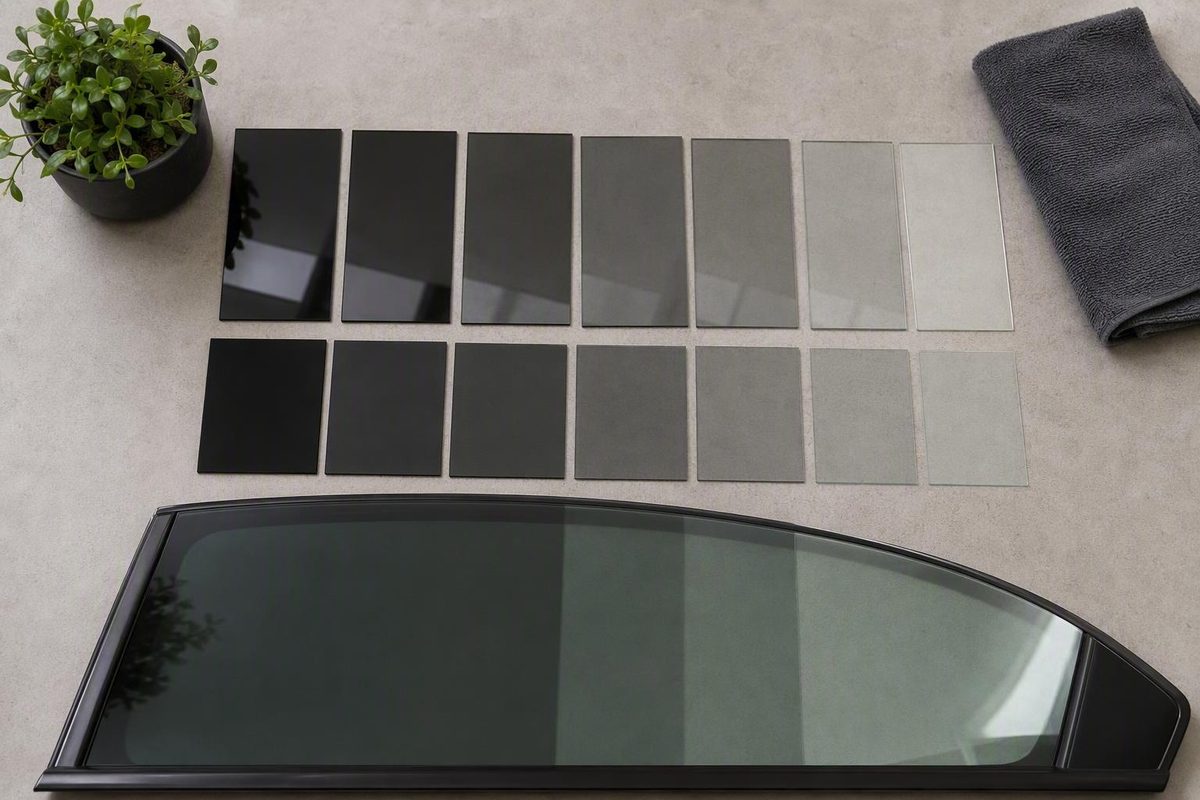
Ceramic tint percentages normally describe visible light transmission (VLT): the share of visible light that passes through the film or filmed glass. A lower percentage is darker, so 20% tint is darker than 35%. “Ceramic” identifies the film technology, not its darkness.
To choose a shade intelligently, identify the window, check the current law for that window and vehicle class, measure the existing glass, and calculate the completed window’s VLT. Then compare compliant ceramic products by visibility, privacy, glare, total solar energy rejection (TSER), and clearly defined infrared data.
Ceramic tint percentage chart: the quick answer
Ceramic films can be light or dark. A 70% ceramic film is very light and visibility-oriented, while 5% is very dark and commonly called limo tint. Ceramic construction can affect solar performance, color, reflectivity, or signal compatibility, but it does not turn the percentage into a different measurement.
| VLT | Approximate shade | Low-light visibility | Decision considerations |
|---|---|---|---|
| 70% | Very light | Best of these options | Subtle appearance; useful when visibility is the priority, but final VLT and legality still depend on the glass and window |
| 50% | Light | Strong | A visible but restrained change; compare heat performance by product rather than assuming it from shade |
| 35% | Moderate | Generally easier than darker shades | A middle-of-the-scale appearance, but not a universal legal limit or “best” choice |
| 20% | Dark | Reduced | Privacy-oriented; give extra consideration to nighttime use and local restrictions |
| 5% | Very dark or “limo tint” | Poorest; severely reduced | An extreme privacy choice that admits very little visible light and may be unsuitable or unlawful on regulated windows |
These are approximate shade descriptions rather than standardized recommendations. Commercial shade guides commonly characterize 70% as very light, 50% as light, roughly 30%–45% as moderate, 15%–20% as dark, and 5% as very dark. They also caution that frequent nighttime drivers should consider lighter options (window-tint percentage guide).
Factory glass, cabin color, ambient light, viewing angle, windshield light entering the cabin, and vehicle shape can all change how the same percentage appears.
The underlying comparison is straightforward: a 20% window transmits less visible light than a 35% window, so 20% is darker than 35%. That does not make either percentage universally appropriate or legal. A windshield, front side window, rear side window, and rear glass can each be governed by different rules, even on the same vehicle.
Calculate the final percentage over factory glass
The percentage printed on a film box is not necessarily the completed window’s VLT. Original glass already reduces visible-light transmission, and the film reduces what remains.
When the film value describes film alone, use this approximate formula:
Final VLT = (film VLT ÷ 100) × (glass VLT ÷ 100) × 100
For example, applying 35% film over glass measured at 80% VLT gives:
0.35 × 0.80 × 100 = 28% final VLT
The same calculation produces these results:
| Film VLT | Existing glass VLT | Estimated final VLT |
|---|---|---|
| 35% | 80% | 28% |
| 20% | 70% | 14% |
| 5% | 75% | 3.75% |
These examples and the multiplication method are also shown by a combined-VLT calculator. The result is an estimate, and its usefulness depends on accurate inputs. A guessed factory-glass percentage can produce a misleading answer even when the arithmetic is correct.
If the existing glass VLT is unknown, ask the installer to measure each relevant window with a VLT meter.
Do not multiply a filmed-glass specification as though it were film-only VLT. For example, 3M’s brochure reports results on 89% VLT test glass. That value already includes glass loss. Ask the manufacturer or installer for film-only transmission or a prediction for your glazing; otherwise the calculation can count glass loss twice. A finished-window meter reading remains the check that matters.
The film’s specified VLT also deserves scrutiny. A nominal product name may differ from its measured transmission, and manufacturer test results may have been obtained on glass unlike the vehicle’s glazing. For planning purposes, use the best available product specification and an actual meter reading from the vehicle.
After installation, measure the completed glass-and-film assembly again. The box label identifies the film, but the finished-window reading is the practical check on the installed result—particularly when the proposed VLT is close to a legal threshold.
Choose a percentage by visibility, privacy, and window position
There is no single best ceramic tint percentage. The practical choice depends on what the driver prioritizes, the position of the window, the original glass, and the applicable law.
| Priority | Range to evaluate | Practical tradeoff |
|---|---|---|
| Maximum low-light visibility | 50%–70% | Preserves more visible light and gives a lighter appearance, subject to completed VLT and local law |
| Moderate shade and some privacy | About 30%–45% | Occupies the middle portion of the scale without making 35% universally ideal or legal |
| Stronger privacy | About 15%–20% | Substantially darker; low-light use and legal restrictions deserve greater attention |
| Extreme privacy | About 5% | Admits very little visible light; suitability and legality become major constraints |
| Solar comfort without a dark appearance | Compare lighter films at similar VLT | Select by product-specific TSER and defined infrared data rather than darkness alone |
These ranges are approximate decision categories, not legal or safety thresholds. Shade guidance consistently describes darker films as providing greater privacy and glare reduction while admitting less light, with lighter shades favored when visibility is the priority (window-tint percentage guide).
Frequent nighttime drivers should give low-light visibility more weight than exterior appearance. A film that seems comfortable under bright showroom lighting will admit the same percentage of available light when the road itself is dim.
Treat each window as a separate decision:
- Front side windows: Influence the view toward intersections, mirrors, pedestrians, and roadside activity.
- Rear side windows: May qualify for different treatment depending on the jurisdiction and vehicle class, but there is no universal rear-window exemption.
- Rear glass: Affects the view behind the vehicle, and some laws connect rear-glass allowances to the presence of qualifying outside mirrors.
A reliable five-step selection sequence is:
- Identify the exact window you want to tint.
- Check the current official legal threshold for that window and vehicle class.
- Measure the factory glass instead of estimating its VLT from appearance.
- Calculate the proposed net VLT for the glass-and-film combination.
- Compare only compliant films by visibility, privacy, glare, TSER, infrared metrics, reflectance, and warranty.
This order avoids a common mistake: choosing a shade for appearance first and discovering later that the completed window is darker than expected or permitted.
Darkness is not the same as heat rejection
VLT measures visible light, not total thermal performance. Darker options generally reduce more visible glare, but that does not prove a proportional improvement in heat or ultraviolet performance.
For overall solar-heat control, look first at total solar energy rejection (TSER). TSER describes the share of total solar energy rejected by the tested filmed-glass system. A higher TSER means less total solar energy is transmitted under the stated test conditions, making it more informative for overall solar control than VLT alone.
Infrared figures require closer reading. An infrared energy rejection (IRER) value may cover a broad wavelength range and account for energy absorbed and reradiated inward. A headline infrared rejection (IRR) value may use a narrower wavelength band. Percentages produced with different ranges or methods are not automatically comparable.
For example, 3M defines IRER for Ceramic XP over 780–2,500 nanometers and says that the measure accounts for transmitted and absorbed infrared energy that may be reradiated into the vehicle. Its separate IRR figure covers only 900–1,000 nanometers. The labels may sound similar, but the underlying measurements are different.
LLumar’s Stratos range shows why visible darkness and heat performance should be considered separately. Its listed 69% VLT option reports 49% TSER, while its 7% VLT option reports 65% TSER. Visible transmission therefore changes dramatically, while the stated TSER difference is 16 percentage points. These are manufacturer figures from representative samples tested under NFRC guidelines on nominal quarter-inch clear glass, and actual performance can vary with glass properties and normal manufacturing variation (LLumar Stratos performance data).
The lesson is not that light and dark films perform identically. It is that choosing the darkest shade is not the only way to obtain meaningful solar-energy rejection. Compare ceramic films at similar VLT so that differences in construction and solar performance are not confused with a simple change in visible darkness.
Why a shade name may not equal measured VLT
A shade number such as “15,” “35,” or “70” can be a nominal model designation rather than a guarantee that the film—or the completed vehicle window—will measure exactly that number.
| Product designation | Listed measured VLT | Stated test context |
|---|---|---|
| LLumar IRX 15 | 20% | Representative sample on nominal quarter-inch clear glass |
| LLumar Stratos 35 | 39% | Representative sample on nominal quarter-inch clear glass |
| 3M Ceramic XP 35 | 40% | Film applied to clear 89% VLT glass |
LLumar’s manufacturer data list IRX 15 at 20% VLT and show CTX ceramic options spanning measured values from 5% to 55% VLT. The same document describes CTX as a ceramic film intended to provide heat rejection without blocking electronic-signal transmission. Its results are based on representative samples and are subject to glass properties and manufacturing variation (LLumar automotive performance data).
3M’s Ceramic XP data list measured VLT options from 5% to 77% on clear 89% VLT glass, including a 40% result for the nominal CMXP 35 product. The manufacturer describes Ceramic XP as nonmetalized and compatible with vehicle electronics, GPS, satellite radio, mobile devices, and 5G (3M Ceramic XP brochure).
These specifications should not be read as an independent ranking of the brands. Glass type, test substrate, manufacturing variation, and nominal product naming can affect reported figures. Testing film on standardized clear glass is not the same as measuring it on a particular vehicle’s factory glazing, and manufacturers do not necessarily use identical substrates or procedures.
When requesting a quote, do not accept “35 ceramic” as a complete product description. Ask for:
- The manufacturer
- The exact film line
- The complete product code
- The relevant technical data sheet
- The specified or measured film VLT
- The existing glass measurement
- The estimated final VLT on that vehicle
Check legality using the completed window, not the film label
Ceramic construction does not create a universal legal exemption. Tint laws may regulate combined glass-and-film transmission, reflectance, placement, window position, vehicle class, restricted colors, labels, mirrors, or exemptions.
Official state materials illustrate how widely the requirements can differ:
- Texas: Texas Department of Public Safety guidance dated September 4, 2020, states that the windows immediately beside the driver must transmit at least 25% of light when measured with the original glass. It also describes separate windshield, reflectance, color, rear-window, mirror, and exemption conditions. Because the guidance is dated, its threshold and related conditions should be checked against the current statute and administrative rules before installation (Texas DPS window-tint guidance).
- North Carolina: The statute generally requires at least 35% total light transmission and limits reflectance to 20%, while providing window-, vehicle-, and exemption-specific provisions. It also includes a meter-based compliance presumption above 32% under the stated conditions (North Carolina General Statute §20-127).
- Rhode Island: The state generally requires a completed window to have at least 70% total VLT unless an exemption applies. Its rules include specific provisions for windshield strips, listed vehicle classes, mirrors, and medical authorization (Rhode Island DMV window-tint guidance).
- Washington: The statute generally requires at least 24% net transmission and no more than 35% total reflectance on covered windows, subject to vehicle, window, mirror, and medical provisions. Its definition of net film screening includes factory treatment and aftermarket film.
These are examples of legal variation, not a nationwide legality chart. The controlling rule may change according to windshield versus side glass, front versus rear position, passenger car versus multipurpose vehicle, mirror equipment, reflectance, restricted colors, inspection tolerance, labels, and medical authorization.
This is why a nominally “legal-looking” film can still create a noncompliant window. A 35% film over glass measuring 80% VLT calculates to a final VLT of 28%, not 35%.
Before approving a shade:
- Consult a current official DMV, legislature, or law-enforcement source.
- Identify the exact window and the vehicle’s official classification.
- Confirm whether the rule applies to film VLT or combined glass-and-film VLT.
- Check reflectance, restricted colors, windshield placement, labels, meter tolerances, mirrors, and exemptions.
- Ask whether an inspection-specific test method or tolerance applies.
- Measure the completed window with an appropriate VLT meter.
Tint laws can change over time. Verify the current limits with the relevant government authority rather than relying on an installer’s general chart, a neighboring state’s rules, or a film label.
What to ask for before approving a ceramic tint job
A useful quote should identify the product and expected result, not merely promise “premium ceramic.” Ask the shop to put the following in writing:
- Exact manufacturer, film line, and product code
- Nominal shade name
- Specified or measured film VLT
- Existing-glass meter reading
- Estimated final glass-and-film VLT
- TSER
- Infrared metric, including wavelength range and methodology
- Visible-light reflectance
- Test glass and applicable test conditions
- Warranty duration, coverage, exclusions, and transferability
Compare products at similar VLT. Comparing a dark film from one brand with a light film from another mixes two variables—film construction and darkness—so the result does not clearly show which technology performs better.
Some specified nonmetallic ceramic products from 3M and LLumar are marketed as avoiding interference with electronic signals. Do not assume that claim applies to every product sold as “ceramic.” Confirm the construction and signal-compatibility statement for the exact product code being quoted.
If the proposed result is close to the legal boundary, request pre-installation and post-installation meter readings on the invoice. The record should identify the window, original-glass reading, installed film code, and finished measurement.
Installation quality also deserves attention. Ask:
- Is the film cut by plotter, or cut by hand on the vehicle’s glass?
- Is the warranty provided in writing?
- Is the warranty transferable, and what defects does it exclude?
- Can the shop show examples of work that has been installed for several years?
- Who handles contamination, edge defects, peeling, bubbling, haze, or replacement?
- Will the invoice identify every film used on each window?
Once the percentage and exact product are settled, Window Tint Central’s ceramic tint pricing guide can help with the separate task of comparing quotes by film tier and vehicle type.
Frequently asked questions
Can I layer ceramic tint over another tint film?
Mathematically, another layer reduces VLT again. Multiply the existing window’s measured VLT by the additional film-only VLT, with both expressed as decimals. For example, adding 50% film to a window already measuring 30% would produce an estimated 15% VLT:
0.50 × 0.30 × 100 = 15%
That calculation does not establish that layering is permitted or appropriate. Final visibility and legality still depend on the completed result. Questions about adhesion, optical appearance, removal, and warranty coverage should be checked against the documentation for the specific films and with the installer rather than assumed.
Washington expressly prohibits installing more than one sheet of sunscreening film on a window, illustrating why local rules must be checked before layering (RCW 46.37.430). Have the existing window metered and ask whether removing the old film and installing one verified product is the better approach.
The final action plan is straightforward: identify the exact window, verify its current official requirements, measure the factory glass, calculate the proposed completed VLT, and compare only compliant ceramic products at similar darkness using TSER and properly defined infrared data. Confirm the exact film code and measure the finished window before treating the job as complete.