
When Apartment Window Film Actually Cuts Cooling Costs
Estimate whether solar film can repay its cost in your rental, then check sunlight, glazing, film ratings, lease length, and removal terms.
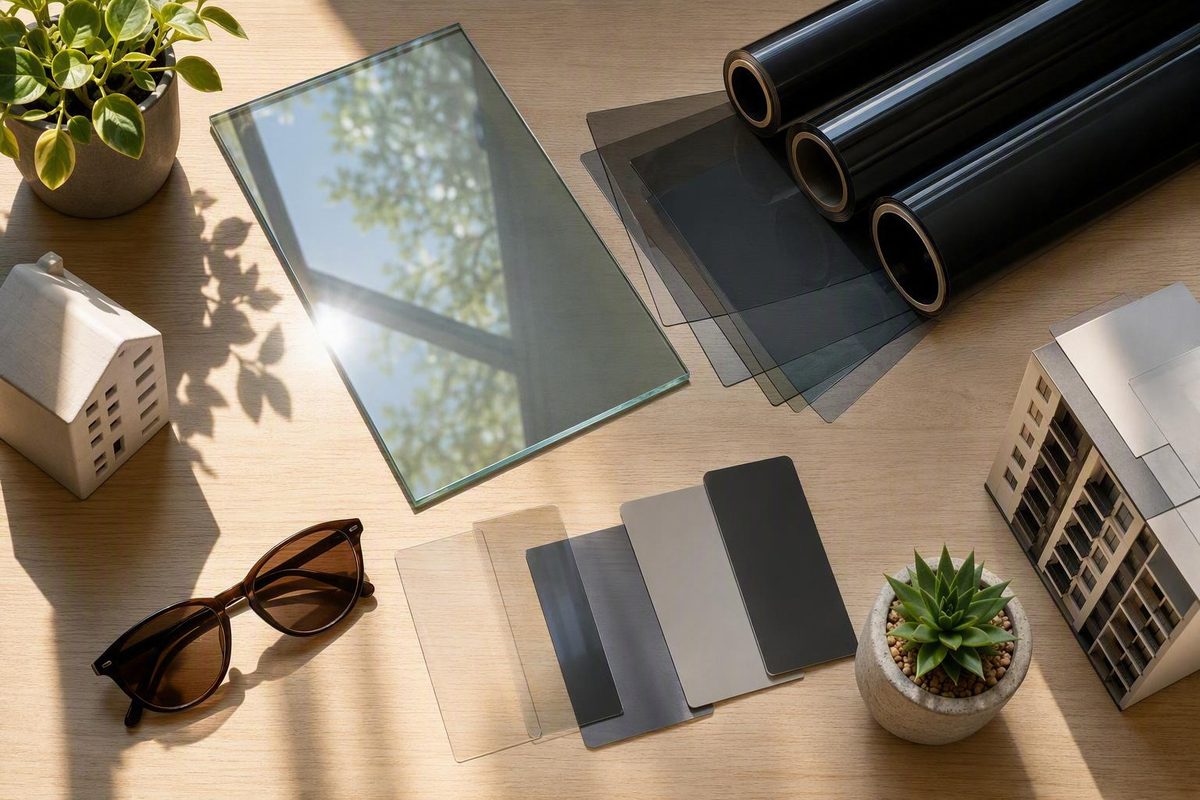
Solar-control window film can lower an apartment power bill when direct sun through the glass creates heat that an air conditioner must remove. The strongest case is a tenant-paid, air-conditioned unit with substantial sunny glass. Savings may be negligible when windows are shaded, cooling is included in rent, or most electricity use comes from appliances and other non-cooling loads. No adequately supported typical apartment-wide saving or payback period is available.
Film can still improve comfort by reducing a hot spot or glare even when the bill change is too small to recover the project cost. Guidance on applied window film and its performance tradeoffs supports the heat-control mechanism but does not establish a standard apartment saving.
Enter your cooling use or spending, then test conservative and optimistic savings assumptions.
Estimate savings only from cooling use. Window details indicate whether solar gain is plausible; they do not create an unsupported savings percentage.
Enter cooling months and total project cost to calculate annual savings and payback.
| Input Or Choice | How The Estimator Uses It | What It Cannot Prove | Decision Check |
|---|---|---|---|
| Window count and area | Defines project scope | Energy savings without building data | Measure only treated glass |
| Orientation | Adds exposure context | Actual sun by itself | Observe sunlight on the pane |
| Direct-sun hours | Rates solar opportunity | Cooling demand or film performance | Match sun with AC operation |
| Film type | Shows product checks | A standard reduction percentage | Compare SHGC and VT |
| Cooling kWh and rate | Calculates cooling spending | Whether every kWh is window-related | Use utility or monitor data |
| Assumed reduction | Runs a sensitivity scenario | A promised result | Test conservative and high cases |
| Project cost | Calculates payback | Costs omitted by the renter | Include removal and restoration |
This is a scenario calculator, not an energy model. It does not account for weather, shade geometry, air-conditioner efficiency, glazing construction, thermostat changes, or winter heating penalties.
Source note: formulas and the $60 × 10% = $6 illustration come from the accompanying article; no apartment-specific typical saving, film-type factor, or payback figure is established by the cited evidence.
The estimator deliberately does not assign an automatic saving to “ceramic” or any other film type. The available evidence does not provide defensible apartment-specific reduction factors by film category, orientation, or square foot of glass. Use product ratings and observations from the apartment to choose a hypothetical reduction, then see whether the project works without aggressive assumptions.
A widely circulated report about a Florida renter says ceramic tint made her apartment cooler and saved substantial money. The article reporting the renter’s claim supplies no before-and-after bills, detailed film specification, installation information, weather adjustment, or controlled comparison. It illustrates a possible result, not a typical one.
Tint Reduces Solar Cooling Load, Not Every Electric Load
Three different measures are often treated as if they mean the same thing:
- Solar-heat rejection describes how a film or filmed window manages incoming solar energy.
- Cooling-energy reduction describes how much less energy the air conditioner uses after installation.
- Total bill reduction describes the change in all electricity consumption.
A film-performance percentage cannot simply be applied to the entire power bill. Film does not reduce electricity used by a refrigerator, water heater, computer, dryer, lights, or unrelated equipment. It also does not repair an inefficient air conditioner.
Start with the cooling-related portion of the bill. If a $150 monthly electric bill includes an estimated $60 of cooling, a hypothetical 10% cooling reduction saves $6 per month. It does not save $15. The 10% figure is an arithmetic illustration, not a published expectation.
The monthly-saving formula is cooling spending multiplied by the assumed cooling reduction. If working from usage, multiply cooling kWh by the electricity rate and then by the assumed reduction.
Break-even in years is total project cost divided by estimated annual savings. Project cost should include film, delivery, installation supplies or labor, and expected removal or restoration. Because the reduction is uncertain, break-even is a scenario rather than a forecast.
Compare the result with the likely remaining tenancy. A project that recovers its cost only after the expected move-out date is financially weak unless the comfort or glare benefit independently justifies the expense.
Direct Sun And Active Cooling Make Film More Promising
A high electricity bill alone is poor evidence that film will help. A hot room beside sunny glass is more useful diagnostic evidence.
Film is a stronger candidate when the tenant pays for air conditioning, several windows receive prolonged direct sun, the area near the glass becomes noticeably hotter, and cooling operates during those sunny hours. Enough time must also remain on the lease to recover installation and removal costs.
Film is weaker when buildings, balconies, trees, awnings, or screens already shade the glass. It may also be a wash when summers are mild, the apartment rarely uses air conditioning, cooling is included in rent, existing glazing already limits solar gain, or non-cooling equipment dominates the bill.
Actual sunlight matters more than a simple compass rule. Record when sunlight reaches each pane and where the sun patch lands. Seasonal changes matter: summer leaf cover may disappear in winter, and nearby structures can shade a nominally sunny orientation.
Fixed film can also remove useful winter solar warmth. That may increase heating demand in a cold or mixed climate. An operable shade is more adaptable because it can close during hot periods and open when daylight or winter warmth is useful.
Film does not stop drafts. Solar-control film changes radiation through the glass; it does not seal gaps around a sash, frame, or meeting rail. Air leakage needs a separate diagnosis and a landlord-approved repair.
Estimate Savings From Cooling Use, Not Window Count Alone
Published savings depend on a particular building and model. Júlia Pereira and colleagues compared three solar-control films with replacing the windows in a Mediterranean office case study, using measured conditions to calibrate their energy analysis. The study found stronger modeled use-stage savings for films with a higher light-to-solar-gain ratio. It does not provide a typical percentage reduction for a tenant’s electric bill. Use your cooling-only scenarios below and keep the film cost, lease length, and daylight trade-off explicit.
Window count, orientation, and glass area help identify opportunity, but they do not produce a defensible dollar estimate by themselves. The calculation also depends on weather, shade, glazing construction, thermostat settings, air-conditioner efficiency, film performance, occupancy, and whether cooling runs while direct sun reaches the window.
A utility bill may not separate cooling from other loads. Estimate cooling use by comparing mild-weather and hot-weather consumption, reviewing hourly or daily utility data if available, or monitoring a plug-in room air conditioner. Keep a range rather than treating the result as exact.
Run at least three scenarios. The low case should use a conservative hypothetical cooling reduction; the middle and high cases can test progressively stronger assumptions. These are sensitivity tests, not promises.
For each scenario:
- Estimate monthly cooling spending or cooling kWh.
- Apply a hypothetical cooling reduction only to that amount.
- Multiply monthly savings by the number of cooling months.
- Include purchase, installation, removal, and restoration costs.
- Compare break-even with the expected tenancy.
If the project works only under the optimistic scenario, its financial case is fragile. If it remains worthwhile under a conservative cooling estimate and includes removal costs, the decision is more resilient.
Current costs are not supplied by the available evidence. Obtain local quotations for the exact product, measured glass area, installation side, and removal requirements. Automotive-tint prices are not a substitute because vehicle and architectural films, glass, specifications, installation, and warranties differ.
SHGC And VLT Matter More Than The Ceramic Label
Pereira’s comparison is a practical reason to examine both solar gain and visible light: the strongest modeled film reduced solar gains without giving up as much daylight. Ask for ratings of the proposed film on your existing glass, then check whether that balance fits the room. A low SHGC achieved by making a living room unacceptably dark may solve the wrong problem.
“Ceramic,” “premium,” “heat blocking,” and “insulating” are not enough to compare products. Look for ratings for the proposed film on the relevant type of glass.
Solar Heat Gain Coefficient (SHGC) is the fraction of incident solar energy admitted through the rated window system. It runs from 0 to 1, and a lower SHGC means the rated system admits less solar heat.
The rated system matters because film does not perform in isolation. Results can differ with the underlying glass, coatings, pane construction, and installation side.
Visible Transmittance (VT), also called Visible Light Transmittance (VLT), describes how much visible light passes through. It is also expressed from 0 to 1. Higher VT preserves more daylight; lower VT produces a darker result.
Do not confuse darkness with solar control. A dark film is not automatically cooler, and a nearly clear film is not automatically ineffective. For many apartments, the useful target is lower SHGC with enough VT to retain acceptable daylight and views.
Spectrally selective film is designed to reject selected unwanted portions of sunlight while allowing relatively high visible-light transmission. It can be a useful starting point in a living room where both heat control and daylight matter. Product-specific ratings and glazing approval still control.
Ceramic is a construction category, not a savings guarantee. Compare a ceramic product with other films using SHGC, VT, reflectance, compatibility, warranty terms, and installed cost.
| Film Type | Main Advantage | Main Tradeoff | What To Verify |
|---|---|---|---|
| High-VT selective | Preserves more daylight | Performance varies by product | SHGC, VT, reflectance |
| Ceramic | Often marketed for heat control and visibility | Label alone proves little | Full rated specification |
| Dark or dyed | Reduces brightness and glare | Darker room and altered view | VT and daylight impact |
| Reflective | Can limit solar gain | Mirrored façade appearance | Rules and night privacy |
| Low-e | May affect summer and winter heat flow | Assembly-specific effects | Placement and compatibility |
| Static-cling | Potentially easier removal | Not universally glass-safe | Exact removal instructions |
UV control, glare reduction, fade protection, SHGC, and VT are separate performance categories. Strong UV or glare performance does not establish a particular electricity saving.
Renters Need Written Approval And Glass Compatibility
Obtain written approval from the landlord or property manager before installation. A lease or building policy may restrict adhesives, alterations, exterior appearance, contractor access, or modifications to building glass even when a product is advertised as removable.
The approval should identify the manufacturer and model, permitted windows, installation side, color and reflectivity, installer requirements, removal deadline, cleanup standard, and responsibility for glass, coating, seal, or warranty damage.
Identify the glazing before ordering. Apartment windows may be single-pane, insulated double-pane, tempered, laminated, factory-tinted, coated, or Low-E, and one window can fall into several categories. Visual inspection may be insufficient. Ask the building manager for labels, etchings, window schedules, or manufacturer records.
Not every film is compatible with every glass assembly. Confirm the exact product, glazing, installation side, and pane dimensions with the film maker, window maker, building manager, or a qualified architectural-film installer. Commercial guidance likewise warns that film must be selected for its intended purpose and glass type.
“Static cling” describes an attachment method, not universal safety for rentals. Verify how long the exact product may remain installed, whether it can leave residue or an outline, which tools or chemicals removal requires, and whether those outcomes are covered by warranty.
Keep the written approval, specification sheet, photographs of the untreated glass, installer paperwork, and removal instructions until after move-out.
Reversible Shades Often Suit Short Leases Better
Film is not the only way to control a sunny apartment. The Attachments Energy Rating Council covers blinds, cellular shades, roller shades, solar screens, pleated shades, storm windows, and shutters, and provides labels and a certified-product search. Its public material does not establish a universal apartment savings percentage.
| Option | Daylight And View | Reversibility | Best Fit |
|---|---|---|---|
| Solar film | Product-dependent | Often limited | Continuous solar control |
| Cellular shade | Reduced when closed | Usually good | Flexible insulation and privacy |
| Solar shade | Filtered view possible | Usually good | Targeted sunny periods |
| Curtain or blind | Adjustable | High | Short leases and seasonal use |
| Solar screen | View may change | Potentially removable | Approved exterior access |
Operable coverings can close during hot, sunny periods and open when daylight or winter solar warmth is welcome. Fixed film cannot be switched off. A reversible attachment is usually the safer experiment when the lease is short, the landlord rejects film, the glass cannot be identified, or removal makes film uneconomic.
Test One Sunny Window Before Treating Every Pane
With approval, trial one representative high-sun window using a removable, glazing-approved product or an interior attachment that does not contact the glass. Do not test the easiest shaded pane or press an unknown material against the window.
For several sunny days, record indoor temperature at the same place and time, thermostat setting, direct-sun conditions, outdoor weather, shade position, occupancy, major heat-producing activities, glare, and daylight quality. Observe air-conditioner runtime if it is available.
A one-window trial cannot establish a precise apartment-wide percentage. Its strongest outputs are practical: whether the hot spot improves, glare declines, the view remains acceptable, and the room requires less aggressive cooling during direct sun.
Utility bills need cautious interpretation because weather, occupancy, rates, billing-period length, thermostat settings, and appliance use can change. A lower bill after installation does not prove that film caused the entire difference.
Expand the project only when comfort improves, daylight remains acceptable, written permission remains valid, the exact film is compatible with the glass, and conservative scenario savings can plausibly recover the complete cost within the lease. If those checks fail, use a rated reversible window attachment instead.