
Choose Cooling Film by Performance, Not Darkness
Compare cooling films by TSER, VLT, IRER and SHGC. Check tint law, glass compatibility and warranty terms before choosing film for a car or building.
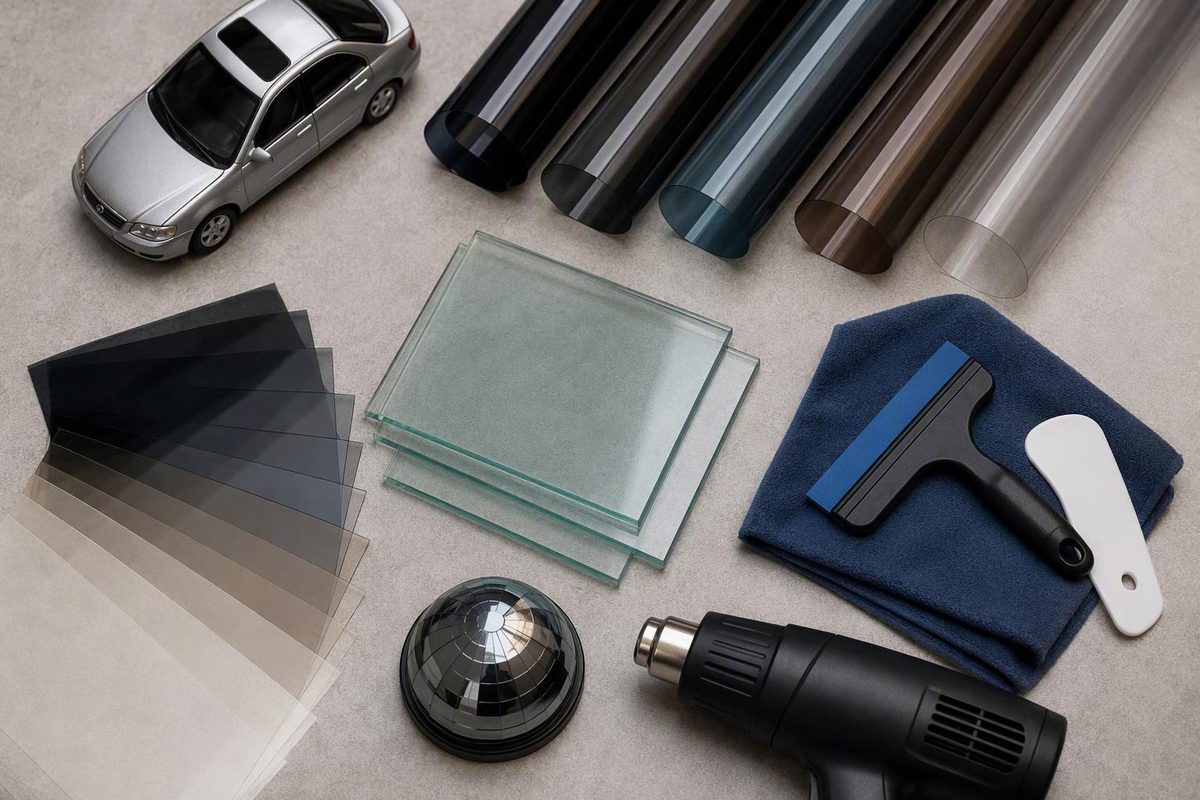
Cooling films are solar-control window films, not a standardized performance grade. For a car, compare total solar energy rejection (TSER) at a legal visible-light transmission. For a home or commercial building, start with solar heat gain coefficient (SHGC) and visible transmittance. In both cases, judge the film on the glass it will actually cover—not by darkness, category name or a headline infrared claim.
Some cooling films are dark, while others are nearly clear. A lighter film can reject more total solar energy than a darker dyed film, so the exact product code and tested specifications matter.
Set the minimum listed VLT you want; the tool identifies the highest-TSER option in this manufacturer comparison.
Compare Four Cooling-Film Specifications
This ranks the listed products by TSER after excluding any below your minimum listed film VLT.
This is the data-sheet VLT, not the finished film-and-glass reading.
Highest Listed TSER
At a 35% minimum listed VLT, IRX 35 has the highest listed TSER: 54% at 39% VLT.
| Product | Type | VLT | TSER |
|---|---|---|---|
| ATC 35 | Dyed | 38% | 35% |
| CTX 35 | Ceramic | 37% | 48% |
| IRX 35 Best | IR ceramic | 39% | 54% |
| AIR 80 | Nearly clear | 77% | 43% |
Source: LLumar 2025 North American automotive performance data on the same stated clear-glass test basis. Manufacturer specifications are not an independent ranking; installed results vary with vehicle glass.
The Numbers That Identify an Effective Cooling Film
| Metric | Where It Matters | How to Read It |
|---|---|---|
| TSER | Primarily automotive data | Higher means more total solar energy is rejected. |
| VLT | Cars and buildings | Higher means more visible light passes through. |
| IRER | Automotive data | Higher means more infrared energy is rejected. |
| SHGC | Building glazing | Lower means less solar heat enters. |
| VT | Building glazing | Higher means more daylight passes through. |
| U-factor | Buildings | Lower means less heat transfer. |
TSER is generally a more useful overall cooling measure than a narrow infrared percentage. VLT describes how much visible light passes through, not how much heat the film rejects. Two products with similar VLT can have substantially different TSER results.
Be cautious with a headline such as “99% infrared rejection.” Infrared tests can cover different wavelength bands, and some results apply to film alone rather than film installed on glass. A percentage without the test range and configuration is difficult to compare with another product.
For example, 3M distinguishes infrared rejection measured over 900–1,000 nm on film alone from IRER measured over 780–2,500 nm while accounting for energy absorbed and reradiated into the car. Its data sheet defines TSER as the total solar energy rejected by filmed glass (3M Crystalline specifications).
UV rejection can help limit interior fading, but it is not a substitute for a heat-rejection figure. Glare reduction is also separate: darker film generally cuts more glare, yet darkness does not guarantee strong cooling performance.
Darker Automotive Film Is Not Necessarily Cooler
A comparison within one manufacturer’s 2025 North American data shows why the product code and test result matter more than a generic label. On the same stated clear-glass test basis, LLumar lists:
- dyed ATC 35 at 38% VLT and 35% TSER;
- ceramic CTX 35 at 37% VLT and 48% TSER;
- infrared-rejecting ceramic IRX 35 at 39% VLT and 54% TSER;
- nearly clear AIR 80 at 77% VLT and 43% TSER.
These are manufacturer specifications, not an independent ranking, and actual results vary with the vehicle glass. They nevertheless show that a substantially lighter film can reject more total solar energy than a darker dyed film (LLumar automotive performance data).
Choose dyed film when appearance, privacy and glare reduction lead the decision, but verify TSER rather than assuming the dark appearance will provide strong heat control.
Compare carbon, ceramic and premium optical films by their data sheets, not by category name alone. A good carbon product can outperform an entry-level ceramic product on an important specification. The useful comparison is between products at similar light levels, as shown in our carbon-versus-ceramic comparison.
A light, high-TSER film can be a better fit when heat control matters but dark glass would be undesirable or unlawful. Factory privacy glass must also be considered separately. Its dark appearance does not automatically provide the solar performance of aftermarket film; use the guidance on privacy glass and window film to decide whether another layer is justified.
Finished VLT Determines Automotive Legality
Tint limits generally concern the finished VLT of the film-and-glass combination, not the film’s advertised VLT or cooling claims. Film marked 35% will normally produce a finished result below 35% when installed over glass that already transmits less than 100% of visible light.
Our final-VLT explanation shows the calculation, but an installer’s meter reading is better than an estimate. Ask for the expected finished VLT on each window, because windshield, front-side, rear-side and back-window rules can differ.
A 1998 NHTSA interpretation explains that, under the federal new-vehicle standard, glazing “requisite for driving visibility” must transmit at least 70% of light at first sale. It also describes restrictions on modifications by manufacturers, distributors, dealers and repair businesses. Vehicle-use, registration and inspection rules after first sale are generally matters for the states (NHTSA interpretation of FMVSS 205).
That interpretation does not establish one universal rule for every vehicle owner or window. Verify the current requirement for each window in every jurisdiction where the vehicle is registered and driven. Windshield film also needs a separate legality and compatibility check.
Building Film Should Be Compared by SHGC and Existing Glass
For residential and commercial glazing, a lower SHGC means less outdoor solar heat enters through the filmed window. A higher VT preserves more daylight. These figures make it possible to compare cooling performance and room brightness without relying on how reflective or dark a sample appears.
The National Fenestration Rating Council says it independently tests, certifies and labels window films for energy efficiency and advises buyers to look for its label (NFRC window-film guidance). Check that a quoted value applies to the proposed film and the relevant glazing configuration.
The appropriate balance depends on the room and its use. A hot west-facing room may justify a low SHGC even if the film reduces some daylight. A storefront may require higher VT and low reflectivity to preserve display visibility. A cooling-dominated building is generally a better candidate for year-round solar-control film than a heating-dominated home that benefits from winter solar gain.
That climate trade-off exists because solar-control film blocks solar gain in winter as well as summer. The NFRC consumer guide describes these films as best suited to cooling-dominated climates and cautions that they generally do not provide substantial insulating benefits (NFRC Consumer Guide). U-factor is the more relevant figure for heat transfer and winter insulation.
Do not accept a universal energy-savings percentage without assumptions for window area, orientation, climate, HVAC efficiency and existing glazing. The draft evidence does not provide one savings figure that applies to every building.
Glass Compatibility Can Limit the Film Choice
Solar-control film reduces heat gain through reflection and absorption. Absorbed energy raises the temperature of the glass, so film cannot be selected from its SHGC or appearance alone.
The NFRC guide recommends checking the window warranty and having the location, glass type and condition assessed for thermal-stress and seal compatibility. This is especially relevant to insulated, laminated, tinted, damaged or partially shaded glazing.
Ask the installer to identify the existing glass and provide written confirmation that the exact film is approved for it. Also check whether the film manufacturer, installer or glass company covers thermal stress, seal failure, removal and replacement. A film warranty and a glass-breakage warranty are not necessarily the same coverage.
Ask for These Seven Details Before Buying
Before approving an automotive or architectural cooling-film installation, request:
- The exact manufacturer and product code, not merely “ceramic,” “nano” or “heat-blocking.”
- A current data sheet showing TSER and VLT for a car, or SHGC and VT for a building.
- The test configuration, including whether the result is for film alone or film applied to specified glass.
- The expected finished VLT on every vehicle window, with confirmation against current local rules.
- Written glass-compatibility approval for a building installation, including thermal-stress and insulated-glass restrictions.
- The warranty terms, including who provides coverage, whether professional installation is required, and whether labor, removal or glass failure is excluded.
- An itemized quote covering film, preparation, old-film removal, difficult glass and any windshield or oversized-pane work.
A credible cooling film is the exact product with verifiable solar performance at the light level you need. It must also be compatible with the glass and, on a vehicle, produce a finished VLT that complies with the applicable rule.