
Smart Glass Can Replace Some Shading—but Not Every Tint Job
Compare smart glass with car window tint: GM’s adaptive windshield patent, heat rejection, retrofit availability, visibility and legal checks.
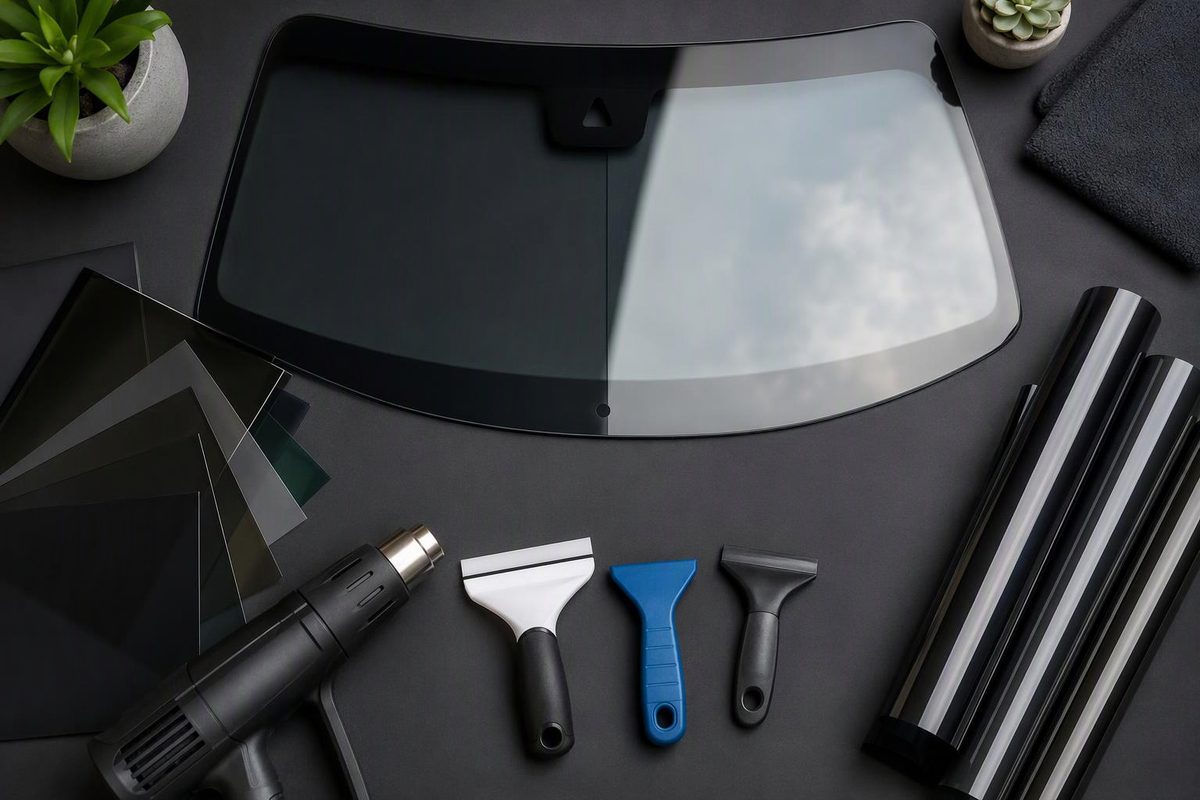
Smart glass could replace some fixed shading, but it is not yet a reason to postpone tinting the car you already own. As of October 29, 2026, coexistence is the more practical purchasing assumption: electrically controlled glass for selected factory applications, and conventional window film for owners improving existing glass.
The distinction matters. A roof that switches from clear to shaded, a windshield that dims only the sun’s position, and ceramic film installed on side windows solve different problems.
What smart glass can do that fixed tint cannot
Conventional tint has a fixed visible light transmission, or VLT. It cannot become lighter for night driving or darken only one small area when the sun moves into view.
Smart glass changes its optical state electrically, but the technology behind that change matters:
- Electrochromic glass darkens through an applied voltage. GM’s proposed adaptive windshield uses this approach.
- Suspended particle device (SPD) glass provides adjustable shading while retaining a view through the glass.
- Polymer dispersed liquid crystal (PDLC) glass switches between transparent and an opaque or frosted-looking state. That is not the same result as transparent dark tint.
Automotive supplier Gauzy describes these technologies separately. Do not buy a product labeled “smart tint” without establishing whether it dims the view or obscures it—especially for glass you need to see through while driving.
This is more than a patent-stage category. Porsche documented an optional Taycan panoramic roof in 2022 with nine controllable segments, clear and partially matte settings, and a matte-white state without power. Its layered construction also uses coatings for solar reflection and insulation. That is an example of smart glass replacing a roof sunshade, not proof that it replaces side-window film. Porsche’s technical explanation makes that distinction useful.
GM’s adaptive windshield is a proposal, not a tint appointment
GM Authority’s August 2026 report identifies a GM patent application for an adaptive shading window. The application was filed February 4, 2025, and published August 6, 2026.
The proposed system divides electrochromic glass into independently controlled regions called pixels. A driver-facing camera tracks head position, gaze and reflections in the driver’s eyes. The controller maps a bright object to the relevant pixels and darkens those areas rather than the whole windshield. Another version uses route and GPS information to anticipate the sun’s position. The disclosure also covers side windows. The application describes the system and its alternatives.
That could address a limitation of fixed tint: reducing a concentrated glare source without darkening the rest of the scene. But the application is not a production announcement, a retail price or evidence of demonstrated safety performance. It also acknowledges a switching delay in some implementations and discusses smaller pixels as one way to reduce it.
Treat the proposal as a possible future vehicle feature. Its publication does not establish that you can buy it instead of your next film installation.
Why adjustable darkness does not settle the heat question
Darkness, glare reduction and heat rejection are separate comparisons. A smart window’s ability to change appearance does not, by itself, establish how much solar heat the complete glazing rejects.
Conventional ceramic film already offers solar-control performance without electrical controls. For example, 3M lists its Ceramic IR series in multiple VLT levels and claims up to 66% total solar energy rejection across the series. That maximum is not a promise for every shade or glass combination, nor a direct comparison against smart glass.
Ask for:
- VLT: how much visible light passes through the finished glass.
- Total solar energy rejected (TSER): solar-control performance, rather than darkness alone.
- UV rejection: a separate specification, not a substitute for heat-rejection data.
- For smart glass: those measurements in each operating state, plus switching time, haze and the state after a power failure.
Compare equivalent glazing and test conditions. An “up to” infrared-rejection claim should not be treated as the percentage of all solar heat rejected. Our guide to cooling-film performance measures explains what to request.
What to choose for your vehicle now
For an existing car: compare legal film options and professional installation quotes. An interior-applied ceramic film such as the 3M product above does not require the camera, controller and specialized glazing described in GM’s application. Gauzy’s automotive page currently says it works exclusively with OEMs and Tier 1 suppliers, with an aftermarket solution intended for the future. That does not rule out other aftermarket products, but it does limit that supplier’s direct retrofit offering.
For a new car with a smart roof: evaluate the actual option. Check its clear-state appearance, heat performance, power-off behavior, warranty exclusions and replacement-glass quote. Do not assume a smart roof means the remaining windows need no film. Separately assess whether factory privacy glass needs window film.
For a switchable windshield or front-side retrofit: verify legal suitability before paying. Being able to switch clear is not proof of compliance. For example, Texas DPS guidance specifies at least 25% light transmission and no more than 25% luminous reflectance for applied sunscreening devices combined with the original glass beside the driver. It also restricts windshield sunscreening placement, with a separate allowance for clear, untinted UV film. Texas Transportation Code §547.613 confirms the side-window thresholds and sets out exceptions. These rules do not establish approval of GM’s proposed system or any particular switchable retrofit.
Confirm current rules with your state DMV or responsible vehicle authority. Then choose by the problem you actually have: adjustable roof shade, targeted glare, cabin heat or privacy—not by whether the product is called “smart.”