
How Dark Can Your Vehicle Windows Legally Be in North Carolina?
The 32% figure is not a separate legal tint limit, and a reading of exactly 32% does not receive the statutory presumption.
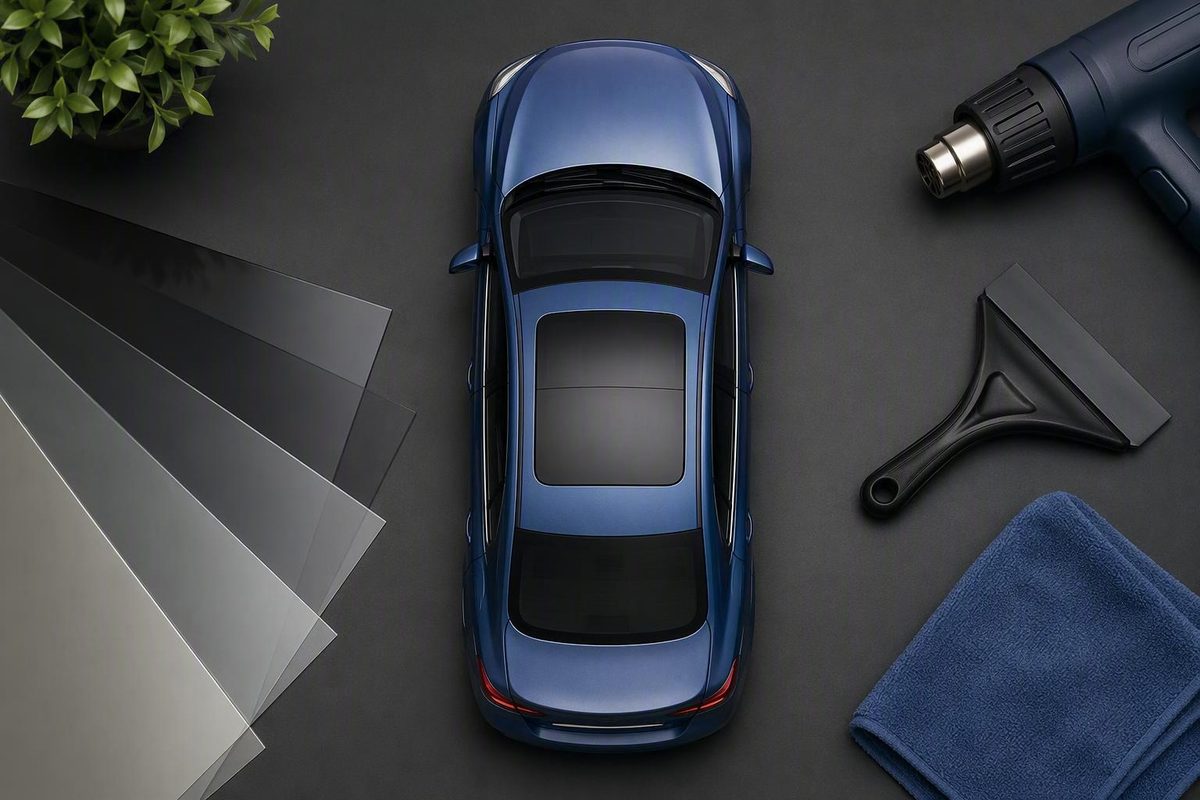
North Carolina tint limits at a glance
North Carolina legal tint generally means that each regulated window must transmit at least 35% of visible light through the completed glass-and-film assembly. A reading of more than 32% on a light meter approved by the Commissioner creates a conclusive presumption that the window complies. The 32% figure is not a separate legal tint limit, and a reading of exactly 32% does not receive that statutory presumption. Current official guidance is available through the North Carolina Division of Motor Vehicles.
Vehicle classification matters. Ordinary passenger cars generally must satisfy the transmission requirement on their front-side, rear-side, and rear windows. For a qualifying multipurpose vehicle, the transmission and reflectance restrictions do not apply to windows behind the driver. Windshields remain subject to a separate placement rule regardless of vehicle class.
| Window | Ordinary passenger car | Qualifying multipurpose vehicle |
|---|---|---|
| Windshield | Ordinary tint may extend through the top five inches or to the AS-1 line, whichever permitted boundary extends farther down. Qualifying untinted clear UV-reducing film receives separate treatment. | Same rule. The windshield does not receive the vehicle-class exceptions available for certain other windows. |
| Front-side windows | At least 35% total VLT. Completed-window reflectance may not exceed 20%. | At least 35% total VLT. The behind-the-driver exception does not cover these windows. |
| Rear-side windows | Generally at least 35% total VLT, with no more than 20% reflectance. | If the windows are behind the driver, the statutory transmission and reflectance restrictions do not apply. |
| Rear window | Generally at least 35% total VLT, with no more than 20% reflectance. | Generally within the behind-the-driver exception, so the transmission and reflectance restrictions do not apply. |
These distinctions are reflected in current commercial compliance summaries, but the legal classification and statutory text control—not the vehicle’s advertising label or general body shape. One current 2026 North Carolina tint overview likewise distinguishes passenger-car windows from the rear windows of qualifying multipurpose vehicles.
Tinting film or other material must be nonreflective and cannot be red, yellow, or amber. The completed tinted window may not exceed 20% light reflectance. The reflectance ceiling should not be treated as permission to install deliberately mirrored film; the material itself is separately required to be nonreflective, as summarized in this North Carolina tint-law update.
A vehicle sold as an SUV, crossover, van, or truck is not automatically entitled to unrestricted rear tint. The statutory definition—not a dealer listing, marketing category, or visual impression—determines whether the behind-the-driver exception applies.
Reviewed: August 23, 2026. Tint laws and administrative procedures can change. Confirm the current rule with NCDMV immediately before installation, especially if the vehicle classification, medical-permit status, or windshield treatment is uncertain.
Why the law says 35% when drivers also hear 32%
VLT means visible light transmission. It is the percentage of visible light that passes through a window. A higher VLT percentage represents a lighter, more transparent window; a lower percentage represents a darker window.
North Carolina’s substantive requirement is that a regulated tinted window transmit at least 35% of visible light. The statute then supplies an evidentiary measurement rule: if a Commissioner-approved light meter reads more than 32% total light transmission, the window is conclusively presumed to comply with the 35% restriction. These provisions appear in G.S. 20-127.
The two figures therefore perform different functions:
- 35% is the underlying total-light-transmission requirement.
- More than 32% is the threshold for the statutory conclusive presumption.
- 32% is not a recommended film shade.
- Exactly 32% does not receive the presumption, because the statute says “more than” 32%.
- Neither figure guarantees that film with a particular package rating will produce a compliant finished window.
Describing the law simply as “North Carolina allows 32% tint” is incomplete. It turns a statutory measurement provision into a design specification for film, even though the law evaluates the completed tinted window.
VLT applies to glass and film together
The relevant result is the amount of light passing through the finished window, including the factory glass and any aftermarket film.
As a simplified illustration, suppose the existing glass transmits 80% of visible light and the selected film transmits 35%. The approximate combined VLT would be:
0.80 × 0.35 = 0.28, or 28% total VLT
In that hypothetical, film labeled 35% would produce a completed window substantially below the 35% standard. Actual glass and film performance vary, so this calculation is an illustration rather than a substitute for measurement. Commercial installer guidance also warns that factory glass can cause nominal 35% film to produce a finished reading below 35%.
The practical lesson is straightforward: do not choose film solely from the percentage printed on its package.
Measure before and after installation
Before selecting film, ask the installer to meter the untreated glass on every regulated window.
The installer can then estimate the expected total VLT of the glass-and-film assembly. A cautious installation should leave a reasonable compliance margin rather than attempting to finish as close to the statutory presumption threshold as possible.
After installation, request a meter reading for each regulated window. Do not assume that one side of the vehicle or a sample pane represents every window. Retain:
- The installation invoice
- The film manufacturer and product information
- The film’s stated VLT and reflectance specifications
- Written post-installation readings identifying each window
- Any warranty or installer documentation
They do not, however, override an official measurement, change the statute, or guarantee the outcome of a citation.
Passenger cars versus qualifying multipurpose vehicles
For an ordinary passenger car, North Carolina generally regulates:
- The driver’s and front passenger’s side windows
- The rear-side windows
- The rear window
Those windows generally must provide at least 35% total VLT and no more than 20% light reflectance.
A qualifying multipurpose vehicle receives different treatment. For that vehicle class, the transmission and reflectance restrictions do not apply to windows behind the driver. The driver’s and front passenger’s windows remain regulated.
This means two similar-looking vehicles may lawfully have different rear-window configurations. A passenger car generally must maintain compliant VLT on its rear-side and rear windows, while a legally qualifying multipurpose vehicle may use substantially darker glass or film behind the driver.
What counts as a multipurpose vehicle?
In practical terms, a qualifying multipurpose vehicle is a passenger vehicle that:
- Is designed to carry 10 or fewer passengers; and
- Is constructed on a truck chassis or has special features designed for occasional off-road operation.
The statutory definition expressly includes minivans and pickup trucks. Commercial comparison guides also show different rear-window treatment for cars and multipurpose vehicles, but an individual vehicle must still fit the legal definition rather than merely a broad retail category. A North Carolina car and multipurpose-vehicle comparison illustrates that distinction.
A conventional pickup or minivan may be relatively straightforward. A crossover can be less obvious because its model name and body shape do not necessarily establish how it is constructed or classified. The same caution applies to vehicles generically advertised as vans, utility vehicles, or trucks.
When classification is uncertain, check:
- The body or vehicle type shown on the registration
- Manufacturer documentation
- Vehicle identification and certification labels
- Current information from NCDMV
- Qualified legal guidance for an unusual or disputed classification
Do not rely solely on a dealer listing, insurance shorthand, online advertisement, or an installer’s visual impression.
“Behind the driver” is the operative location
Even when a vehicle qualifies as multipurpose, the exception is tied to the position of the window. It applies to qualifying windows behind the driver; it does not make every piece of glass unrestricted.
For example:
- The driver’s side window remains regulated.
- The front passenger’s side window remains regulated.
- Rear door glass behind the driver may receive the exception.
- Cargo-area side glass may receive the exception.
- The rear window may receive the exception.
- The windshield remains subject to the separate windshield rule.
This distinction matters on vehicles with several seating rows, small quarter windows, extended cabs, or unusual glass arrangements. First determine the vehicle’s legal classification, then identify each window’s position relative to the driver.
The rear-window exception is limited
The multipurpose-vehicle provision removes specified transmission and reflectance restrictions from windows behind the driver. It should not be read as a blanket waiver of windshield placement, prohibited-color rules, traffic-stop obligations, or any applicable federal requirement.
North Carolina also identifies limited exceptions for certain excursion passenger vehicles, motor homes, ambulances, limousines, law-enforcement vehicles, and specified property-hauling vehicle rear windows. Those exceptions vary in scope. Specialized use alone does not establish that every window or every type of tint is exempt.
Windshield placement, reflectance, and prohibited colors
North Carolina regulates ordinary windshield tint by placement, rather than applying the standard 35% rule across the windshield.
Tint may run along the top and extend through the top five inches or to the AS-1 line, whichever permitted measurement extends farther down.
             TOP EDGE OF WINDSHIELD
        ┌───────────────────────────────┐
        │       Permitted top band      │
        │                               │
        ├ - - - five-inch boundary - - ┤
        │                               │
        ├ - - - - AS-1 line - - - - - ┤
        │                               │
        │   Ordinary viewing area:      │
        │   no ordinary tinted brow     │
        │   below the farther-permitted │
        │   boundary                    │
        └───────────────────────────────┘

Use whichever permitted boundary extends farther down.
Diagram not to scale.
If the AS-1 line is lower than the five-inch measurement, tint may extend to that line. If the five-inch boundary extends farther down, the five-inch measurement controls. A commercial summary similarly describes the top-five-inch or AS-1 rule, whichever is longer.
The windshield rule applies without the vehicle-class exceptions available for some other windows. A qualifying pickup, minivan, or other multipurpose vehicle cannot use its behind-the-driver exception to extend ordinary tint farther down the windshield.
Clear UV-reducing windshield film
The statute separately allows an untinted clear film that does not obstruct vision and reduces or eliminates ultraviolet radiation. This is distinct from permission to install ordinary dark tint across the windshield.
A product described in advertising as “clear” should still be assessed in its installed form. The relevant legal questions include whether it is actually untinted and whether it obstructs vision. A marketing description by itself does not determine compliance.
Reflectance has two components
North Carolina’s wording creates two related requirements:
- The completed tinted window may have no more than 20% light reflectance.
- The film or other material used to tint the window must be nonreflective.
The first concerns the measured reflectance of the completed window. The second concerns the character of the applied material. The 20% ceiling is therefore not affirmative permission to install mirrored or deliberately reflective film.
Ask for written product specifications before installation. If a film has an obviously mirrored appearance or the seller cannot explain whether it is nonreflective, selecting a different product is a conservative compliance choice.
Prohibited colors
Red, yellow, and amber tinting materials are prohibited. Color and darkness are separate compliance questions: a relatively light film can still be impermissible because of its color or reflective character, while a neutral-colored film can be impermissible because the completed VLT is too low.
The statute does not establish a broader prohibition on every color-shifting product. Drivers who want such a film should nevertheless verify its actual color and specifications rather than relying on a product name or sample photograph.
What changed on December 1, 2025—and what did not
North Carolina stopped including window-tint testing in annual vehicle safety inspections on December 1, 2025. The change did not repeal the darkness, windshield-placement, reflectance, or prohibited-color rules. Police may still measure and enforce suspected unlawful tint during a traffic stop, as reported by Spectrum News.
The key distinction is between an inspection procedure and a road-use restriction:
- An inspection procedure determines what an inspection station checks during the annual safety inspection.
- A road-use restriction governs whether the vehicle complies while operated on a highway or public vehicular area.
North Carolina changed the first. It did not eliminate the second.
Before-and-after timeline
Before December 1, 2025
- Aftermarket tint was checked through the annual safety-inspection process.
- The tint test carried a separate $10 charge.
- The inspection supplied a recurring compliance checkpoint.
From December 1, 2025 forward
- Annual safety inspections no longer include tint testing.
- The separate tint-testing charge is no longer collected.
- A vehicle can complete its annual inspection without receiving a tint measurement.
- Existing darkness, windshield-placement, color, and reflectance restrictions continue.
- Suspected unlawful tint may still be addressed during a traffic stop.
Contemporary reporting described both the removal of the inspection checkpoint and the end of the former $10 charge while emphasizing that the underlying law remained in force. The Charlotte Post’s November 2025 report provides additional context on that transition.
A vehicle’s post-December 1, 2025 inspection result therefore says nothing conclusive about whether its tint was legal. “It passed inspection” is no longer proof that an inspection station measured the windows.
This is particularly important for used-car buyers. A current inspection, registration renewal, recently issued plate, or dealer sale does not establish that the existing tint complies.
The approached-side window rule
When a law-enforcement officer approaches a vehicle with tinted windows, the tinted window on the officer’s approach side must be lowered.
In practice:
- If the officer approaches from the driver’s side, lower the tinted driver’s-side window.
- If the officer approaches from the passenger’s side, lower the tinted passenger-side window.
This is an approach-side requirement, not merely a standing instruction to lower one particular window at every stop. The supplied evidence does not resolve how the rule applies to a mechanically inoperable window or establish separate procedural rights concerning a disputed roadside meter test, so drivers facing those circumstances should seek current official or legal guidance.
Medical tint exceptions and required proof
A qualifying photosensitive person may apply for a medical exception permit allowing tint that differs from the ordinary restrictions. The exception is not a general authorization to use any darkness on any vehicle.
A medical permit is:
- Vehicle-specific
- Window-specific
- Required to state the permitted tint levels
- Generally valid for no more than five years
- Potentially valid for a shorter period if directed
- Required to be carried in the applicable vehicle
A permit therefore should not be assumed to follow its holder automatically into every borrowed, household, replacement, or newly purchased vehicle. Its scope depends on the vehicle and windows identified in the permit.
A medical-exception sticker must be displayed at the lower-left corner of the rear window. Failure to display the required sticker is an infraction carrying a statutory $200 fine. These requirements are also summarized in a commercial overview of North Carolina medical tint permits and sticker placement.
The medical sticker requirement should not be converted into either of two broader claims: that every ordinary legal tint installation requires a state exemption sticker, or that North Carolina never requires any tint-related sticker. The supported requirement discussed here applies specifically to a vehicle operating under a medical exception.
Because forms and administrative procedures can change, consult current NCDMV window-tint information and request the current medical-exception materials before relying on a permit. Confirm:
- The current application form
- Required physician documentation
- Eligibility criteria
- Vehicle and window information that must be submitted
- Permitted tint levels
- Sticker instructions
- Permit duration
- Renewal or recertification requirements
Do not install darker medical tint first and assume approval can be obtained afterward. Resolve the permit, vehicle, window, and documentation requirements before operating the vehicle under the claimed exception.
Violations, corrective action, and limited exceptions
Applying unlawful tint to a covered vehicle or driving a noncompliant vehicle on a highway or public vehicular area can constitute a Class 3 misdemeanor. The statute does not support describing every case as a universal “$50 tint ticket” or promising a fixed total after court costs.
North Carolina also provides a potential corrective defense when unlawful tint is removed within 15 days and compliance is certified by the Division of Motor Vehicles or the Highway Patrol. This is a conditional statutory defense, not an automatic guarantee of dismissal. The offense, defense, out-of-state exception, and federal-compliance provisions are set out in G.S. 20-127.
If tint is suspected to be unlawful:
- Obtain a reliable measurement of every regulated window.
- Confirm the vehicle’s legal classification.
- Identify whether the issue concerns VLT, windshield placement, reflectance, color, or medical documentation.
- Preserve the citation, installer invoice, film specifications, and available meter records.
- If pursuing the 15-day corrective defense, promptly determine what certification is required and who may provide it.
- Do not assume that removal alone satisfies every statutory or court requirement.
The statute also provides a limited exception for an out-of-state vehicle that complies with the tint requirements of its state of registration. The supplied evidence does not resolve every issue that may arise when an owner moves to North Carolina or the vehicle later becomes subject to different registration requirements. A recently relocated owner should confirm the vehicle’s status with NCDMV or a qualified North Carolina attorney.
Vehicles governed by Part 393 of Title 49 of the Code of Federal Regulations must comply with that federal Part. Owners of commercial or otherwise federally regulated vehicles should determine whether federal requirements apply in addition to state law.
Limited exceptions commonly remove specified transmission and reflectance restrictions rather than every tint-related rule. Do not assume that an exception for a vehicle or rear window also waives windshield placement, prohibited-color, traffic-stop, documentation, or federal requirements.
A driver who has received a citation, disputes a meter result, wants to use the corrective defense, or owns an unusually classified vehicle should consult NCDMV or a qualified North Carolina attorney. General compliance information cannot determine the outcome of an individual stop, charge, hearing, or criminal case.
A pre-installation and used-car compliance checklist
Use this checklist before paying for an installation or accepting delivery of a tinted used vehicle.
1. Confirm the legal vehicle classification
Do not assume that every SUV, crossover, pickup, van, or minivan receives identical treatment. Check the registration and manufacturer information. Ask NCDMV when the classification remains unclear.
2. Identify every regulated window
Mark which windows are in front of the driver and which are behind the driver. On an ordinary passenger car, expect the front-side, rear-side, and rear windows to be regulated. On a qualifying multipurpose vehicle, identify exactly which windows are eligible for the behind-the-driver exception.
3. Meter the existing glass
Have every relevant window measured before selecting film. Check both sides because replacement glass, prior film, or other differences can produce unequal readings.
4. Select film by expected total VLT
Use the existing glass measurement to estimate the completed glass-and-film VLT. Do not choose a film solely because its package says 35%. The finished window may meter lower than the film’s advertised rating.
5. Leave a reasonable compliance margin
Do not treat the more-than-32% statutory presumption as the ideal design target.
6. Check the windshield boundary
Locate the AS-1 line and measure five inches from the top of the windshield. Use the permitted boundary that extends farther down, and ensure the tint brow does not continue below it. Treat full-windshield clear film as a separate issue requiring confirmation that the material is untinted and does not obstruct vision.
7. Reject prohibited or questionable material
Do not accept red, yellow, or amber tinting material. Avoid mirrored or deliberately reflective products rather than relying on an informal statement that the completed window will remain under the reflectance ceiling.
8. Obtain post-installation readings
Request a meter reading for each regulated window after installation. Keep a written record identifying the vehicle, window, film product, and measured total VLT.
9. Retain installation records
Keep the invoice, film specifications, warranty, and meter results. These records do not override an official measurement, but they help establish what was installed.
10. Inspect a used vehicle independently
Do not assume existing tint is lawful because a dealer sold the vehicle, a previous owner drove it for years, or the registration is current. Meter the windows and inspect the windshield brow, film color, and reflectance before purchase or during any return period.
11. Do not rely on a post-2025 inspection
Passing an annual safety inspection after December 1, 2025 does not establish tint compliance because window-tint testing is no longer part of that inspection.
12. Verify medical-exception documents
If the vehicle relies on a medical exception, confirm that the permit identifies that vehicle and the relevant windows. Carry the permit and verify that the required sticker is displayed at the lower-left corner of the rear window.
13. Recheck the current rules before installation
Review the current text of G.S. 20-127 and current NCDMV guidance immediately before the work is performed. Ask the installer to explain how the selected product will comply on the completed window—not merely what percentage appears on the package.
Window Tint Central is an informational publisher covering tint legality, film, costs, and installation. It is not NCDMV, a tint installer or seller, or a provider of individualized legal advice.
Frequently asked questions
Is 35% tint legal in North Carolina, or does the window have to read above 35%?
The legal standard for a regulated window is at least 35% total VLT through the completed glass-and-film assembly. A reading of more than 32% on a Commissioner-approved meter receives a conclusive presumption of compliance, so a window does not have to read above 35% to receive that presumption.
A reading of exactly 32% does not receive it. Commercial compliance guidance also distinguishes the 35% substantive standard from the above-32% meter provision.
Do not confuse either figure with a guarantee that film labeled 35% will be legal after installation. The package rating describes the film, while the completed glass-and-film assembly determines total VLT.
Can I use any tint darkness on the rear windows of an SUV, minivan, or pickup?
Only when the vehicle meets the statutory multipurpose-vehicle definition and the windows are behind the driver. Minivans and pickup trucks are expressly included in the definition, but labels such as SUV, crossover, truck, or van should not be the sole basis for claiming the exception.
Even when the exception applies behind the driver, the front-side windows remain regulated. Other requirements may also continue to apply. Commercial comparison charts showing darker rear tint for SUVs, vans, and similar vehicles should therefore be read subject to the statutory classification.
Can police enforce illegal tint now that annual inspections no longer test it?
Yes. Removing tint testing from annual inspections did not repeal North Carolina’s substantive tint restrictions. A vehicle can complete its inspection without a tint measurement and still be subject to roadside measurement and enforcement.
When an officer approaches a vehicle with tinted windows, the tinted window on the approach side must be lowered. Spectrum News reported both the continued roadside enforcement and the driver-side or passenger-side approach rule.
Does North Carolina allow tint below the windshield’s AS-1 line?
Ordinary windshield tint may extend through the top five inches or to the AS-1 line, whichever permitted boundary extends farther down. Tint may therefore extend below the AS-1 line when the five-inch measurement reaches farther, but it cannot extend below the farther lawful boundary.
Untinted clear film that does not obstruct vision and reduces or eliminates ultraviolet radiation receives separate treatment. The alternative five-inch and AS-1 boundaries are also described in this North Carolina tint-law summary.
Does film labeled 35% guarantee a legal finished window?
No. Factory glass already reduces visible-light transmission. Installing film rated at 35% over that glass can produce a completed window with total VLT below 35%.
Have the existing glass measured first, select film according to the expected combined VLT, and request a post-installation reading for every regulated window. A current 2026 installer guide likewise emphasizes that VLT applies after the factory glass is taken into account.
Keep the readings and product information for your records, but remember that installer paperwork and private measurements do not override an official legal measurement.
The concise compliance rule is: start with the 35% total-VLT standard, confirm whether a behind-the-driver exception actually applies to the vehicle, and measure the completed glass-and-film assembly. Do not mistake the end of annual tint testing for repeal of the law. Review current G.S. 20-127 and NCDMV guidance before installation or when addressing a citation, medical exception, or uncertain vehicle classification.