
Compare Tint Darkness, Visibility and Finished VLT
Compare 5%, 20%, 35%, 50% and 70% tint levels, estimate finished VLT, and weigh visibility, privacy, heat rejection and legal limits.
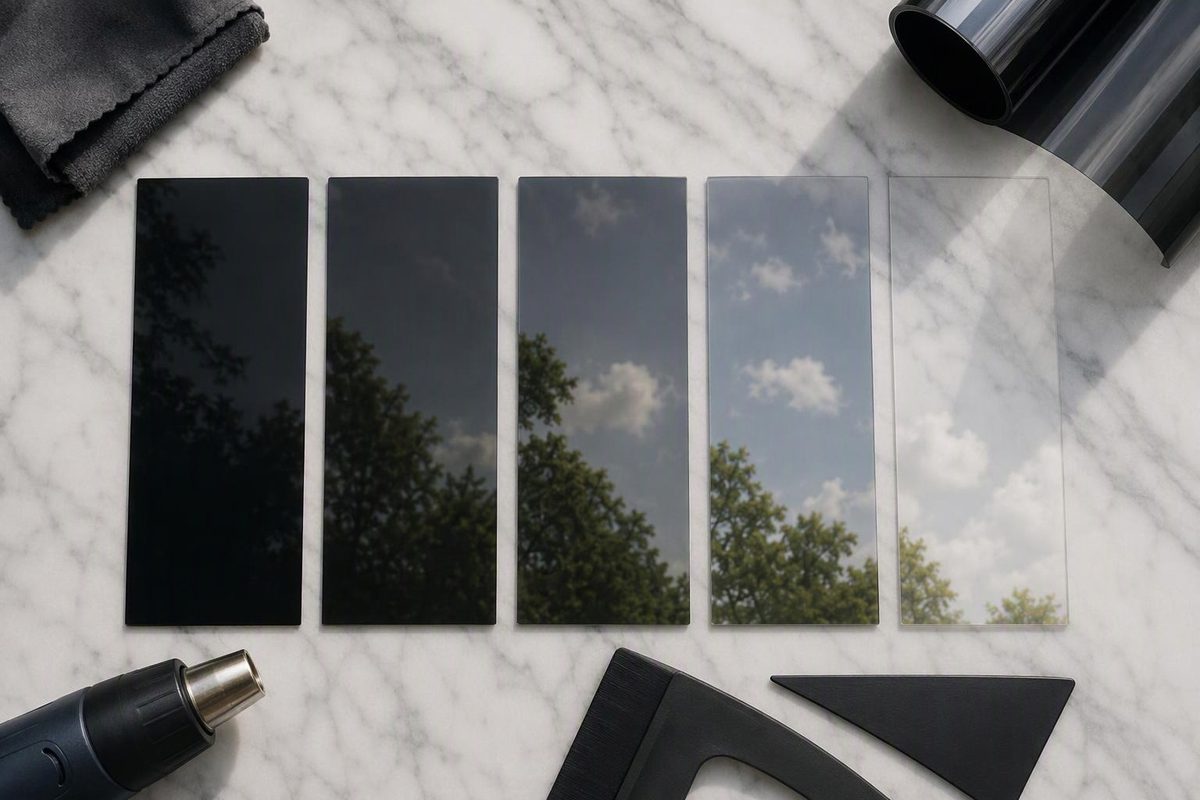
A tint level is its visible light transmittance (VLT): the percentage of visible light that passes through filmed glass. Higher percentages are lighter; lower percentages are darker. A 70% tint is comparatively light, while 5% tint is very dark. The practical choice depends on the window, nighttime visibility, desired privacy and the law wherever the vehicle will be driven.
Enter the glass and film VLT to estimate the finished window.
Finished VLT Estimator
Use measured bare-glass VLT when available. The film number should come from the specific product sheet.
Compare With A Legal Minimum
Estimated Finished VLT
~28%
No legal minimum entered. Verify the completed window with a meter.
Formula: glass VLT × film VLT. For the default values, 0.80 × 0.35 = 0.28.
Source note: Calculation method and product-variation caveat are based on the article’s cited LLumar performance data. Results are estimates; glass, product tolerances and meter accuracy can change the reading.
Common Tint Levels Compared
| Tint level | Appearance | Main trade-off | Sensible use, where legal |
|---|---|---|---|
| 70% | Nearly clear | Preserves the most visible light but adds little privacy | Minimal appearance change with suitable heat or UV specifications |
| 50% | Light | Mild glare reduction without a heavily tinted look | Drivers prioritizing visibility and a subtle finish |
| 35% | Medium | Noticeable shade and some privacy, with less light available at night | Permitted side or rear windows |
| 20% | Dark | Stronger daytime privacy with a substantial low-light visibility compromise | Rear side and rear glass where permitted |
| 5% | Very dark; often called “limo tint” | Strong privacy but very limited outward visibility in darkness | Specialty or rear-window applications where expressly legal |
These descriptions are relative, not a promise of appearance. The same film can look darker on a vehicle with a black interior, a small cabin or existing privacy glass. Bright weather and a pale interior can make it look lighter. For a more focused comparison, see how common ceramic tint percentages differ.
The Advertised Percentage May Not Be The Finished VLT
Two details routinely cause ordering mistakes.
First, a product name is usually a shade category rather than a guarantee of an exact meter reading. In LLumar’s North American performance sheet, products carrying “35” in the name have published VLT figures from 37% to 39%, while products named “50” range from 53% to 60%, depending on the series. The manufacturer also says actual results vary with the glass and its properties (LLumar performance data, August 2025).
Second, film is installed over glass that already transmits less than 100% of visible light. Estimate finished VLT by multiplying glass VLT by film VLT, with both percentages converted to decimals.
If the original glass meters at 80%, the estimated results are:
| Film VLT | Glass VLT | Estimated finished VLT |
|---|---|---|
| 70% | 80% | 56% |
| 50% | 80% | 40% |
| 35% | 80% | 28% |
| 20% | 80% | 16% |
| 5% | 80% | 4% |
For example, 0.80 × 0.35 = 0.28, or 28% estimated final VLT. Putting “35% film” on a window therefore does not necessarily produce a legal 35% window. The detailed 35% tint guide covers this distinction further.
Treat the calculation as an estimate. A shop should meter the bare glass and the completed window because product tolerances, glass type and meter accuracy can change the reading.
Tint Darkness Does Not Determine Heat Rejection
VLT describes visible light, not total solar heat performance. Darker film often reduces more glare within the same product line, but that does not mean every dark film rejects more heat than every light film.
LLumar’s published values illustrate the difference. Its 5% VLT dyed ATC film lists 44% total solar energy rejection (TSER), while its much lighter IRX ceramic product—listed at 54% VLT—has 50% TSER. Those figures were measured on specified clear glass and should not be transferred directly to a different vehicle, but they show why shade alone cannot rank heat control (LLumar performance data).
3M likewise publishes Crystalline products intended to reject substantial heat at relatively light VLT levels and defines TSER as the percentage of total solar energy rejected by filmed glass (3M Crystalline brochure).
When heat is the goal, compare the manufacturer’s TSER on the same glass and at similar VLT, not a headline infrared figure measured over an unexplained wavelength range. Film construction and price matter too; carbon and ceramic tint should be compared by matched specifications rather than category name alone.
Choose Front And Rear Window Tint Separately
Start with the front side windows because they affect intersection checks, turns and mirror use. If you regularly drive after dark, a lighter compliant level is the conservative choice.
In an archived U.S. Department of Transportation study, 24 subjects tried to detect a stationary pedestrian in vehicle rear-view mirrors. Increasing tint was associated with more detection failures, shorter detection distances and greater variation among subjects (USDOT ROSA P study record). The study’s result applies to that mirror-detection task and should not be treated as a measurement of every driving situation.
Treat rear glass separately. Rear-window limits often differ from front-side limits, and SUVs or vans may be treated differently from passenger cars. Existing factory privacy glass also means the rear may already be dark before film is added.
Set privacy expectations realistically. A 20% or 5% film can make the cabin difficult to see into during daylight, but tint is not one-way privacy. Interior lights at night can expose the cabin.
Before choosing, ask the installer to place actual film samples against the cleaned glass. View them from inside and outside in daylight, shade and a dim parking area rather than relying on a backlit display.
Tint Laws Apply By Window And Vehicle Type
There is no universally legal tint level in the United States. Rules can vary by state, windshield area, front or rear window, vehicle class, reflectivity and medical-exemption status.
Official rules also show why the combined film-and-glass result matters. Texas requires the side windows immediately beside the driver to provide at least 25% light transmission when the film and original glass are measured together. Its windshield strip, rear-window and mirror provisions are different (Texas Department of Public Safety).
Minnesota generally prohibits regulated side or rear windows below 50% VLT, with a stated tolerance and exceptions for specified vehicles and medical needs (Minnesota Statutes §169.71). These examples apply only to their stated jurisdictions and provisions.
Before installation, verify the current official rule for every window and vehicle type in each place the vehicle will be operated. Ask the installer to write the proposed film series, nominal shade and expected final meter reading on the quote. That is more useful than requesting “legal tint” without identifying the glass, vehicle and window.