
How Light 70% Window Tint Really Looks on a Car
When 70% refers to visible light transmission (VLT), the tint looks very light—nearly clear—with only a faint smoked or shaded effect. It normally preserves a…
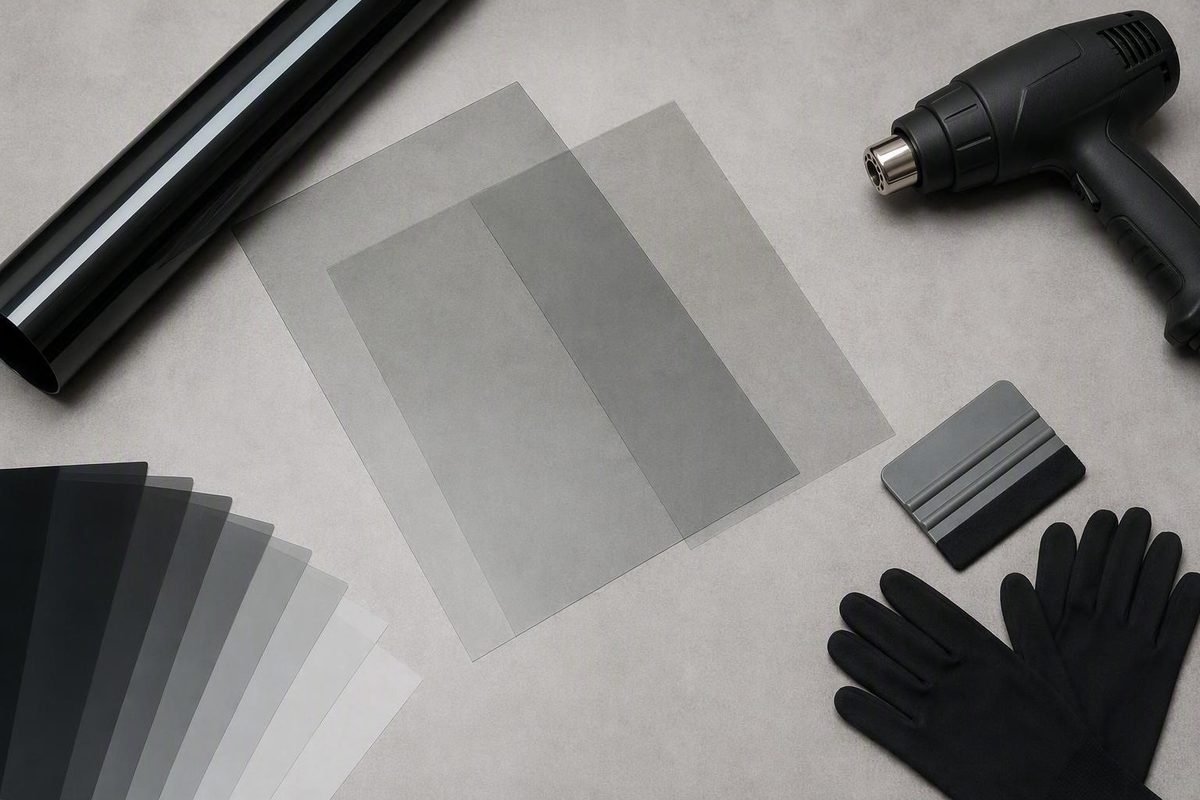
The short answer: 70% tint looks almost clear
When 70% refers to visible light transmission (VLT), the tint looks very light—nearly clear—with only a faint smoked or shaded effect. It normally preserves a factory-like exterior rather than creating the dark-window appearance associated with privacy tint. Commercial tint guides consistently describe 70% VLT as subtle or barely visible at first glance (UPPF’s comparison of 70% tint and untreated glass).
From outside the car, the glass may look slightly more filtered than an untreated window, particularly when the two are directly beside each other. At other angles, reflections from the sky, buildings, pavement, or nearby vehicles can dominate the view and make the difference harder to judge.
Expect occupants, seats, and objects inside the cabin to remain visible in ordinary conditions. Reflections and a dark interior may conceal some detail temporarily, but 70% tint is not a dependable privacy treatment.
From inside, the view generally remains bright. The change is more likely to register as a mild reduction in brightness or a subtle color cast than an obvious sense of looking through dark film. The effect depends on the original glass, film hue, weather, viewing conditions, and the driver’s sensitivity to reduced light.
A practical description is:
- At first glance: close to clear
- Beside untreated glass: faintly shaded
- In bright daylight: potentially easier to notice
- From inside: bright, with a subtle filter
- For privacy: weak
- For dramatic styling: usually too light
This is a text-based visual guide, not a controlled photographic demonstration. No single image can reproduce how 70% tint will look across different vehicles, camera exposures, screens, interiors, films, and lighting conditions. A physical sample viewed on your own car is a more reliable preview.
What 70% means: VLT, not 70% darkness
VLT stands for visible light transmission. It describes the percentage of visible light that passes through a film or completed window.
A 70% VLT film transmits approximately 70% of visible light and blocks approximately 30%. The relationship works this way:
- A higher VLT allows more visible light through and therefore looks lighter.
- A lower VLT allows less visible light through and therefore looks darker.
Madico’s tint guide likewise defines tint percentage by the light transmitted and explains that lower percentages produce darker tint (Madico’s explanation of automotive tint percentages).
The phrase “70% tint” can nevertheless cause confusion. A seller may mean 70% VLT, while another person may use the same phrase to mean that the material blocks 70% of the light. Those descriptions are opposites: blocking approximately 70% would correspond to roughly 30% VLT.
Before comparing products, ask:
Does this percentage describe visible light transmitted or visible light blocked?
Every percentage in this article refers to VLT—light transmitted—unless explicitly stated otherwise.
The following classifications are qualitative, but they provide a useful reference for how common VLT levels are generally described (GA Tuning’s VLT appearance guide):
| VLT | General visual impression | Typical privacy impression |
|---|---|---|
| 70% | Very light and nearly clear | Little privacy |
| 50% | Lightly tinted and visibly shaded | Limited privacy |
| 35% | Noticeably dark | Moderate visual screening |
| 20% | Dark and privacy-oriented | Considerably more privacy |
| 5%–10% | Near-opaque from many exterior viewpoints | Very high visual screening |
These descriptions are not guarantees. The same nominal film can appear different after installation because it works in combination with the vehicle’s existing glass.
That distinction matters when comparing products or checking legal compliance. A number printed on a sample card may describe the film alone, while a tint meter or inspection may evaluate the completed glass-and-film assembly.
Why the same 70% tint can look different from car to car
Two cars can use film labeled 70% and still look different. VLT is central to the result, but it is not the only factor affecting perceived darkness.
Lighting and weather
In open shade, the difference from untreated glass may be difficult to detect.
The direction of the light also changes the result. A brightly illuminated cabin can make a window look transparent from outside. Against a dark cabin, the same window may appear deeper or more shaded.
Rather than treating any single condition as representative, inspect the film in direct sun, shade, and overcast light.
Reflections and viewing angle
Vehicle glass reflects part of its surroundings. At an oblique angle, reflected sky, pavement, buildings, or vegetation may obscure the cabin and make even lightly tinted glass look dark. Looking more directly through the same window can reveal the interior.
The picture may capture more reflected scenery and less of the light passing through the glass.
Interior color
Cabin color affects how much interior detail an observer can see. Light upholstery and trim can make the cabin appear brighter through the glass. Dark seats, dashboards, headliners, and footwells can make it appear less visible.
The interior does not change the film’s measured VLT. It changes the contrast and illumination behind the glass, which can alter the viewer’s impression of darkness.
Existing factory glass
Automotive glass is not necessarily colorless or equivalent to 100% VLT.
Once film is applied, the glass and film work together. The completed window can therefore look darker—and measure lower—than the film label suggests.
That difference affects the overall appearance of the car.
Adjacent dark windows
A lightly tinted windshield may look more noticeable when the side and rear windows are much darker. Those surrounding windows can reduce the apparent brightness of the cabin, making the windshield look more shaded from outside.
Conversely, applying 70% film to only one window may make the change easier to spot because an untreated adjacent window provides an immediate reference.
Film hue and reflectivity
Two films with the same nominal VLT need not have the same visual character.
The label “70%” alone does not tell you whether a product will look neutral, smoky, cool-toned, or reflective.
Why online photos are unreliable
Online photographs are affected by:
- Camera exposure
- Automatic high-dynamic-range processing
- White balance
- Polarizing filters
- Viewing angle
- Reflections
- Time of day and weather
- Interior color
- Tint on adjacent windows
- Image editing
- Screen brightness and color settings
A TintDude discussion comparing 50% and 70% windshield film illustrates the problem: the supplied vehicle photos showed the 50% installation rather than a controlled 70% comparison, while participants’ impressions depended partly on the vehicle’s surrounding tint (TintDude discussion of 50% versus 70% windshield film).
The best preview is a physical sample placed against your own glass. View it outdoors in sun and shade, from inside and outside, straight on and at an angle. If the film is being considered for a windshield or front side window, inspect it from the driver’s seat after dark as well.
70% versus clear, 50%, 35%, and 20% tint
A 70% film sits near the light end of the tint range. Visually, it is much closer to bare vehicle glass than to 20% privacy tint.
“Bare glass” does not mean 100% VLT. Automotive glass composition and treatments vary, so the term below means the vehicle’s existing glass without added aftermarket film.
| Option | Exterior appearance | View from inside | Privacy |
|---|---|---|---|
| Bare vehicle glass | Original factory appearance; may already have a slight hue | Brightest baseline for that vehicle | Usually low, although factory privacy glass varies |
| 70% VLT film | Nearly clear with a subtle filtered or smoked effect | Bright and lightly shaded | Little |
| 50% VLT film | More visibly shaded than 70% | Still relatively bright, with a clearer reduction in light | Limited |
| 35% VLT film | Noticeably dark | Clearly dimmer than light tint | Moderate visual screening |
| 20% VLT film | Substantially dark and privacy-oriented | Considerably darker, especially in low light | Much stronger than 70% |
Both 50% and 70% are commonly described as light tints, but 50% transmits less visible light and is normally easier to recognize as tinted. Xcel Tint characterizes 70% as the subtler, more stock-looking of the two (Xcel Tint’s comparison of 50% and 70% VLT).
At 35% VLT, darkening becomes a more prominent part of the vehicle’s appearance. At 20%, styling and visual screening become much more dominant. At 70%, the first impression is generally “lightly filtered glass,” not “dark tint.”
A meaningful comparison requires the main variables to remain constant:
- The same vehicle or identical glass samples
- The same underlying glass
- The same window position
- The same interior
- The same viewing angle and distance
- The same weather and time of day
- The same camera with locked exposure and white balance
Without those controls, a photograph of 70% film on one vehicle can look darker than a photograph of 50% film on another. For the most useful real-world comparison, look for images that include exterior and driver-seat views of bare glass, 70%, 50%, 35%, and 20% under matching daylight and nighttime conditions, with the completed VLT of each window measured and labeled.
A 70% film may not produce a 70% finished window
A film’s labeled VLT and the completed window’s VLT are not necessarily the same.
The original glass already transmits less than all incoming visible light. Adding film introduces another light-reducing layer, so the completed window generally transmits less light than either the film rating or the original glass would individually.
A practical estimate is:
Glass VLT × film VLT = approximate combined VLT
Convert both percentages to decimals before multiplying.
For example, if the existing glass measures 80% VLT and the selected film is rated at 70% VLT:
0.80 × 0.70 = 0.56
The estimated completed-window transmission is therefore 56% VLT, not 70%. Industry training material uses the same multiplication method and explains that a meter assesses the glass and installed film together (LA Wrap and Tint School’s VLT guide).
The following figures are hypothetical illustrations, not specifications for every vehicle:
| Hypothetical original glass VLT | Film VLT | Calculation | Estimated completed VLT |
|---|---|---|---|
| 90% | 70% | 0.90 × 0.70 | 63% |
| 85% | 70% | 0.85 × 0.70 | 59.5% |
| 80% | 70% | 0.80 × 0.70 | 56% |
| 75% | 70% | 0.75 × 0.70 | 52.5% |
This calculation is an estimate. A sensible process is to meter the untreated glass, calculate the expected result, and then meter the completed window.
One forum participant reported that a particular 70% film installation often measured near 61% VLT. That anecdote involved a specific product and unspecified glass and measurement conditions, so it should not be treated as a normal or universal result.
The distinction is particularly important where compliance depends on the completed window. Packaging marked “70%” does not establish that the installed glass will measure 70% VLT.
Privacy, daytime visibility, and night driving
A 70% tint is best understood as a visibility-first option.
Privacy from outside
It offers little visual privacy. Under ordinary conditions, people can generally see occupants, seats, and objects in the cabin. Bright reflections or a dark interior may obscure the view temporarily, but the effect changes with lighting and angle.
If privacy or a dramatic custom appearance is the primary goal, 70% will probably feel too light. Do not select it because one photograph makes the interior look hidden; that apparent privacy may come from reflections, exposure, or the cabin color rather than the film.
Daytime outward visibility
Because 70% VLT is a light tint, commercial guides consistently characterize outward visibility as strong. The view should remain brighter than it would through 50%, 35%, or 20% film, although hue, haze, reflectivity, installation quality, and the existing glass can still affect what the driver sees.
“Strong visibility” does not mean that the film is optically invisible. Inspect an actual sample rather than relying solely on a shade name or sample-card photograph.
Night driving
Commercial guides also present 70% as a visibility-oriented choice for nighttime use, but they do not establish that night vision remains completely unchanged for every driver or installation. Any reduction in the completed VLT means less visible light passes through that window, and the practical effect can vary (Xcel Tint’s 50% and 70% visibility comparison).
Low-light performance may be influenced by:
- The completed glass-and-film VLT
- The driver’s visual acuity and low-light sensitivity
- Headlight performance and aim
- Street lighting
- Rain, fog, or snow
- Glass cleanliness or damage
- Interior reflections
- Film clarity, haze, or distortion
- Whether the film is on the windshield or a side window
Glare reduction should be treated as a possible product-specific benefit, not a guaranteed or quantified result for every 70% film. The supplied commercial descriptions do not provide controlled testing that establishes a universal improvement in glare, pedestrian detection, or nighttime safety.
Before committing, inspect the proposed film through the actual glass after sunset. Look for pedestrians, lane markings, unlit roadside objects, and interior reflections—not only bright signs and headlights. Most importantly, evaluate the expected completed VLT, not just the film label.
Light appearance does not determine heat or UV performance
VLT describes visible-light transmission. It does not, by itself, establish how effectively a film manages ultraviolet radiation, infrared energy, or total solar energy.
Two films can both carry a 70% VLT rating yet have different:
- UV-transmission or rejection specifications
- Infrared-rejection measurements
- Total solar-energy rejection
- Visible reflectance
- Color
- Haze
- Construction and adhesive systems
Dyed, carbon, ceramic, metallic, and multilayer films use different designs. Construction can influence performance, but the category name alone does not prove a particular result. Not every ceramic film performs equally, and darker film is not automatically better at managing every part of solar energy.
Some light films are marketed with UV-filtering or heat-control features. Those claims must be checked against the technical data for the exact film series and shade. Commercial comparisons acknowledge that film construction can matter more to heat performance than VLT alone, but their promotional figures should not be generalized to all 70% products.
When reviewing a technical sheet, identify the metric being reported:
- VLT: the proportion of visible light transmitted
- UV transmission or rejection: ultraviolet performance within the stated test range
- Infrared rejection: performance over a specified infrared wavelength range
- Total solar-energy rejection: a broader measure of rejected solar energy
- Visible reflectance: the proportion of visible light reflected by the surface
Compare exact products using the same metric and comparable test conditions. Ask whether the specifications were measured on film alone or on film installed over a stated type of glass.
In short, appearance, privacy, visibility, and solar performance are separate buying criteria. VLT helps describe how light the window looks; it does not answer every performance question.
Is 70% tint right for you? Use this pre-installation checklist
A 70% film is likely to suit you if you want:
- A subtle, nearly clear appearance
- Minimal change to the car’s factory look
- A bright outward view
- Less visual impact than 50%, 35%, or 20% tint
- Product-specific solar features without necessarily choosing dark glass
It is probably the wrong choice if your primary goal is:
- A visibly dark custom style
- Meaningful visual privacy
- Making objects in the cabin difficult to see
- Visually matching very dark rear privacy glass
Before authorizing an installation, work through the following checks.
Confirm what “70%” describes
Ask whether the quoted percentage is:
- Film-only VLT
- Expected completed glass-and-film VLT
- A shade name rather than an exact measured specification
- Light transmitted or light blocked
Do not proceed until the terminology is clear.
Measure the original glass
Ask the installer to meter the untreated window. This gives you a vehicle-specific starting point and supports a more useful estimate of the finished VLT.
Use:
Original glass VLT × film VLT = estimated completed VLT
Then request a meter reading after installation. Keep the invoice and product documentation, but do not assume that paperwork replaces a completed-window measurement where an authority tests the glass directly.
View a physical sample
Inspect the proposed film on your own vehicle rather than relying only on a shade chart or online image. Check it:
- In direct daylight
- In open shade
- From straight ahead
- From an angle
- From inside the driver’s seat
- After dark
Look for hue, reflectivity, haze, distortion, interior reflections, and the relationship between the proposed film and adjacent windows.
Request product-specific performance data
If UV or heat control matters to you, request the technical sheet for the exact product and 70% shade. Confirm which metrics are reported and whether the figures apply to film alone or to a stated glass-and-film system.
Do not assume that all films described as ceramic, carbon, metallic, or dyed provide the same performance.
Check the finished appearance
A small swatch may appear almost perfectly clear when held by itself. Once installed, it can look darker because it is combined with the original glass and viewed against the complete vehicle interior.
If possible, inspect a finished vehicle with similar glass and cabin colors. Treat it as an approximation, not a guarantee.
Verify legality for the exact window
Tint legality varies by jurisdiction and can differ by window position, vehicle type, reflectivity, exemptions, and the completed VLT. General state-law summaries also warn that requirements vary by window and vehicle category, so a 70% film label alone does not establish compliance (Global Hi-Tech Films’ general tint-law guide).
Check the current rule issued by the relevant state, provincial, or national authority before installation, especially for a windshield or front side window. Full-windshield rules may differ from rules for a narrow upper strip. Window Tint Central likewise advises drivers to verify changing limits with the applicable DMV or official authority (Window Tint Central’s tint-law notice).
A responsible pre-installation discussion should answer:
- What does the original glass measure?
- Is the proposed 70% rating for the film alone?
- What completed VLT does the installer predict?
- What does the finished window measure?
- What hue and reflectivity does the film have?
- What exact UV and solar-performance data are available?
- Is the completed result permitted on this window in the applicable jurisdiction?
- Can you inspect the appearance in daylight and after dark?
Frequently asked questions
Can people see inside a car with 70% tint?
Yes, generally. A 70% VLT tint offers little visual privacy, so occupants, seats, and objects usually remain visible. Reflections, viewing angle, weather, and a dark interior can temporarily obscure the cabin, but those conditions are variable.
If preventing people from seeing into the vehicle is your main objective, 70% is unlikely to provide the result you want.
Is 70% tint noticeably different from untinted glass?
It can be, but the difference is normally subtle. Expect a faint smoked or filtered appearance rather than an obviously dark window.
The distinction is easiest to see when a treated window sits directly beside an untreated one under identical lighting. Because bare automotive glass varies, the final appearance also depends on what the film covers.
Will 70% film make the finished window measure 70% VLT?
Usually not. The existing glass already reduces some visible light, so the film and glass combine to produce a lower transmission.
If the glass measures 80% VLT and the film is rated at 70% VLT, the estimate is:
0.80 × 0.70 = 0.56, or 56% combined VLT
A tint meter is the practical way to verify the finished result.
Is 70% tint lighter than 50% tint?
Yes, when both numbers describe VLT. A 70% film transmits more visible light and therefore appears lighter than a 50% film.
Both are broadly considered light tints, but 50% normally looks more visibly shaded. Compare them on the same underlying glass and under identical conditions.
Can 70% ceramic tint reduce heat without looking dark?
Potentially. A light ceramic film can be designed with solar-control features while maintaining a high VLT, so visible darkness is not the only factor affecting performance.
However, “ceramic” and “70%” do not establish a universal level of heat rejection. Compare the technical data for the exact product, including total solar-energy rejection and the stated test conditions. Do not rely solely on an isolated infrared figure or assume a guaranteed cabin-temperature reduction.
Ultimately, 70% VLT is a nearly clear, faintly shaded tint for drivers who value a stock appearance and outward visibility more than privacy. Remember that the film label may not equal the completed window’s VLT, solar performance must be verified through product-specific data, and legality must be confirmed for the exact window and jurisdiction before installation.