
When Carbon Tint Is Worth the Money
Compare carbon tint performance, cost, VLT and heat rejection, then learn how to verify film specs, legal darkness, warranty and installer quality.
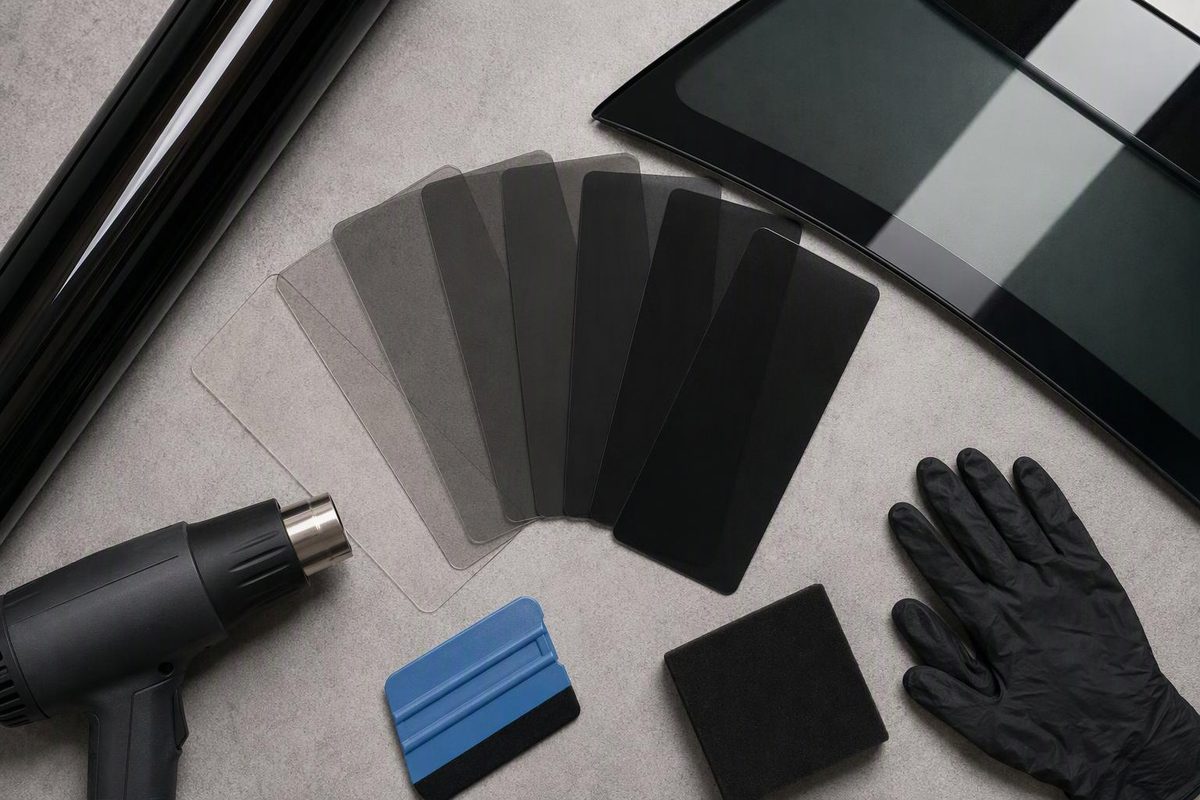
Carbon tint is a strong mid-tier choice when the exact film has documented performance, a nonmetal construction and a suitable warranty. It can provide a stable black appearance, useful heat and glare control, low reflectivity and signal-friendly performance without the highest ceramic price—but the word “carbon” alone does not establish quality.
Two carbon films at similar darkness can have materially different solar performance. Buy by manufacturer, product line and specifications rather than accepting “premium carbon” as a performance grade.
Enter the glass and standalone film VLT; the calculator estimates the finished darkness.
Estimated Finished VLT
80% × 35% = 28%
This estimates darkness, not legal compliance. Meter the finished window and check the rule for its position, vehicle class and jurisdiction.
Source: the glass-VLT × standalone-film-VLT method and 80% × 35% example described in this article. Actual glass, film and meter tolerances can change the result.
What Carbon Window Tint Is
Products sold as carbon tint use carbon particles or carbon-based technology to control light and solar energy, although the exact construction varies by manufacturer and product line.
SunTek, for example, describes its Carbon Series as using carbon technology and its upgraded CXP line as a nonmetal, nano-hybrid carbon composition. It markets both as non-reflective and signal-friendly, with limited-lifetime warranty protection against color change subject to restrictions (SunTek).
Common reasons to consider carbon film include:
- A black or charcoal appearance rather than a conspicuously reflective finish
- Better claimed color stability than basic dyed products
- Signal-friendly performance when the specified film is nonmetal
- A price and performance tier between many dyed and ceramic options
Those are tendencies, not guarantees. Ask for the manufacturer, product line and data sheet rather than accepting “carbon” as a complete description.
Carbon Tint Advantages and Trade-Offs
Carbon film often costs less than an upper-tier ceramic installation. It is available in nonmetal constructions that should not create the signal concerns associated with some metallized films. Depending on the product, it can also provide low visible reflectance, useful heat control and long-term color-stability warranty coverage.
The main limitation is inconsistency within the category. The carbon label does not establish total solar energy rejection, infrared performance, optical quality or even a particular construction. Entry-level carbon can trail upgraded carbon or ceramic by a substantial margin.
Darkness is another trade-off. A darker shade reduces visible light and glare, but it can make nighttime visibility worse without delivering the best available heat rejection. Warranty terms, legal VLT and installation quality also vary independently of the film category.
Compare Performance Numbers, Not Category Labels
The most useful specifications are:
- VLT (visible light transmission): The percentage of visible light passing through the tested glazing system. Lower is darker.
- TSER (total solar energy rejected): A broad measure of solar-energy rejection. Higher is better when test conditions match.
- IRER (infrared energy rejection): Infrared rejection across a stated wavelength range, including absorbed energy that may be reradiated inward.
- Visible-light reflectance: An indication of how reflective the glazing appears.
- UV rejection: Meaningful only for the exact product and stated wavelength range.
Do not compare an isolated “95% IR rejection” headline with another product’s TSER. Manufacturers can use different wavelength ranges and metrics. For example, 3M defines IRR over 900–1,000 nm, while its IRER definition covers 780–2,500 nm and accounts for transmitted and absorbed infrared energy that may be reradiated into the car (3M).
Carbon Films Do Not All Perform Alike
SunTek’s specifications provide a useful same-manufacturer comparison. On nominal 6 mm clear glass, Carbon 35 reports 36% VLT and 38% TSER. The upgraded carbon-based CXP 35 reports 33% VLT and 53% TSER, while the similarly dark CeramicIR 30 reports 33% VLT and 55% TSER (SunTek specifications).
Johnson’s Ray Guard carbon line reports 37% VLT and 50% TSER for RG 35 on 6 mm clear test glass (Johnson Window Films). Do not automatically rank that number against another manufacturer’s figure without checking the full test basis.
Compare named products at the closest available VLT, preferably within the same manufacturer’s data sheet. That controls more of the testing differences and reveals how little the category name predicts performance.
Carbon Tint Versus Dyed and Ceramic Film
| Decision Factor | Dyed | Carbon | Ceramic |
|---|---|---|---|
| Common price tier | Entry | Middle | Upper |
| Color stability | Varies; low-cost lines are the main concern | A common selling point, but product-dependent | A common selling point, but product-dependent |
| Heat control | Often modest | Moderate to strong, depending on line | Often strong, but not universally best |
| Connectivity | Signal-friendly if nonmetal | Signal-friendly if the specified product is nonmetal | Usually sold as nonmetal and signal-friendly; verify the line |
| Best fit | Appearance on a tight budget | Balance of price, appearance and comfort | Strong performance at lighter shades or maximum available heat control |
A premium carbon film can approach or beat an entry ceramic product on an individual specification. Our carbon-versus-ceramic comparison shows why matched-VLT product data matter more than the label.
Professional Carbon Tint Costs About $250–$550
For rough 2026 planning, allow about $250–$550 for professional carbon film on the side and rear windows of an ordinary car. This is not a national average.
Window Tint Central’s film-type cost guide places carbon around $250–$400, while one Michigan installer’s published guide gives a $300–$550 full-car carbon range (Prestige Protective Films). Local labor, vehicle design, film line and package scope can move the actual quote outside that band.
Before comparing totals, have each shop identify these details in writing:
- Vehicle year, model and body style
- Every pane included, especially quarter and rear glass
- Film manufacturer, line and shade
- Existing-film and adhesive removal
- Separate windshield, sunroof and panoramic-roof charges
- Tax and total installed price
- Manufacturer warranty and separate workmanship coverage
“Full car” often excludes the windshield and roof glass. Rear-window curvature, deep seals, extra quarter windows and old adhesive can materially change the labor charge. See the broader window-tint cost guide or compare how vehicle design affects estimated carbon-tint installation complexity.
Darkness, Heat Control and Legality Are Separate
A darker carbon film reduces more visible light and glare, but it is not automatically the better heat-control film. In SunTek’s published table, Carbon 5 is much darker than CXP 35 yet reports lower TSER: 46% versus 53%. Construction can matter more than shade.
Legal compliance depends on the finished glass-and-film VLT, window position, vehicle class and jurisdiction—not the word “carbon” or the shade name printed on a box.
For a rough calculation, multiply the existing glass VLT by the film’s nominal standalone VLT. The formula is finished VLT = glass VLT × film VLT ÷ 100. For example, 80% glass with 35% film produces approximately 28% final VLT.
Do not multiply again when a manufacturer’s table already reports VLT for film mounted on glass, as the SunTek and Johnson tables cited above do. Real glass, film and meter tolerances can also change the result. Have the installer meter the finished window and verify the current rule for that window position and vehicle. Our 35% tint guide explains the calculation in more detail.
Buy the Product and Installation Together
Request the data sheet for the exact film, inspect a physical sample outdoors and look through a completed installation from inside the vehicle. Check for unwanted color, haze and reflections rather than judging only exterior darkness.
Get the warranty card and itemized invoice before leaving. Some manufacturer warranties require authorized installation and proof of purchase. In the United States and Canada, for example, 3M says its automotive-film warranty applies to film installed by an authorized installer; a claimant must present a completed warranty card and original invoice. Its stated remedy for a covered defect includes replacement film and reapplication labor, but coverage differs by series and is nontransferable (3M). Ask separately whether removal of failed film or other shop labor is covered.
Follow the instructions for the film actually installed. Do not lower door windows until the installer permits it, and do not use abrasive cleaners on the interior film surface. Product-specific instructions can differ: 3M says its automotive window films may be cleaned after 30 days with normal household cleaning solution and a soft, lint-free cloth, while warning against abrasives.
Carbon tint delivers good value when the quote identifies a documented film, the finished shade complies with current law and the installer provides sound workmanship coverage. Without those three elements, the carbon label says too little.