
Removable Window Tint: When Static Cling Makes Sense
Compare removable static-cling tint with adhesive film for cars and rentals, including VLT, installation, glass compatibility and legal checks.
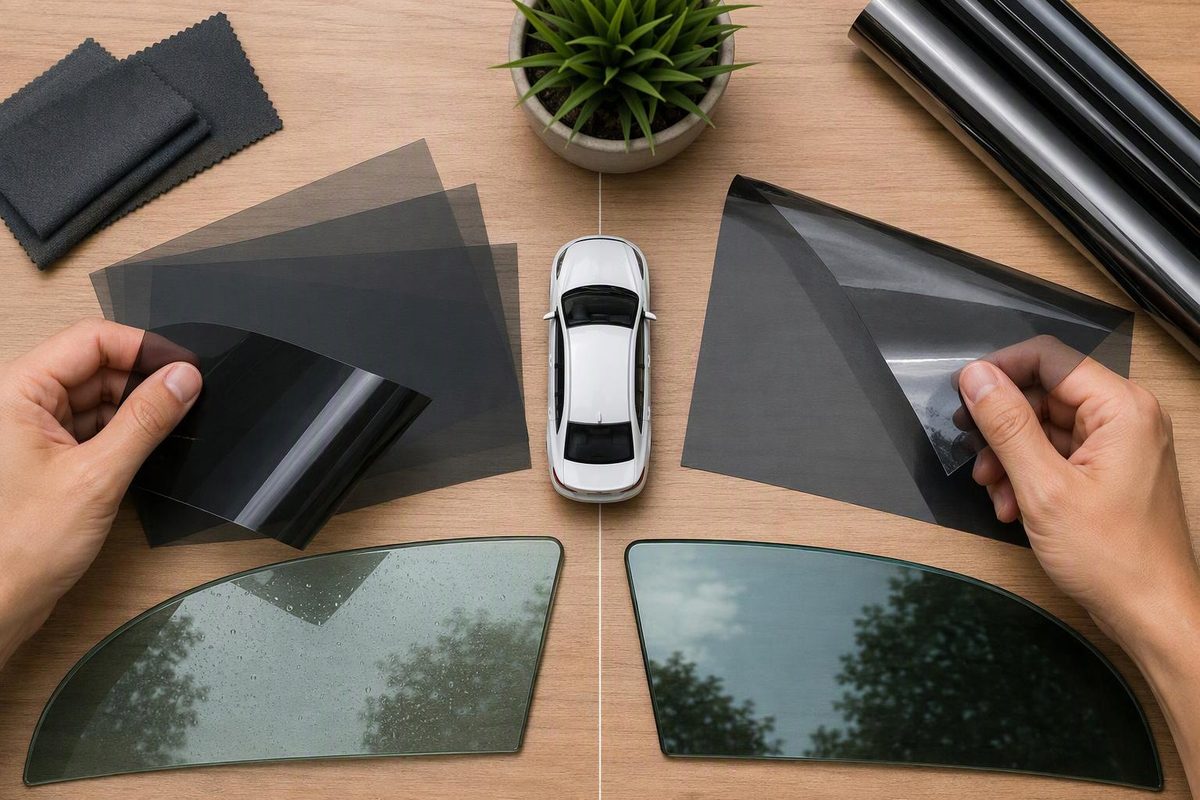
Most products sold as removable window tint are static-cling vinyl with no adhesive. They can be peeled from the glass and may be reusable if they remain clean, flat and undamaged. That makes them useful for a leased car, rental home, seasonal glare problem or temporary privacy need.
The trade-off is that easy removal does not guarantee the appearance, clarity or performance of a professionally installed adhesive film. Removable tint makes the most sense when reversibility matters more than a permanent, factory-like finish.
What “removable” actually means
“Removable” is a marketing description, not one precise film category. Check how the product attaches before buying:
| Film | How it attaches | Reusable? | Typical use |
|---|---|---|---|
| Static cling | Non-adhesive vinyl clings to smooth glass | Often | Temporary tint and DIY projects |
| Adhesive automotive film | Adhesive-backed film | Generally no | Long-term vehicle tint |
| Adhesive architectural film | Adhesive selected for a compatible glazing system | Generally no | Long-term solar, glare or privacy control |
Gila describes its automotive static-cling line as removable and reusable. Its FAQ identifies the material as adhesive-free vinyl and says its static-cling products can be reapplied, while removed adhesive film cannot (Gila static-cling range; Gila automotive FAQ). Reuse is still conditional: dust, creases, stretching and poor storage can spoil the next installation.
Ordinary adhesive tint can also be removed, but it is not reusable and removal may leave glue to clean up. Follow a controlled process such as removing window tint with steam rather than treating “removable” as a promise of effortless, residue-free removal.
When static cling is the better fit
Consider static-cling tint when:
- You need a temporary vehicle solution. It can suit a leased vehicle or short-term glare problem, but check the lease and tint law first.
- You rent your home. A removable privacy or glare layer may be easier to reverse when moving, subject to the lease and the film maker’s glass restrictions.
- You want to correct DIY mistakes. Cling film can usually be lifted, cleaned and repositioned if dust or an air pocket appears.
- You expect to remove and store it. Some products are specifically designed for later reuse, although the storage method matters.
Choose adhesive film when long-term appearance and optical clarity matter more than reversibility. One static-cling manufacturer acknowledges that its vinyl has slightly lower clarity than adhesive film (Greenfilm FAQ). A universal sheet can also be difficult on compound-curved automotive glass; Gila says such windows may require film to be installed in strips because one sheet cannot stretch over a curve in two directions (Gila automotive FAQ).
Do not put generic residential film on a vehicle. Gila’s architectural static-cling instructions, for example, expressly prohibit using that product on motor-vehicle windows (Gila architectural instructions). Buy a product approved for the actual application.
Check the specifications that affect the result
VLT and the finished window
Visible light transmission (VLT) is the share of visible light that passes through. Lower VLT means darker film. The package number normally describes the film, not necessarily the completed window with film installed over factory glass.
A useful estimate is:
finished VLT = glass VLT × film VLT
For example, 80% VLT glass combined with 50% VLT film gives an estimated 40% finished VLT. Manufacturing variation and meter accuracy mean the result should be measured when compliance is important. Ceramic tint percentages explains combined VLT in more detail.
Static cling receives no legal exemption because it peels off. The applicable rule can change by jurisdiction, window position and vehicle class. As reviewed September 24, 2026, New York DMV says at least 70% of outside light must pass through the windshield and front side windows; its treatment of rear glass depends partly on vehicle classification and mirror equipment (New York DMV). Check the current DMV guidance or statute for every place where the vehicle will be used.
Heat, UV and glare
Darkness alone does not establish heat performance. Compare films at a similar VLT and look for a complete performance table.
Useful figures include:
- TSER: total solar energy rejected across the solar spectrum
- IRR: infrared rejection over a stated wavelength range
- IRER: a broader infrared-energy measure that accounts for absorbed and reradiated energy
- UV rejection: ultraviolet radiation rejected
A high IR figure can cover only a selected wavelength range, so it should not be treated as a complete measure of cabin heat control. 3M’s terminology guide recommends considering infrared figures with TSER for a fuller picture (3M tint terminology guide). Give more weight to a dated data sheet that states the test method and glazing configuration than to an unsupported “maximum heat blocking” claim.
Glass compatibility
Removable does not mean safe for every window. The International Window Film Association says low-E compatibility depends on the type and location of the low-E surface and the desired performance. It also notes that absorbed solar energy can contribute to thermal stress and recommends consulting the manufacturer’s film-to-glass guidance (IWFA FAQ).
For a building installation, identify whether the window is single-pane, insulated, tempered, laminated or low-E. Then follow the exact product instructions. Greenfilm, for example, warns against applying one of its cling products to non-tempered low-E glass (G-Cling product notes). Obtain written landlord approval if the lease restricts window coverings or alterations.
How to install removable tint cleanly
- Measure each pane. Confirm the roll is wide enough. For a vehicle-specific kit, verify the year, make, model and body style; precut window tint explains what a kit does and does not solve.
- Work on cool glass in a clean, still area. Dust and fibers remain visible under repositionable film.
- Clean the glass and perimeter thoroughly. Follow the film maker’s cleaner instructions, especially around seals and defroster lines.
- Wet the glass as directed. Use the specified application solution rather than assuming every soap mixture is suitable.
- Position the film and squeegee from the center outward. Lift and rewet it instead of forcing a crease.
- Trim only as instructed. Automotive film normally installs on the interior; the outside may be used as a cutting template (Gila automotive FAQ).
- Observe the product’s waiting period. Greenfilm says not to operate a roll-down window for 48 hours, while Gila describes a seven-to-10-day cure period during which the window should stay closed (Greenfilm FAQ; Gila automotive FAQ). Follow the instructions for the film actually purchased.
Small water pockets or temporary haze may clear during curing. Air and debris generally need to be pushed out or corrected by lifting and reapplying the cling film. If an older adhesive installation is bubbling, use the checks in window tint bubbles.
Buying judgment
Removable static-cling tint is a sensible choice when you need a reversible, DIY-friendly layer and can accept possible compromises in clarity and finish. Buy according to the product’s VLT, documented solar performance, dimensions, approved glass types, installation instructions and warranty—not a vague “removable ceramic tint” label.
For a daily-driven vehicle where long-term appearance and optical quality matter, properly installed adhesive automotive film is usually the stronger choice. For temporary glare or rental-home privacy, static cling is the lower-commitment option, provided the exact product is compatible with the glass and permitted by the lease or vehicle law.