
Wisconsin Aftermarket Tint Laws Require 50% Front-Side and 35% Rear VLT
Check Wisconsin tint laws by window, including finished-VLT limits, windshield strips, reflective film, mirrors and medical documentation.
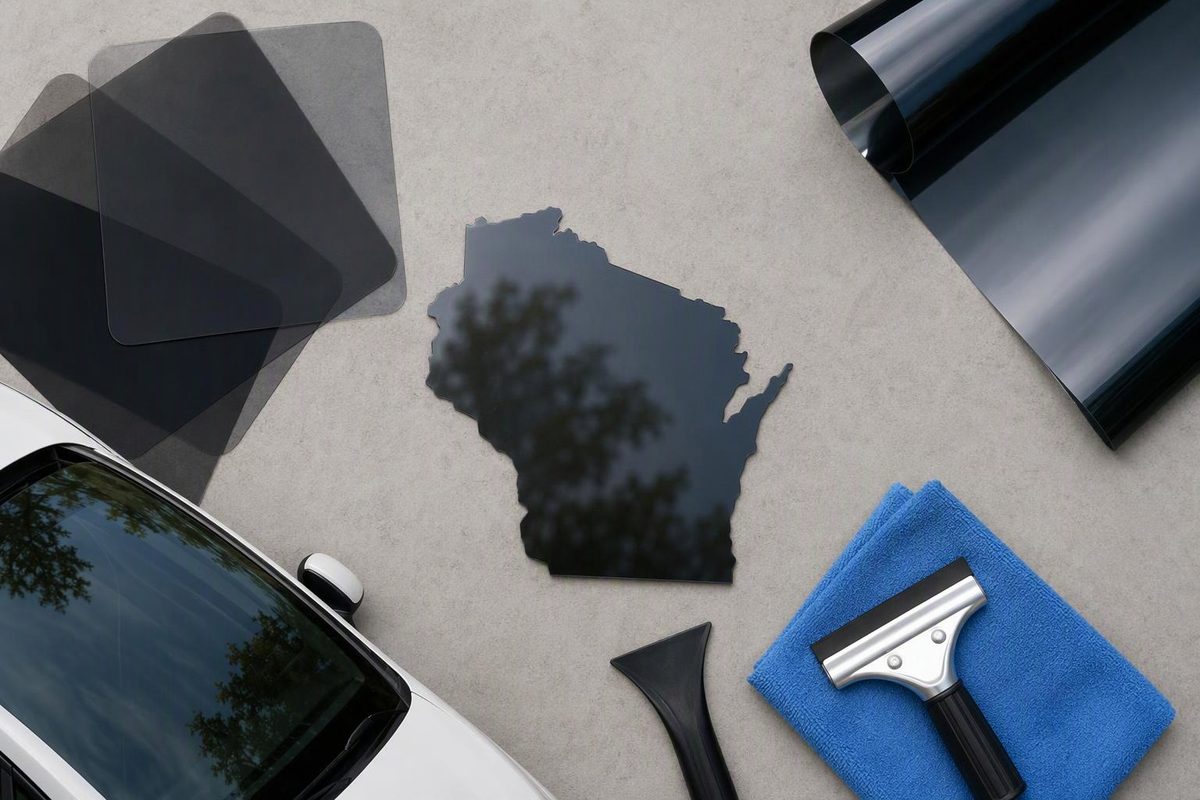
Wisconsin generally requires at least 50% visible light transmission (VLT) through aftermarket-tinted front vent and front side windows and at least 35% VLT through aftermarket-tinted rear side and rear windows. These are finished glass-and-film measurements, not simply the percentage printed on the film box.
Rules and official sources were reviewed September 30, 2026.
Wisconsin tint limits by window
| Window | Aftermarket tint rule |
|---|---|
| Windshield | Film may be attached only above the manufacturer’s marked horizontal line and outside the windshield critical area. If the windshield has no such manufacturer mark, no film may be attached. |
| Front vent and front side windows | At least 50% finished VLT |
| Rear side windows | At least 35% finished VLT |
| Rear window | At least 35% finished VLT; two outside mirrors are required if rear-window VLT is below 60% |
Wisconsin Administrative Code Trans 305.32 sets the 50% minimum for front vent and front side windows and the 35% minimum for rear side windows. Permitted aftermarket film may not be reflective. The rule separately permits glazing tinted by its manufacturer and installed during the vehicle’s original manufacturing process (Wisconsin Legislature, Trans 305.32).
For the rear window, the glass-and-film combination must transmit at least 35% of visible light. If it transmits less than 60%, the vehicle must have an outside rearview mirror on both the left and right sides of the driver’s compartment (Wisconsin Legislature, Trans 305.32(5)). Rear side windows also have a 35% finished-VLT minimum for applied film (Wisconsin Legislature, Trans 305.32(6)).
These provisions apply directly to automobiles, motor homes and light trucks. Wisconsin also applies the window and windshield sections to heavy trucks, so the code does not provide the familiar sedan-versus-SUV rear-window exception found in some states (Wisconsin DOT, Trans 305.07 and 305.485).
The legal percentage is the finished VLT
A film marked “50%” does not necessarily produce 50% VLT after installation. The existing glass already blocks some light, and Wisconsin’s rule measures the combination of glazing and film.
Use this estimate before choosing a shade:
Glass VLT × film VLT = estimated finished VLT
For example, 50% film installed over glass that transmits 80% of visible light produces an estimated 40% finished VLT:
0.50 × 0.80 = 0.40, or 40% VLT
That would be below Wisconsin’s 50% front-side minimum. On the same 80% glass, 70% film would produce an estimated 56% finished VLT:
0.70 × 0.80 = 0.56, or 56% VLT
Ask the installer to meter the bare glass before recommending a film and meter the completed window afterward. Film labels and calculations should not replace a final measurement. See the practical differences between 35% tint and darker 20% tint, but choose by finished VLT on each window.
Windshield tint is limited to a top strip
Wisconsin does not authorize full-windshield aftermarket film under the ordinary rule. Film or other material may be attached only where it is both:
- Above the horizontal line identified by the windshield manufacturer’s specified mark; and
- Outside the “windshield critical area.”
If the manufacturer did not affix the specified mark, the rule says no tinting film may be attached. It defines the critical area as the windshield portion normally used for the driver’s necessary forward observations, including the area normally swept by the factory-installed wipers (Wisconsin Legislature, Trans 305.34(6); Trans 305.05(43)).
Do not assume a generic “top six inches” strip is compliant. The marked line and critical area on the actual windshield control. Compare film and visor-strip considerations in our front windshield tint guide.
Reflective film and factory privacy glass
Wisconsin prohibits reflective aftermarket film on front side, rear side and rear windows under the applicable film provisions. The rule does not state a numeric reflectance allowance, so mirror or highly reflective film is not a sound compliance choice even if its VLT is high enough.
Factory-tinted glazing is treated separately when it was tinted by the glazing manufacturer and installed during the vehicle’s original manufacturing process. Adding aftermarket film over factory privacy glass, however, brings the film installation under the applicable finished-VLT requirement.
Medical tint exception
A medical recommendation can reduce the minimum for front vent and front side windows from 50% to 35% finished VLT. It does not authorize darker-than-35% front-side tint or create a full-windshield exception.
The recommendation must come from a physician or Christian Science practitioner treating the vehicle owner or an immediate family member. A written statement must remain in the vehicle and identify:
- The patient;
- The medical condition supporting the recommendation;
- Whether the condition is temporary or permanent; and
- The vehicle’s make, model, year and vehicle identification number.
The film must be removed when the vehicle is sold, when the person covered no longer lives in the owner’s household, or when the stated temporary condition expires. The medical film may not be reflective (Wisconsin Legislature, Trans 305.32(4)).
Enforcement and penalties
A traffic officer or motor-vehicle inspector may direct a driver to stop for an equipment inspection and may test the vehicle’s glass. When a vehicle does not comply, Wisconsin law allows a repair order. Unless another statute provides a different penalty, violating these equipment rules carries a forfeiture of $10 to $200; the final amount can include additional assessments or costs (Wisconsin Statutes § 110.075).
For the lowest-risk installation, have the shop record the measured bare-glass and finished VLT values on the invoice, avoid reflective film, preserve the required mirror arrangement, and keep any medical statement in the specific vehicle it identifies.