
What Georgia Drivers Need to Know Before Choosing Window Tint
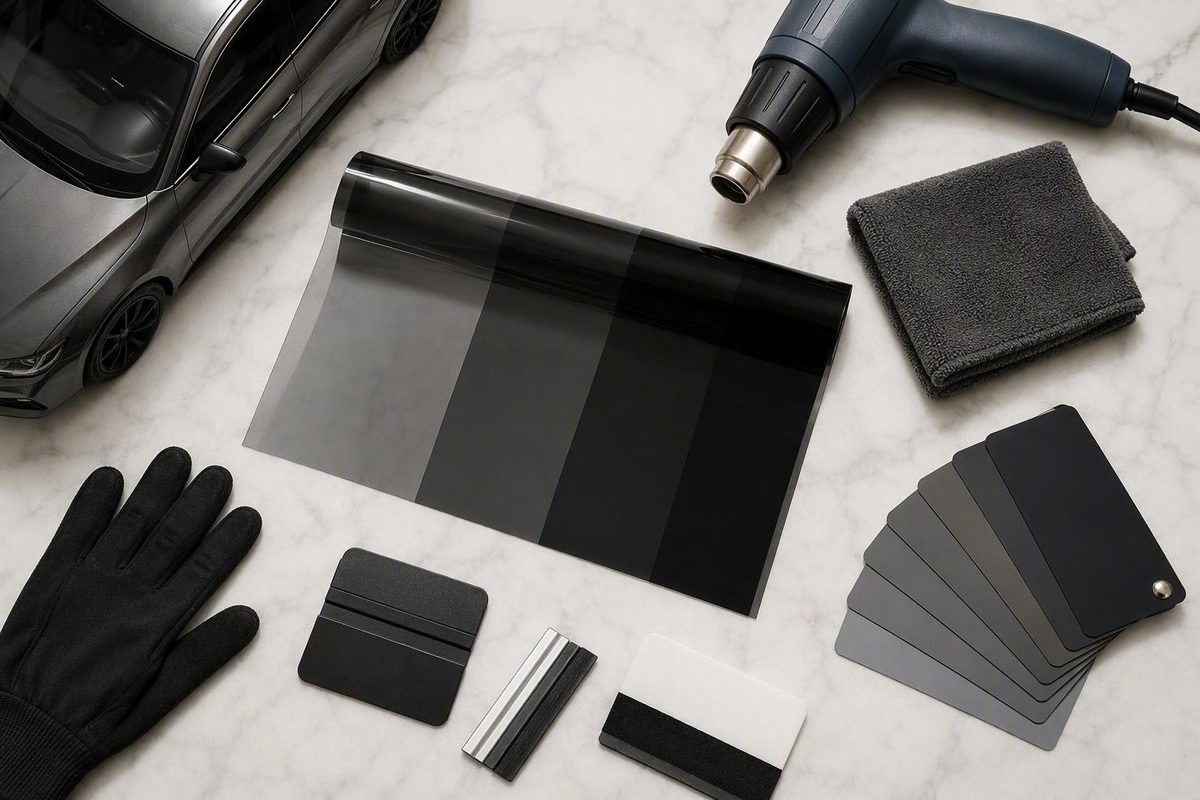
The Short Answer: Georgia Tint Limits Reported Effective July 1, 2026
Effective-date and verification notice: A third-party reproduction of O.C.G.A. § 40-8-73.1 is labeled effective July 1, 2026 and reports limits different from the older 32% rule. Because Justia is not Georgia’s official statutory publisher and warns that its code reproductions may not be current or accurate, confirm the operative text with the Georgia Department of Public Safety or another official Georgia source before buying or installing tint.
For ordinary passenger vehicles operated in Georgia on or after that date, the reproduced section reports these general rules:
- Front side or door windows directly beside the driver: at least 28% light transmission, plus or minus 3%
- Covered rear side or door windows and the rear windshield: at least 15% light transmission, plus or minus 3%, unless a listed exception applies
- Reflectance: no more than 20% on covered side and rear windows
- Front windshield: material that reduces light transmission is generally prohibited, subject to narrow statutory exceptions
These figures and restrictions appear in the Justia reproduction of O.C.G.A. § 40-8-73.1 labeled effective July 1, 2026. Its legislative history says the amendment changed the front-side threshold from 32% to 28% and established a separate 15% threshold for covered rear windows.
The phrase “plus or minus 3 percent” is part of the reported statutory wording. It should not be converted into a categorical shopping rule. In particular, the available authority does not establish that consumers may treat 25% front-side tint or 12% rear tint as automatically lawful. It also does not explain authoritatively how Georgia applies that language to meter precision, calibration, product variation, roadside testing, or enforcement decisions.
The older 32% figure has a genuine official source, but that source describes legislation effective in 2005. Historical Georgia Department of Public Safety guidance stated a general 32% light-transmission threshold, plus or minus 3%, and a 20% reflectance ceiling. It should not be presented as independent confirmation of the standard applying on or after July 1, 2026.
Older DPS guidance also said Georgia’s tint restrictions applied to residents and nonresidents. The available materials do not independently confirm whether that statement remains unchanged under the 2026 amendment. Out-of-state motorists should therefore verify the current rule rather than assume that registration elsewhere creates an exemption.
Georgia Tint Rules by Window: VLT, Reflectance, and Windshield Treatment
Georgia’s reported framework must be applied one window at a time. A rear-window exception should not be transferred to the front doors, and permission for a top windshield strip does not authorize tint across the full windshield.
The following table summarizes the definitions in subsection (a) and the operating restrictions in subsection (b) of the reproduced O.C.G.A. § 40-8-73.1:
| Window position | Rule reported effective July 1, 2026 | Reflectance | Important qualifications |
|---|---|---|---|
| Front windshield | Light-reducing material is generally prohibited | No general full-windshield percentage is stated | A transparent item that is neither red nor amber may occupy the uppermost six inches. Additional narrow exceptions address specified areas and required items. |
| Front side or door windows | At least 28% light transmission, plus or minus 3% | No more than 20% | These are the windows directly to the driver’s right and left. The plus-or-minus wording is not an unconditional guarantee that a 25% result is lawful. |
| Rear side or door windows | Generally at least 15% light transmission, plus or minus 3% | No more than 20% | These are side and door windows not directly beside the driver. Listed vehicle categories may be exempt from the rear-window restriction. |
| Rear windshield | Generally at least 15% light transmission, plus or minus 3% | No more than 20% | Vehicle-category, factory-glazing, and federal-law exceptions may affect the result. |
Front side or door windows
The reproduced statute defines front side and door windows by their position: they are the windows directly to the driver’s right and left. On a typical passenger car, this means the two front-door windows, not every pane located ahead of the rear axle.
Under the reported rule, material and glazing applied to those windows generally may not reduce light transmission below the stated 28% reference point, using the statute’s plus-or-minus 3% language. The material also may not increase outward reflectance above 20%.
Both characteristics matter. A completed window can transmit enough light yet still create a reflectance issue. Selecting film only by how dark it looks therefore leaves part of the reported legal test unanswered.
Rear side or door windows
Rear side and door windows are defined as side and door windows not directly to the driver’s right and left. For vehicles covered by the restriction, the reproduced text reports a 15% light-transmission reference point, accompanied by the same plus-or-minus 3% wording, and a maximum reflectance of 20%.
That rear-window rule is not universal. The statute identifies defined or listed vehicle categories for which the rear restrictions do not apply. Whether an exception is available depends on legal classification and any associated statutory conditions—not merely on whether a seller calls the vehicle an SUV, crossover, truck, van, bus, or limousine.
Rear windshield
For a covered rear windshield, the reported general rule matches the rear-side-window rule: a 15% light-transmission reference point, plus or minus 3%, and no more than 20% reflectance.
Vehicle classification and the nature of the glazing can affect whether that restriction applies. The treatment of a rear windshield should not be transferred to the front windshield, which is governed by a materially different restriction.
Front windshield
The reproduced section generally prohibits applying material and glazing to the front windshield when the result reduces light transmission. It does not establish a generally permitted full-windshield VLT percentage. Claims such as “70% full-windshield tint is legal in Georgia” cannot be inferred from this source.
A transparent item that is neither red nor amber may occupy the uppermost six inches. Other narrow exceptions include windshield-mounted sun visors, specified lower-corner areas, qualifying signs, and stickers required by federal, state, or local government.
These exceptions should be read according to their terms. They do not create general permission to install ordinary light-reducing film across the entire windshield.
How to Read Tint Percentages Without Choosing the Wrong Film
Visible light transmission, or VLT, is the percentage of light allowed to pass through a surface. A higher VLT percentage allows more light through; a lower percentage generally means darker glazing.
Film VLT is not automatically completed-window VLT
The reported statutory test concerns the resulting window or glazing with the material applied—not the film roll considered by itself.
For example, film marketed at 28% VLT does not guarantee that the completed front window will measure 28%. The underlying glass and the film operate together, so the resulting window may transmit less light than the product label suggests.
Before installation, ask the shop to:
- Measure or evaluate the untreated glass.
- Estimate the combined glass-and-film result.
- Identify the film actually being installed.
- Measure each regulated window after installation.
- Provide the completed-window measurements in writing.
A finished-window measurement is more useful for compliance planning than the film-box number alone.
VLT and reflectance measure different things
VLT concerns light passing through a surface. Reflectance concerns the amount of light reflected outward by a product or material.
A dark-looking film may raise a VLT concern, while a shiny or mirror-like appearance may raise a separate reflectance concern. Under the reported Georgia framework, covered side and rear windows must be assessed for both characteristics.
A compliance plan should therefore address the expected completed-window VLT and the film’s effect on outward reflectance. A VLT meter reading alone does not necessarily establish compliance with a separate reflectance ceiling.
Why “plus or minus 3%” is not a guaranteed buying margin
It is tempting to read “28 percent, plus or minus 3 percent” as blanket permission to target 25%. The same arithmetic might suggest that 12% is automatically acceptable where the reported rear reference point is 15%.
That interpretation is not established by the available authority. The reproduced section does not explain how the language interacts with meter calibration, roadside testing, equipment precision, manufacturing variation, or enforcement policy. It also does not say that a consumer may intentionally design an installation around the lowest mathematical edge.
A cautious approach is to:
- Treat the stated percentages as the statutory reference points.
- Ask for the expected combined glass-and-film VLT.
- Avoid making the tolerance edge the installation target.
- Measure each completed window.
- Retain the film specifications and written results.
The available evidence does not establish any particular buffer as legally “safe,” however. An installer’s recommended margin is practical advice, not a substitute for the operative law.
Why Older Pages Still Say 32%: Georgia’s 2026 Rule Change
The appearance of 32% in search results does not mean every older page was inaccurate when it was published. Georgia’s reported standard changed over time.
Georgia DPS guidance summarizing H.B. 20, effective May 2, 2005, described a general rule under which windows beside and behind the driver could not transmit less than 32% of light, plus or minus 3%. It also reported a 20% reflectance ceiling and identified several exceptions. Those figures remain visible on the official DPS page describing the 2005 legislation.
The third-party code reproduction labeled effective July 1, 2026 instead reports:
- A 28% reference point, plus or minus 3%, for front side or door windows
- A distinct 15% reference point, plus or minus 3%, for covered rear side windows and rear windshields
- A 20% maximum reflectance rule for covered side and rear windows
A 2025 lawyer-forum response also told a consumer that Georgia’s front-side limit was 32%. That response addressed a citation received in 2025, before the reported 2026 effective date. It illustrates how a date-specific answer can become outdated; it is not controlling authority for conduct after the amendment took effect.
Before July 1, 2026 versus on or after July 1, 2026
- Before July 1, 2026: Older Georgia guidance described a general 32% VLT standard, plus or minus 3%.
- On or after July 1, 2026: The third-party amended-code reproduction reports separate reference points for front-side and covered rear windows.
- Do not combine the standards: A page quoting 32% may be describing the former law rather than the version applicable to later conduct.
The date of an alleged violation may therefore matter, especially for a traffic stop or citation close to July 1, 2026. Check the date on the citation and compare it with the version of the law effective on that date.
The available authorities do not establish that tint installed under an earlier standard was grandfathered after the amendment. Installation and operation are separate events, and a driver should not assume that a previously compliant installation remains protected without an express transition provision.
When reviewing an online tint chart, check whether it:
- Gives an effective date
- Distinguishes front from rear windows
- Preserves the statutory plus-or-minus wording
- Addresses reflectance as well as VLT
- Accounts for vehicle-specific rear-window exceptions
- Identifies whether its legal text comes from an official or third-party publisher
Rear-Window Exceptions: SUVs, Vans, Buses, Limousines, and Factory Glass
The reported 15% rear-window restriction includes important exceptions, but they apply to defined or specifically listed categories. The reproduced O.C.G.A. § 40-8-73.1 does not create a blanket exemption for every vehicle marketed as an SUV, crossover, pickup, truck, or van.
The statutory definition of a multipurpose passenger vehicle
The reproduced section defines a multipurpose passenger vehicle as a motor vehicle that:
- Is designed to carry ten persons or fewer; and
- Is constructed on a truck chassis or has special features for occasional off-road operation.
That is a legal definition, not a dealership marketing category. Vehicle records, manufacturer information, or an authoritative regulatory classification may be more informative than the body-style description in an advertisement.
Some vehicles commonly called SUVs may meet the definition, but appearance alone does not prove eligibility. The available sources do not classify individual makes, models, or trim levels, so a model-by-model exemption list would be unreliable.
Categories with reported rear-window exceptions
The reproduced section identifies rear-window exceptions involving:
- Qualifying multipurpose passenger vehicles
- Specified buses
- Certain nonprofit vans
- Limousines
- Windows darkened before factory delivery
- Glazing expressly permitted by federal law or regulation
The relevant conditions still matter. Terms such as “bus,” “van,” and “limousine” should not be treated as self-proving labels. Construction, passenger capacity, ownership, use, or regulatory classification may determine whether an exception applies.
Factory glazing also requires careful analysis. A reported exception for windows darkened before factory delivery does not establish that every window described as “factory,” “custom,” “privacy glass,” or “dealer installed” qualifies. Dealer-applied film is not necessarily glass darkened before factory delivery, and a prior owner’s installation does not become lawful merely because it came with the vehicle.
A practical rear-window decision sequence
Before selecting rear film, work through these questions:
-
Which window is involved? Determine whether it is directly beside the driver, behind the driver, or the rear windshield. A rear exception does not ordinarily change the treatment of the front side windows.
-
What is the vehicle’s legal classification? Do not stop at an informal label such as “SUV” or “van.” Look for reliable records addressing construction, passenger capacity, and classification.
-
Does a listed exception cover that vehicle and window? Read the scope of the exception. Some reported exceptions concern rear side windows and the rear windshield rather than every pane of glass.
-
Is the glazing factory-darkened or aftermarket? Preserve factory window markings, manufacturer information, build records, dealer paperwork, and the film invoice where available.
-
Can the classification be verified before installation? If not, seek clarification from Georgia DPS or Georgia-specific legal counsel instead of asking an installer to classify the vehicle from appearance alone.
A pickup truck illustrates the problem. The word “truck” does not by itself answer what may be installed on each window. The front windows beside the driver remain a separate issue, while treatment of the rear glass depends on whether a statutory category or exception actually applies.
Similarly, a family minivan should not automatically be treated as a nonprofit van or qualifying bus. An everyday vehicle name and its legal classification may differ.
Medical, Occupational, and Commercial-Vehicle Exceptions
The reproduced statute reports limited exceptions beyond the ordinary passenger-vehicle framework, including medical, occupational, government, and commercial-vehicle provisions. These provisions should be verified before nonstandard tint is installed because apparent eligibility is not necessarily equivalent to completed authorization under the reported statutory framework.
Medical exemptions
The Georgia Department of Public Safety may grant a medical exemption for a vehicle owned by a medically affected person or a vehicle in which that person is a habitual passenger. The reproduced provision requires an application supported by written attestation from a licensed physician or certified optometrist.
A medical letter should not be described as automatic authorization. It supports the application, but DPS approval is part of the reported framework. Installing darker tint before confirming approval and its scope could leave the owner unable to establish that an exception applies.
The available sources do not establish the current:
- Application form
- Fee, if any
- Submission address or online process
- Approval duration
- Renewal schedule
- Required in-vehicle documentation
- Permitted darkness after approval
- Treatment of multiple vehicles
Applicants should obtain these details directly from Georgia DPS. They should also confirm whether approval must be issued before installation, which vehicle and windows it covers, and what evidence must be carried or retained.
Law-enforcement, government, detective, and security vehicles
The reproduced text also identifies exceptions for qualifying:
- Law-enforcement vehicles
- Specified government vehicles
- Vehicles used by licensed or registered private-detective businesses
- Vehicles used by licensed or registered private-security businesses
These are vehicle-use or occupational provisions, not necessarily personal benefits that follow an employee to any privately owned car. Employment in security, for example, does not by itself establish that darker tint is authorized on a personal vehicle.
Business licensing, registration, ownership, vehicle assignment, and actual use may matter. Eligibility should be verified with the responsible authority, and any documentation the authority identifies as relevant should be retained.
Commercial motor vehicles
The reproduced section treats commercial motor vehicles separately and directs applicable vehicles to federal motor-carrier glazing standards under 49 C.F.R. § 393.60. Operators should not automatically apply the ordinary passenger-vehicle percentages to a regulated commercial vehicle.
Classification depends on the applicable regulatory definition and operation. Fleet owners and drivers should identify the governing category and verify the current federal standard with the responsible motor-carrier authority.
A Pre-Installation Compliance Checklist
A careful installation starts with classifying the vehicle and windows—not with selecting the darkest film on a display board.
1. Identify the vehicle class
Record the vehicle’s year, make, model, body type, passenger capacity, and any authoritative classification information. If you believe a rear-window exception applies, identify the statutory category and the records supporting it.
Do not ask only, “How dark can my SUV go?” Ask, “Does this vehicle meet the relevant legal definition, and which windows does that exception cover?”
2. Separate the windows into four decisions
Evaluate these independently:
- Front windshield
- Front side windows directly beside the driver
- Rear side windows
- Rear windshield
This prevents a rear-window option from being copied onto a regulated front window. It also avoids confusing a permitted windshield strip with authorization for full-windshield film.
3. Confirm the applicable date and authority
For operation on or after July 1, 2026, do not rely solely on a chart that gives one 32% figure for all side and rear windows. Confirm the post-amendment text with an official Georgia authority.
For a historical installation or citation, retain records showing the relevant dates. Do not assume that an earlier installation date creates grandfather protection.
4. Ask for completed-window VLT
Request the expected VLT of the finished glass-and-film combination, not just the film’s advertised rating.
Ask:
- What does the untreated glass measure?
- What combined VLT is expected?
- Will every regulated window be measured?
- Will the results be supplied in writing?
- How much variation is expected between panes?
A film marketed at a statutory reference percentage may produce a lower completed-window reading.
5. Address reflectance separately
Ask how the proposed film affects outward reflectance and whether each covered completed window is expected to stay within the reported 20% ceiling.
A VLT reading does not independently prove reflectance compliance. Product specifications may help, but they should correspond to the film actually installed.
6. Avoid designing around the tolerance edge
Do not plan an installation on the assumption that 25% front or 12% rear is guaranteed to be lawful. The available authority does not establish that interpretation.
No particular compliance buffer can be declared universally safe from the available evidence. The practical goal is to avoid making uncertain tolerance language the installation target.
7. Measure the completed windows
At the time the installer considers appropriate for reliable testing, request a completed-window measurement. Record:
- The VLT measured for each relevant window
- The measurement date
- The vehicle identification
- The person or business performing the test
- Any meter information supplied
A written measurement is useful practical evidence, but it is not permanent immunity from enforcement or a guarantee of how a court will rule.
8. Keep useful records
Retain:
- The itemized invoice
- Manufacturer and film-line information
- Advertised film specifications
- Written completed-window measurements
- Photographs of each window
- Photographs of factory glass markings
- Vehicle-classification records
- Medical or occupational authorization, if applicable
- Written communications describing the proposed result
These records can help establish what was installed and measured. They do not conclusively prove legal compliance.
9. Do not treat a sticker or promise as decisive
A label, receipt, warranty, installer statement, or “street legal” sticker does not replace the legal test applied to the completed window.
Georgia DPS guidance for the 2005 framework said compliance labels were not required. That is historical guidance, not independent confirmation of post-amendment labeling policy. In any event, a label does not establish how much light a completed window transmits or reflects.
10. Remember that installers can also face exposure
The reproduced section describes both operating a noncompliant vehicle and unlawfully installing tint as misdemeanors. The historical DPS guidance likewise described violations by motorists and Georgia installers as misdemeanors.
The available sources do not establish a universal fine, court cost, points assessment, licensing action, or other consequence. Those details should not be assumed without checking current Georgia law and the relevant court’s procedures.
11. Complete an official verification step
Immediately before installation, confirm the current requirements with Georgia DPS or another official Georgia source. This is particularly important when:
- The planned result is near a stated threshold
- The vehicle may qualify for a rear-window exception
- A medical or occupational exemption is involved
- Windshield material is proposed
- The vehicle may be regulated as a commercial motor vehicle
- The owner resides outside Georgia
For an unresolved classification or exemption question, seek a written agency response where available or consult a qualified Georgia attorney.
What to Do After a Georgia Tint Citation
A tint citation should be evaluated using the actual document, the law effective on the alleged violation date, and the vehicle’s measured condition. The following steps are general information, not legal advice.
Review the citation carefully
Check:
- The cited code section
- The date and location of the alleged violation
- The affected window or windows
- Whether the allegation concerns VLT, reflectance, windshield coverage, or another issue
- Any measurement recorded by the officer
- The court, response deadline, and appearance instructions
A missing VLT measurement should not be treated as automatic proof that the citation is invalid. The available authorities do not establish that every Georgia tint citation must state a meter reading.
If the alleged violation occurred near July 1, 2026, determine which version of the statute was effective on that date. Do not answer a pre-amendment allegation solely with post-amendment percentages, or the reverse.
Obtain an independent written measurement
Consider asking a capable automotive tint shop or law-enforcement agency whether it can test the affected windows and provide written results. No particular shop or agency is necessarily required to offer testing, and its measurement is not guaranteed to control a court’s decision.
A useful report should identify:
- The vehicle
- The affected windows
- The measured results
- The measurement date
- The person or business performing the test
If the alleged issue concerns reflectance or windshield coverage rather than VLT alone, make sure the evidence addresses that particular allegation.
Preserve the vehicle’s history
Gather and retain:
- Current photographs
- Photographs taken near the time of the stop, if available
- Purchase documents
- Dealership communications
- Prior-owner records
- Film invoices and warranty documents
- Factory-glass information and markings
- Written measurements
- Vehicle-classification records
- Exemption approvals or correspondence
Purchasing a vehicle with tint already installed does not establish compliance. Nor does a statement that the glass is factory, custom, or dealer installed. The relevant questions concern the applicable law, the window’s actual condition, and any valid exception.
Consider correction if the window is noncompliant
If reliable testing indicates noncompliance, removal or replacement may be a sensible practical step. Preserve:
- The original measurement
- Photographs before correction
- The removal or replacement invoice
- A new written measurement
- Photographs after correction
Proof of correction may be relevant to the court, but it does not guarantee dismissal, reduction, or another favorable result. Do not miss a deadline or court appearance merely because the tint has been corrected.
Get Georgia-specific legal advice when needed
Because the reported statute describes a violation as a misdemeanor, case-specific questions should be directed to a Georgia-licensed attorney familiar with traffic matters in the relevant court.
An attorney can review the law effective on the alleged violation date, the citation, measurement evidence, possible exceptions, and local procedure. Legal advice may be particularly useful where the dispute involves vehicle classification, factory glazing, a medical exemption, or interpretation of the plus-or-minus wording.
Frequently Asked Questions About Legal Tint in Georgia
Is 32% tint still legal in Georgia after July 1, 2026?
The older 32% rule should not be described as Georgia’s general post-July 1, 2026 standard. It appears in official Georgia DPS guidance addressing legislation effective in 2005.
For conduct on or after July 1, 2026, the third-party code reproduction summarized above reports a 28% reference point for front side windows and a 15% reference point for covered rear side windows and rear windshields, each with plus-or-minus 3% wording.
A completed-window reading of 32% is numerically above both reported reference points, but that fact alone does not resolve legality. The affected window, reflectance, vehicle class, applicable exceptions, and authoritative interpretation of the statute still matter.
Does Georgia’s plus-or-minus 3% wording mean 25% front tint is automatically legal?
No automatic conclusion is supported. The reproduced language states “28 percent, plus or minus 3 percent,” but it does not explain that consumers may intentionally treat 25% as a guaranteed lawful target.
Ask for the expected completed-window VLT, avoid relying on the mathematical edge, and obtain a written measurement after installation. Confirm the interpretation with an official Georgia authority if the result is close to the reported limit.
Can I tint the full front windshield in Georgia?
The reproduced statute generally prohibits material applied to the front windshield when it reduces light transmission. It does not provide a generally authorized full-windshield VLT percentage.
A transparent item that is neither red nor amber may occupy the uppermost six inches. Other narrow exceptions address specified areas and required items, but they do not create broad permission for ordinary light-reducing film across the full windshield.
Are all SUVs, trucks, and vans exempt from Georgia’s rear-window tint limit?
No. The reported exceptions apply to defined or specifically listed categories, not every vehicle marketed as an SUV, truck, or van.
A multipurpose passenger vehicle is defined by passenger capacity and construction on a truck chassis or with special features for occasional off-road operation. Other reported categories include specified buses, certain nonprofit vans, limousines, factory-darkened windows, and glazing permitted by federal law or regulation.
Confirm the vehicle’s legal classification and the exception’s scope before choosing rear tint. A rear-window exception should not be assumed to change the treatment of the windows directly beside the driver.
Can a medical condition qualify me for darker window tint in Georgia?
Potentially. Under the reproduced statute, Georgia DPS may grant an exemption for a vehicle owned by a medically affected person or one in which that person is a habitual passenger. The application must be supported by written attestation from a licensed physician or certified optometrist.
A clinician’s letter alone should not be treated as automatic authorization. Confirm the current application process, approval requirements, covered vehicle and windows, duration, and documentation rules directly with Georgia DPS before installing or relying on darker tint.
The practical bottom line is window-specific: the third-party amended-code reproduction reports a 28% front-side reference point, a 15% general rear-window reference point, a 20% reflectance ceiling, and a general prohibition on light-reducing front-windshield material beginning July 1, 2026. The plus-or-minus wording, vehicle exceptions, and unresolved need for official confirmation can change the analysis. Identify the vehicle class, measure the completed glass, retain documentation, and verify the current law with a Georgia authority before relying on an installer’s promise or an older 32% chart.