
Louisiana front side windows need 25% final VLT—not 25% film
Check Louisiana’s 2026 tint limits by window, including 25% front-side VLT, rear-window exceptions, reflectance, labels and medical exemptions.
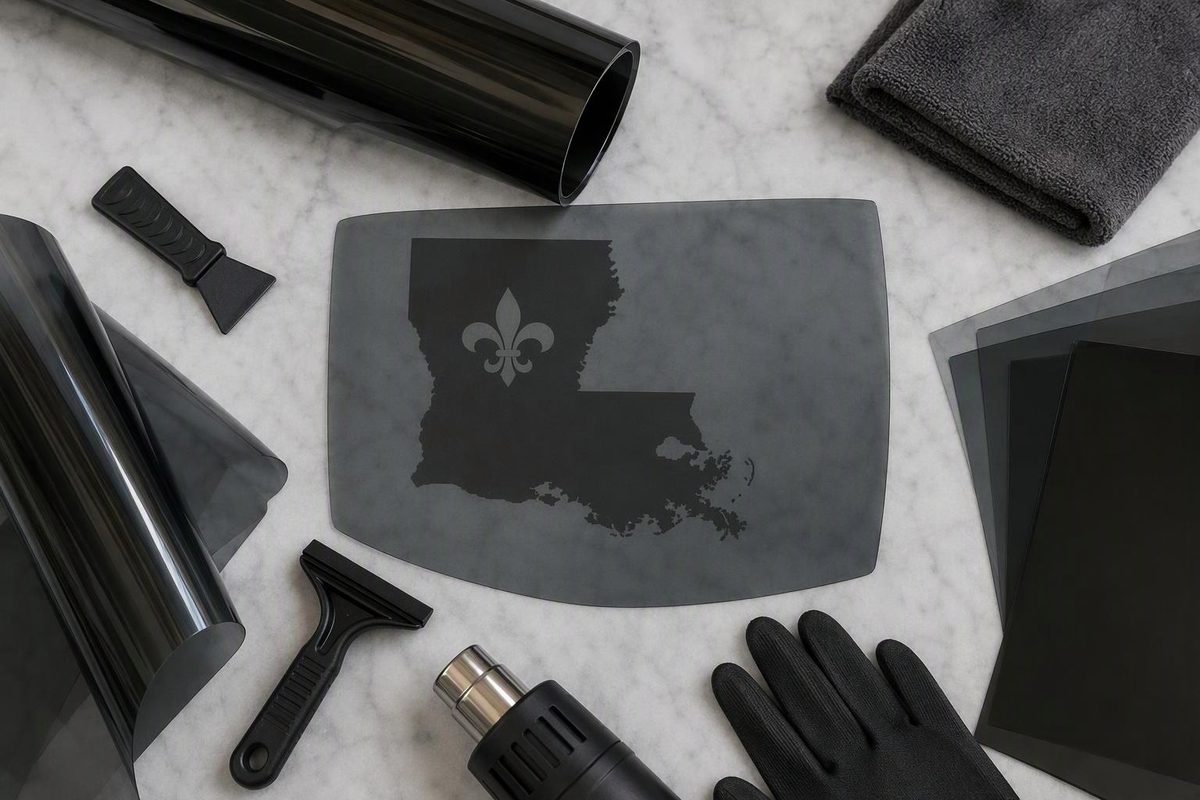
Last reviewed: September 28, 2026. Louisiana does not use one legal tint percentage for every window. On a typical passenger car, the completed glass-and-film assembly must transmit at least 25% of visible light through the front side windows, at least 25% through side windows behind the driver and at least 12% through the rearmost window.
The important word is completed. Louisiana defines light transmission using the tint product together with the vehicle glazing. Film labeled “25%” will normally produce less than 25% VLT when installed over glass, so it is not a safe choice for a window that must measure at least 25%.
Louisiana tint limits at a glance
| Window or measurement | Ordinary passenger car | Truck, bus, trailer, motor home or multipurpose passenger vehicle |
|---|---|---|
| Windshield | Transparent, non-red and non-amber material on the top 5 inches only | Same |
| Front side windows | At least 25% VLT | At least 25% VLT |
| Side windows behind the driver | At least 25% VLT | No minimum VLT under this section |
| Rearmost window | At least 12% VLT | No minimum VLT under this section |
| Luminous reflectance | No more than 20% | No more than 20% |
These limits come from Louisiana Revised Statutes §32:361.1. Its light-transmission exception applies to windows behind the driver on trucks, buses, trailers, motor homes and “multipurpose passenger vehicles.” It does not relax the 25% minimum for front side windows. Nor does the text expressly remove the separate 20% reflectance cap.
Vehicle classification therefore matters. Do not assume a crossover, van or hatchback qualifies merely because it is marketed or informally described as an SUV. If the rear-window exception affects your film choice, ask Louisiana State Police how the vehicle is classified before installation.
The front-side limit changed from 40% to 25%
Louisiana Act 143 reduced the front-side minimum from 40% to 25%, effective August 1, 2025. The legislature’s final digest for Act 143 describes that change, while the HB 119 history records the effective date and its enactment as Act 143.
That change explains why an older Louisiana tint chart may still list 40% for front side windows. The current statutory text says 25%.
Choose film by final VLT, not its box label
VLT is the percentage of visible light transmitted. Lower numbers are darker. Because Louisiana’s definition accounts for the film and existing glazing, a useful estimate is:
Glass VLT × film VLT = estimated final VLT
For glass that meters at 70%:
- 40% film: 0.70 × 0.40 = 28% final VLT
- 35% film: 0.70 × 0.35 = 24.5% final VLT
- 25% film: 0.70 × 0.25 = 17.5% final VLT
In that example, nominal 35% film would already fall below Louisiana’s 25% front-side minimum. The statute says its minimum includes all tolerances, so do not treat 25% as a target with room below it. Ask the installer to meter the bare glass, calculate the proposed combination and leave a practical margin. Our 35% tint guide explains final VLT in more detail.
Darkness is also not a heat-performance rating. Compare published heat-rejection specifications for the exact products at a legal finished VLT rather than choosing only by shade. See how to choose automotive window tint for the other specifications worth comparing.
Windshield tint is more restricted
For an ordinary vehicle, §32:361.1 permits transparent material only on the topmost five inches of the windshield. That material cannot be red or amber. The general rule does not authorize full-windshield film below the strip.
The six-inch language found in Louisiana’s medical-exemption materials is not a general allowance. The medical-exemption statute addresses the top six inches in the exemption context and permits an exemption below that area only when specifically authorized for a patient diagnosed with light-sensitive porphyria. Without an approved exemption, use the ordinary five-inch rule. For the practical differences between a visor strip and full-glass film, see the front windshield tint guide.
Reflectance and installer labels
Every sun-screening device is limited to 20% luminous reflectance. This is separate from VLT: transmission measures light passing through the assembly, while reflectance measures light reflected outward. A film can meet the darkness limit yet be too reflective.
Louisiana also requires an installer label no larger than 1.5 square inches. It must be permanently and legibly installed between the film and each glazing surface to which the film is applied, identifying the installer’s name and city. The statute separately directs the person applying the material to place the label at the lower-right corner of the driver-side window. At minimum, inspect that location before accepting the job.
Medical exemptions require State Police authorization
A physician’s note alone is not the completed exemption. Under Louisiana Revised Statutes §32:361.2, a Louisiana-registered vehicle may qualify when the registered owner, spouse or family member who operates or is authorized to operate it has a covered sun-related medical condition. The process uses a prescribed affidavit and medical certification, requires State Police review and includes criminal-history requirements. Approved vehicles must display a state-issued decal, and the required documentation must stay in the vehicle.
The Louisiana State Police application states that an exemption is not valid until State Police authorizes it. The statute generally subjects exemptions to review every three years unless the department decides otherwise; it gives an ownership-duration exception for diagnosed light-sensitive porphyria. The form also contains special duration language for vehicle owners age 60 or older. Follow the expiration shown on the issued authorization and confirm unusual cases directly with State Police.
If an exempt vehicle is sold or traded, the statute requires removal of the tint unless the new owner has applied for and received an exemption.
What to request from a Louisiana installer
Before paying a deposit, put these items on the quote:
- The vehicle classification and every window included.
- The bare-glass meter reading for regulated windows.
- The film’s nominal VLT and estimated finished VLT.
- Confirmation that luminous reflectance will not exceed 20%.
- The required installer labels and manufacturer warranty paperwork.
- A final meter reading after installation.
For a Louisiana-registered vehicle, violating §32:361.1 can bring a fine of up to $150 for a first offense, $250 for a second and $350 for a third or subsequent offense. Choosing a shade with measurement margin is generally less costly than removing and replacing a borderline installation.